The Counting World
Every claim in this record traces to a receipt. Wherever you see a ✓ receipt chip, the experiment behind the claim is one press away: its full source code, its captured output, its figure — and a Run button that executes the same Python in your browser so you can check the numbers yourself.
THE COUNTING WORLD — The Complete Record
Levan Bakhia & Claude — assembled 2026-07-09, rebuilt and audited 2026-07-10 (sessions 54–56). One file that holds the entire program: the claim and its three verdicts, the axioms, the theorems with proofs, the full story, all fifty-two findings with the session chronicle, the physics bridges, the judgment of the founding record, the unified open frontier, the evidence manifest, the bibliography, the means of reproducing every number, and the companion — the same theory told start to finish in Levan's own logic and language. The parts below are the canonical documents included whole — verbatim, so that no argument, calculation, nuance, or failure is lost — joined by this map and by the syntheses of Parts 0 and VIII (Parts X–XII are verbatim copies of the canon).
PART 0 — THE READER'S MAP
What this program is. A multi-year-in-two-days collaboration testing one idea: reality progresses in indivisible steps, and what physics calls the time dimension is an internal size register — a count each thing keeps, not a road it travels. The idea was rebuilt from scratch as six axioms, pushed through forty-nine computational experiments (pre-registered from experiment 10 onward — Finding 14 filed the program's first pre-registered prediction, and the discipline was universal from then on), confronted with real astronomical and collider data six times, adversarially audited, and made to judge its own founding documents.
The one rule everything obeys. Every claim traces to a receipt: a numbered finding (Part V), backed by a theorem with a proof (Part III) or a script (Part IX; pre-registered headers from script 10 onward), or both. Failures are never deleted — they are kept in place with their autopsies, and corrections are applied over visible retractions. If a claim is open, it is labeled open; if it died, its corpse is on display.
The parts.
| part | content | source document |
|---|---|---|
| I | The Claim — three layers, three verdicts; kill-list and crown-list | THE-CLAIM.md |
| II | The Foundation — six axioms, the retired table, the open ledger | AXIOMS.md |
| III | The Theorems — eighteen theorems and a corollary, with proofs and honest scopes | theorems.md |
| IV | The Story — the monograph, v14: the complete narrative from two counters to the exchange rates | the-counting-world-draft.md |
| V | The Laboratory Record — all 50 findings and the session chronicle | FINDINGS.md |
| VI | The Bridges — every claimed contact with real physics, B1–B8, with levels and verdicts | BRIDGES.md |
| VII | The Archaeology — the founding record judged: 406 claims, five fates, 37 gems | ARCHAEOLOGY.md |
| VIII | The Open Frontier — every open item from every ledger, unified | (maintained in assemble_record.py) |
| IX | Reproduction — the forty-nine scripts and how to re-run everything | (maintained in assemble_record.py) |
| X | The Evidence Manifest — claims ledger, key numbers, external data, figures | MANIFEST.md |
| XI | Bibliography — every external reference, consolidated | BIBLIOGRAPHY.md |
| XII | The Companion — the theory in Levan's logic, order, and words; the record as referee | PSP/PSP.md |
The numbers, as of assembly. 52 findings; 49 experiments (scripts 01–49, each with its figure; pre-registered headers from 10 onward); 18 theorems + 1 corollary; 8 bridges; 6 confrontations with measured data; 2 independent converging ceilings on the beat (ε < 7×10⁻³⁶ s and ε < 4.9×10⁻³⁶ s); 406 founding claims judged (89 later proven, 167 transformed, 101 refuted, 12 category errors, 37 open gems); 14 dated correction notes filed at the session-56 verification audit, originals kept on display; 57 sessions, three days, 2026-07-09/11; live at proportionalstepwiseprogression.com since 2026-07-11.
The status labels. The founding legend (Part V, header): PROVEN, KNOWN MATH, STRUCTURAL, SPECULATIVE; the working record extends it with COMPUTED (measured in simulation, fixed seeds), DERIVED (calculated then verified), ANALYSIS (argued from prior results), IMPORTED THEORY (external result, attributed), compounds of these, and the qualifier pre-registered (the prediction was in the script header before the first run).
PART I — THE CLAIM
The verdict of verdicts. If you read nothing else, read this: what is proven, what is provably undecidable, what is open, what would kill it, what would crown it.
The Claim
Levan Bakhia & Claude — 2026-07-09. The verdict of verdicts: what this project claims, and exactly how much of it holds. Written in plain words, for ourselves and for any future reader. Receipts for every sentence live in FINDINGS.md (52 findings), theorems.md (18 theorems and a corollary), and scripts 01–49.
The claim, in one sentence: reality progresses in steps, not in flow — and what physics calls the time dimension is really an internal size register: a count each thing keeps, not a road each thing travels.
That one sentence contains three different claims, and they have three different verdicts. Keeping them separate is the whole discipline of this project.
Layer 1 — "Could the world work this way?"
Verdict: PROVEN. Finished. Cannot be taken away.
From six axioms — a unit that is indivisible, a shared beat, relational size, a substrate that remembers and forgets, disorder instead of a grid, and a tunable complex clock — we recover, by computation checked against theory to three and four decimals: time dilation, E = γm, momentum, velocity addition, the relativity of simultaneity, the twins, the full energy–momentum hyperbola; quantum correlations at exactly the quantum ceiling (Bell, CHSH 2.828 — a propagation-blind sector preserved exactly by construction, against the propagation-read sector that dies); a force whose range is a memory law; quantized composite masses (two robust levels, a third grazing threshold); decoherence — why big things look classical (quadratic law confirmed; rate ~1.2× the naive count, audit-corrected); and a miniature of the information paradox (a structural rhyme, labeled as such). Eighteen theorems and a corollary carry the load- bearing walls. Nobody can ever again say the idea is incoherent or empty.
And the arrow points both ways — with a scope the audit sharpened. Of the three kinematics that symmetry allows (Lorentz, Galileo, Euclid — Ignatowsky's trichotomy), the ordered beat forbids the time-reversing world, and bounded signal speed — a property the quantum-walk sector has by construction — forbids the Galilean one. In the walk sector, relativity is forced, not found (Theorem 18, Finding 44). And the framework knows exactly what the forcing costs, because it contains the counterexample in-house: its own classical trunk is a one-unit counting world that IS Galilean (absolute simultaneity, unbounded paces, a detectable rest frame) — so the two-sector map reads: classical trunk = Galileo; unitary walk = Lorentz; the complex step with local unitarity is what buys the difference. Einstein's light postulate is a theorem of the walk sector, and the famous number 299,792,458 m/s is the exchange rate between the meter and the second — a fact about human units, not about light. In the quantum sector, relativity exists because size is arbitrary — and the step is not.
The same mechanism claims Planck's constant (Theorem 19, Finding 45): ℏ is to the turn what c is to the step — the exchange rate of counting's second currency, single across species by construction of the one phase currency (measured: the de Broglie loop closes onto one mass-independent constant; the stronger impossibility argument is filed as a follow-up), its famous magnitude mere bookkeeping. Two of physics' three sacred constants thereby dissolve into counting's unit-monism; the third — the size of the step — is the one genuinely dimensionful secret, bounded by our two ceilings and honestly open. Asked "how many fundamental constants?" (the Duff–Okun–Veneziano trialogue), this framework is the rare one that can answer from a model: one.
Layer 2 — "Is size the TRUE dimension, rather than time?"
Verdict: PERMANENTLY UNDECIDABLE — and that is our own theorem, not a disappointment.
Theorem 16 proves the counting book and the spacetime book produce identical numbers everywhere they overlap — proven for every observable the model possesses. No experiment can crown either reading, in either direction. (Scope, for precision: the beat's fingerprints — foam, jitter, dispersion — live identically in BOTH books; they test Layer 3's discreteness, never this layer's choice of book.) The crown does not exist, for us or for the textbook. What this project owns on this layer is everything an interpretation can maximally own: full coherence (Layer 1), an economy argument (Theorem 17: the size-register reading needs fewer assumptions), and an audit trail — every intuition tested, every corpse kept — that few interpretations in physics have ever assembled. "Time is secondary" holds exactly as well as logic permits anything of its kind to hold.
Layer 3 — "Is the world actually stepwise underneath?"
Verdict: OPEN, FALSIFIABLE, UNDEFEATED — the only layer where the fight continues, because it is the only layer where the idea differs from the textbook.
The record of attempted refutation, all against real published data:
| attack | outcome |
|---|---|
| Cosmic-ray bound on the beat (UHECR) | survived; ceiling ε < 7×10⁻³⁶ s |
| Rigid cubic lattice at the Planck beat | KILLED — corpse kept on display; the disordered substrate survived |
| Quasar-imaging foam test | survived by ~55 orders, on the data that kills rival foam |
| Wavefront-coherence bound (ours, new to our knowledge; checked 2026-07-09) | survived; second independent ceiling ε < 4.9×10⁻³⁶ s (audit-corrected), converging with the first |
| Photon-dispersion searches | survived — we predict null forever, at every order |
| Higgs coupling fit (ATLAS Run 2) | survived; SM-compatible — stake neither excluded nor favored; f > 0.97/0.89 TeV |
| GRB timing bound on the jitter class | survived; first bound (to our knowledge) ε < 1.7×10⁻²⁴ s — 12 orders from where our signal lives |
One version of the idea was genuinely executed by nature. The surviving version has been attacked as many times as the table has rows, and lives. No positive detection exists; the Planck beat sits 7–8 orders below both beat ceilings — alive and silent.
What would kill it (all warrants filed, in advance)
- Any confirmed systematic photon dispersion — light of different energies arriving shifted, not spread. No parameter escape exists.
- Any detected spacetime foam scaling as 1/λ or 1/λ² (ours is 1/λ³).
- Any detected arrival jitter scaling as E, or growing linearly with distance (ours: E², square root).
- A confirmed Higgs coupling κ_V > 1, or scattered incoherent coupling deviations (the composite lean requires correlated suppression).
- A matter top-speed deficit ruled out below the Planck-beat level — δ-bounds improved ~10¹⁶-fold close the window from the other side (Finding 24).
- Any observable that separates the size register from the time dimension — the standing bounty; Theorem 16 says none exists, so finding one would break the framework's own spine.
What would crown it (honestly ranked)
- The Higgs window — the only path realistically open in our lifetime: if Higgs couplings drift below 1 together, along the composite curve (HL-LHC probes to f ≈ 1.45 TeV), the framework called it in advance.
- A foam detection with our fingerprint (1/λ³, √L) — identity card filed; no foreseeable instrument reaches the Planck-beat amplitude; the card waits for technology.
- A jitter detection with our fingerprint (E², √L, zero mean) — same status; lives on the coherence side, never the timing side.
How to hold it
Three sentences, which are the true state of the idea:
The logic is won. The crown is unwinnable — by anyone, in either direction. The physics is undefeated but unproven.
Most ideas never find out what they are worth. This one did: part of it is proven, part of it is provably beyond proof, and part of it stands in the open field where nature can kill it — with the death warrants pre-signed by its own authors, and not yet served.
Where the receipts live: AXIOMS.md (the foundation and the retired table) → the-counting-world-draft.md (the full story, v13) → theorems.md (proofs) → FINDINGS.md (the lab notebook, 52 findings) → BRIDGES.md (every claimed contact with real physics, B1–B8, levels and verdicts) → ARCHAEOLOGY.md (the founding documents judged: 406 claims — 89 later proven, 101 refuted, 37 open gems with tests).
PART II — THE FOUNDATION
The six axioms that survived, the axioms that died with their causes of death, what the set buys, and the open ledger.
The Counting World — Axioms, Second Edition
Levan Bakhia and Claude, 2026-07-09. The founding axioms (folder axioms/,
2026 spring) rebuilt at the thirty-finding mark (the record now runs to fifty-two
findings, forty-nine experiments, eighteen theorems and a corollary, and six
confrontations with data — see FINDINGS.md), on the strength of thirty
findings, twenty-six experiments, sixteen theorems and a corollary, and
three confrontations with the measured
universe (cosmic rays, quasar imaging, the beat ceiling). Every axiom below
carries its provenance and its evidence class. Nothing here is kept for
sentiment; everything retired is buried with its cause of death.
The Axioms (what must be assumed)
A1 — The Unit. There is an indivisible step: all physical quantities are counts of it and ratios of counts (1/1 = 1). Status: survived intact from the original Axiom 1 — as the OPERATIONAL grounding of measurement, not as a claim about continuum mathematics. A curiosity earned along the way: in the interaction dynamics, the floor never needs to be enforced (Theorem 9) — the unit rules by being the unit, not by being a wall.
A2 — The Beat (relational form). Every counter advances once per beat. The beat is bookkeeping: from inside, only ratios of rates are observable (Finding 15: measured rates are exact ratios and compose multiplicatively). Status: the original "same tempo for all" survived in the weakened form its own author gave it ("inside, a step feels like one step; outside, tempo may be relative"). Known leaks of the absolute frame, stated exactly: a de facto reference if a densest trail exists (Finding 15, the CMB-like case); granularity residues (Findings 17, 24) — Planck-suppressed; and, in the classical trail-clock toy only, the clock-rate optimum (Finding 16), which is superseded in the final picture by the Lorentzian clock of the complex walk (Finding 23).
A3 — Relational Size. A counter's pace/size is physical only as a ratio to another counter; no counter can detect its own scale from within. Status: the founding insight ("relativity of experience without speed"), formalized and verified operationally (Experiment 11). This is Galileo's principle with size in the place of velocity.
A4 — Memory. The substrate can hold marks; all lasting interaction is mediated by them; and memory must FADE for signals to exist at all. Status: NEW as an axiom — earned twice over. The mediation theorem (Corollary 4) proved lasting interaction requires substrate memory; the blackout law (Finding 18) proved eternal memory forbids all communication. The old metaphysical Axiom 4 ("memory, deviation, correction") is retired; this is its rigorous heir.
A5 — Disorder. The substrate has no global grid: step directions are statistically isotropic, with no preferred axes. Status: NEW — and not chosen but FORCED by observation. The evenly spaced substrate (the rope) is excluded by cosmic-ray data at the natural beat (Finding 25); the disordered substrate is exactly isotropic on average at a cost ~40 orders below observability (Finding 26), passes quasar imaging where rival models die (Finding 27), and does not cage light in three dimensions at physical wavelengths (Finding 28).
A6 — The Tunable Clock (the complex step). The step carries a continuously tunable rotation: it is a complex quantity, h + iv. Status: the old QM-structure axiom, now the load-bearing keystone. Two verified principles support it without proving it (Finding 29): masses are tick rates and ticking must be tunable (a real step can only flip; a rotating real pair IS the complex numbers); and only complex bookkeeping makes a many-counter world locally learnable (real books provably hide entries; quaternionic books cannot merge). This axiom carries one of the program's two remaining mysteries — the same one professional physics carries. (The other, named by Finding 45: how big is the step? — the one genuinely dimensionful secret, bounded by two converging ceilings, underived.)
The Theorems (what must NOT be assumed — the old axioms that became results)
Einstein's second postulate — an invariant speed — is a theorem of the walk sector (Theorem 18, scoped at audit: the classical trunk realizes Galileo; bounded local unitarity buys Lorentz).
One universal ℏ — single across species by construction of the one phase currency (Theorem 19; the impossibility argument is a filed follow-up).
The quadratic budget v² + r² = 1 — the SizeSpace axiom itself — is a THEOREM given A6 plus unitarity and one-site-per-beat locality (the checkerboard construction; premises itemized at the session-52 audit) (Finding 23: measured from evolving packets to 0.3%). The founding framework's central assumption, whose circular "proof" broke the old papers, needs no assuming: the circle is the shadow of the complex step.
Time as parameter is not an interpretation of the formalism; it is the formalism. In the surviving construction, time enters only as the step index; the clock-like quantity is the internal register σ; proper time is a count (Findings 22–23). Operational anchor in the real world: the SI second is defined as a count (9,192,631,770 cesium oscillations), and the Compton-clock experiment (Lan et al., Science 2013) referenced a clock to a single particle's mass — mass as tick rate, measured.
Spin-1/2 is mandatory in three dimensions (Meyer's no-go; Finding 25a): the old open problem "no mechanism for spin" needed no mechanism — only dimension.
Lorentz-factor kinematics, E² = m² + p², the de Broglie rest clock — all derived (Finding 23), none assumed.
The full chronometry — closure universality and the trichotomy of allocation geometries — proven (Theorems 12–13). Multiplicative composition of measured rates is empirical, not a theorem — Finding 15 (COMPUTED, pre-registered; the composition structure of Bondi's k-calculus).
The Retired (with causes of death)
| old axiom / claim | cause of death |
|---|---|
| The rope: evenly spaced base units | excluded by cosmic-ray anisotropy bounds at the natural beat (Finding 25) |
| Rope loops as literal transverse geometry | replaced by the internal register σ; the "loop" is the tick (Findings 22–23) |
| Coprimality governs interaction | replaced by the visibility law gcd(S,T)/S (Theorem 1) and transparency windows (Theorem 11) |
| The counting principle resolves physics' infinities | refuted: the vacuum-energy sum reproduces, not repairs, the discrepancy (papers-era audit) |
| Metaphysical Axiom 4 (C_adam, the rule, the 1/3 split) | retired as metaphysics; its memory-core survives as A4 |
| π/polygon axioms | unused by the surviving framework |
| c as literal minimum spatial speed of massive movers | transformed: all paths move at light pace, rest is pure turning (Finding 23; checkerboard form) |
What the set buys
From A1–A6 alone, in this order: relativity of experience (A2, A3); events, delay, and fields-as-memory (A4); matter as persistent pattern, with emergent fractional velocities (join/kick dynamics on A4; Findings 11–13); statistical isotropy and observational silence (A5; Findings 26–28); the rest clock, the mass–energy–momentum hyperbola, the quadratic sizespace budget, time dilation as reallocation, and mandatory spin (A6 + dimension; Findings 22–25). One sentence:
Reality counts (A1–A3), on a substrate that remembers and forgets (A4), without a grid (A5), with a tunable complex clock (A6) — and spacetime's geometry is the bookkeeping of that counting.
The open ledger
The Born rule (from the excavation, session 53 — the top open item). The founding documents demanded it three separate times and the trunk silently imports it in every measurement: P = |ψ|² is used everywhere, derived nowhere. Designed test on file (ARCHAEOLOGY.md, Harvest #1).
The harvest. 37 claims of the founding record were never tested; the ranked list with one-session test designs is trunk/ARCHAEOLOGY.md — headline items: the Page-curve miniature (fading memory), gravitational time dilation from trail density (door B2, from the quantum side), statistical π on the shuffled substrate, the Lp selection (would upgrade Theorem 13 to a derived trichotomy), why-three-dimensions (the hardest).
The dimension ladder (Levan, session 56 — filed as a conjecture). A point is the dimension where on/off lives; a line is the dimension where points live; a plane holds lines; space holds planes; size holds space — and the ladder TERMINATES there: nothing is left for size itself to live in, so size is the last possible dimension. Status: intuition, not theorem. First task: define precisely what "a dimension of X" means, so the termination claim becomes attackable. If it holds, it answers why the tower of dimensions stops — the complement of why-three-dimensions (the harvest's hardest item), which asks why space has three rungs inside.
The mystery (A6's ground): why is the step complex? Reduced to the clock and the ledger principles (Finding 29); shared with professional foundations; unsolved.
The bounty (standing offer): find one observable where size-as-register differs from time-as-dimension. None is known; Theorem 16 proves none may exist within the model — so any candidate found would break the equivalence theorem, the framework's own spine. That is why the bounty sits on the kill-list, not the crown-list: it would be the program's most consequential possible observation precisely because the theorem forbids it.
Research horizons: genuine 3+1D constructions beyond quantum walks; ring topologies (two-way signaling; fork F1); fork F3 — the honest substrate (from the PSP companion, session 57): memory as SHED counting with conservation of total counting rate built in; measured there: universal cooling to the floor, the one-way line freezes, the unit-stepper cannot write; the ember test (rings) pending; the droplet–quasiparticle mapping (B1); kick-map dynamics (B6).
PART III — THE THEOREMS
The load-bearing walls: eighteen theorems and a corollary, each with proof, attribution, and — where the audit demanded it — an honest scope.
The Counting World: Collected Theorems, with Proofs
Levan Bakhia and Claude — 2026-07-09. Companion to the-counting-world-draft.md
and FINDINGS.md. Everything here was first discovered by simulation (script
numbers given); this note upgrades what can be upgraded to proof, and says
plainly what remains empirical.
Definitions. A world is a set of counters. A counter has a position x ∈ ℤ and a pace S ∈ ℤ₊; at every beat n → n+1 it moves x → x + S. Counters may mark positions; a mark stores (owner, pace-at-writing, beat). The join/kick rule with threshold k: a counter of pace S reading a mark of pace M becomes M if |S−M| ≤ k, else |S−M|. A messenger of pace f is a counter used for signaling. Where two signal paces exist we write f (fast) and s (slow), s < v < f for the devices concerned.
Part I — Pure counting
Theorem 1 (Visibility). For counters of paces S and T started at 0, the fraction of T's landing sites that are also S-sites is gcd(S,T)/S. Proof. T's sites are the multiples of T; those that are also multiples of S are the multiples of lcm(S,T), i.e. one in every lcm(S,T)/T = S/gcd(S,T) of T's sites. ∎ (Finding 1; script 01.)
Theorem 2 (Aliasing). A pattern of integer period P, sampled by a counter of pace S, is experienced with period P/gcd(S,P) in the counter's own steps. Proof. The experienced sequence is n ↦ c(Sn mod P); its period is the least n with Sn ≡ 0 (mod P), which is P/gcd(S,P). ∎ (Finding 2; script 01.)
Theorem 3 (Loneliness). Two counters with fixed paces occupy the same position at the same beat at most once (unless identical in pace and start). Proof. Their gap g(n) = (a−b) + (S−T)n is affine in n with nonzero slope when S ≠ T, hence has at most one zero; if S = T the gap is constant. ∎ (Finding 5; script 02.)
Corollary 4 (Mediation). Any interaction between fixed-pace counters that recurs must be mediated by persistent state in the substrate (marks): direct coincidence cannot recur, by Theorem 3. (Finding 5′.)
Theorem 5 (Ring meetings). On the ring ℤ_M, counters (a,S), (b,T) with d ≡ S−T, g = gcd(d,M), Δ ≡ b−a (mod M) meet at exactly the beats n solving dn ≡ Δ (mod M): no beats if g ∤ Δ; otherwise an arithmetic progression of period M/g. Proof. Standard theory of linear congruences. ∎ (Finding 6; script 03.)
Theorem 6 (Conservation of average contact). For any fixed pace pair on ℤ_M, the meeting rate averaged over all M² starting pairs is exactly 1/M. Proof. Fix d and g = gcd(d,M) (with gcd(0,M) = M). For each offset Δ the rate is g/M if g | Δ, else 0. Exactly M/g offsets qualify, so the average is (M/g)(g/M)/M = 1/M. ∎ (Finding 7; script 03.)
Part II — Dynamics on the marked line
Theorem 7 (Ceiling). Under the join/kick rule, no counter's pace ever exceeds the initial maximum pace of the world. Proof. Induction on beats: a join copies a pace already present; a kick produces |S−M| ≤ max(S,M). ∎ (Finding 10; script 06.)
Theorem 8 (Frontier immunity). In a world born at a common origin whose maximum initial pace P is unique, the counter holding P never reads a mark, hence never changes, for all time. Proof. By Theorem 7 all paces stay ≤ P, and every other counter has pace < P at beat 1, so at beat n its position is ≤ Pn − 1, while the leader sits at Pn. Every previously visited position is therefore < Pn, so the leader's landing is unmarked, every beat. ∎ (Finding 8a; scripts 04–05.)
Theorem 9 (Scale covariance). Scaling every pace, position, and the threshold by c ∈ ℤ₊ yields a beat-for-beat isomorphic world. Proof. Joins: |cS−cM| ≤ ck ⟺ |S−M| ≤ k. Kicks: |cS−cM| = c|S−M|. The floor max(1,·) never binds, since d = 0 always takes the join branch (0 ≤ k) and the kick branch has d ≥ 1. ∎ (Finding 21a; script 17, verified to zero deviation.)
Theorem 10 (Saturated descent; restated at the session-52 audit). Let every position of an interval carry band marks {B, B+1} with threshold k = 1. Then (i) any pace S ≥ B+3 strictly decreases with each reading while it exceeds B+2, so descent into {2, …, B+2} is forced; (ii) paces B−1 and B+2 join the band at their next reading of the appropriate mark; (iii) a residual low pace joins only if it READS marks of both band values — e.g. pace 2 against B = 4 is kicked to 3 by a 5-mark (|2−5| = 3 > 1), then joins at the next 4-mark; a walker whose landing sites, by parity or stride arithmetic, carry only ONE mark value can cycle without converting (pace 2 reading only 4-marks stays at |2−4| = 2 forever). The original unconditional conclusion — "no pace survives a sufficiently long saturated zone" — was FALSE as stated: Finding 40a's parity-protected pace-2 remnant is exactly clause (iii)'s exception, realized. Proof. For S ≥ B+3, |S−B| and |S−(B+1)| lie in [S−B−1, S−B] ⊂ [2, S−1]: strictly smaller, still ≥ 2, giving (i); (ii) is one arithmetic check each; (iii) by the two-step 2 → 3 → join computation and the one-mark counterexample. ∎ (The empirical blackout of Finding 18 — 0/60 survivors in unsaturated real wakes — is consistent with this: no surviving pace there had a protected residue; script 14, and script 35 for the realized exception.)
Theorem 11 (Residue selection). If a sun of pace σ ≡ 0 (mod r) is born with all offsets ≡ ρ (mod r), every sun mark forever lies in the residue class ρ (mod r). A messenger with stride ≡ 0 (mod r) keeps its launch residue forever and, if launched with residue ≠ ρ, never lands on a sun mark; a stride d visits exactly the residues x₀ + gcd(d, r)·ℤ (mod r), so it meets the sun's class infinitely often iff ρ ≡ x₀ (mod gcd(d, r)) — in particular, every stride with gcd(d, r) = 1 does. (Audit correction, session 52: the original text claimed any stride ≢ 0 (mod r) visits ALL residues — false for composite r, e.g. stride 2 mod 6 visits only a 3-element coset.) Proof. Positions offset + σt ≡ ρ (mod r) since r | σ. The orbit of x₀ under x → x + d (mod r) is the coset x₀ + ⟨gcd(d, r)⟩ by elementary number theory. ∎ (Finding 19's grammar, with r = 3, ρ = 2: predicted survival fraction 8/10 was measured exactly; script 15.)
Part III — Chronometry
Theorem 12 (Closure). Any clock is a closed cycle of messenger legs among comoving devices (common pace v), with fast legs (pace f) and slow legs (pace s). Closure forces total forward displacement = total backward displacement = W, and the period is T(v) = W/(f−v) + W/(v−s) + O(number of legs), independent of the route. Proof. A fast leg spanning gap L closes it at relative speed f−v, taking L/(f−v) beats (up to one beat of rounding); a slow leg spanning L is overtaken at v−s. Summing, forward gaps total W and backward gaps total W because the cycle returns to its starting device. ∎ (Finding 17a; script 13: bounce, triangle, and zigzag collapse onto one curve.)
Theorem 13 (Allocation trichotomy). Let an entity split each beat's step between a space register (rate v) and a size register (rate r), under one of three geometries; let clocks be (i) the size register, (ii) a transverse messenger bounce across a size-gap L, (iii) a longitudinal bounce across a space-gap L. Then:
| geometry | register | transverse | longitudinal | reconciling factor |
|---|---|---|---|---|
| L∞ (both registers per beat) | 1 | 1 | 1−v² | 1−v² |
| L1 (one register per beat) | 1−v | 1−v | 1−v² | 1+v |
| L2 (v² + r² = 1) | √(1−v²) | √(1−v²) | 1−v² | √(1−v²) |
In every geometry the register and transverse clocks agree; the longitudinal clock disagrees unless moving lengths are rescaled by the geometry's reconciling factor — which is the Lorentz contraction exactly and only in L2, among the three geometries considered (the trichotomy is stipulated, not derived; other splitting rules were not examined). Proof. Register rates are the definitions of the geometries. Transverse: the messenger must deliver L size-units while matching the drift vT in space; in L∞ the space-tracking is free (T = L); in L1 it costs beats (T = L + vT); in L2 the size-rate available is √(1−v²) (T = L/√(1−v²)) — each reproducing its register rate. Longitudinal: out-and-back at closing speeds f∓v with f = 1 gives 2L/(1−v²) in all three. The factors follow by division. ∎ (Finding 22; script 18, L∞/L1 rows lattice-verified; the L2 row is analytic there, its lattice evidence coming from script 19, Finding 23.)
Theorem 14 (The walk's clock and cone; classical results applied). The 1D two-component walk U(k) with mass angle θ has dispersion cos ω = cos θ cos k (standard). Corollaries proved by expansion: rest frequency ω(0) = θ exactly (the de Broglie clock); ω² = θ² + k² − (1/3)θ²k² + O(6) (coefficient verified numerically to 5 decimals); maximum group speed of the massive branch cos θ, i.e. deficit θ²/2 + O(θ⁴); and for wave packets, v² + r² = 1 + O(θ², k²) where v is group drift and r the proper phase rate in units of θ. Scalar walks are excluded by Meyer's no-go theorem (1996): a translation-invariant scalar unitary walk is a single shift — in one line, |Σ_d c_d e^{−ik·d}| = 1 for all k forces all coefficient autocorrelations to vanish, leaving one term. Hence isotropic 3D walkers need ≥ 2 internal components coupled through the Pauli algebra: spin-½. (Findings 23–25; scripts 19–21. The walk results are established mathematics — Feynman 1965, Meyer 1996, Bialynicki-Birula 1994; stated here for the audit trail, not claimed as new.)
Theorem 15 (Representation). In the counting world, a walker's history is three counts — x(n), σ(n), n — and in the continuum limit they obey the Euclidean budget (dx)² + (dσ)² = (dn)²; equivalently, rearranged, (dσ)² = (dn)² − (dx)²: the register tally σ IS the Minkowski proper time, and the "minus sign of time" is an algebraic rearrangement of a Euclidean identity among counts. Proof. From cos ω = cos θ cos k: the packet's drift v = dω/dk and proper rate r = (ω − kv)/θ satisfy v² + r² = 1 + O(θ², k²) (Theorem 14); dσ = r·dn and dx = v·dn. Verified per beat to lattice accuracy (script 26: tick tally vs Minkowski diagonal, equal to ~3 decimals at four speeds). ∎
Theorem 16 (Translation). The sizespace description (x, σ dynamical counts; n an index) and the Minkowski description (x, t = n coordinates; τ = σ derived) are bijectively intertranslatable, observable for observable; hence no experiment separates the two bookkeepings. Proof. The dictionary is Theorem 15's identity read left-to-right and right-to-left; every kinematic observable is a function of (x, σ, n). ∎ (This makes the interpretation-equivalence of "time is secondary" precise — and permanent.) Scope, stated at the session-52 audit: the proof covers the observables of the model (kinematics of the walk); discreteness effects — the beat's fingerprints of Findings 24/33/41/43 — appear identically in BOTH books, so they test the shared discrete substrate (Layer 3 of THE-CLAIM), never the choice of book (Layer 2). Any document quoting this theorem as "no prediction differing from standard theory" must carry that distinction.
Theorem 17 (Economy). Three primitives of the time-as-dimension description are theorems of the counting description: (i) the metric signature (Theorem 15's rearrangement); (ii) the clock hypothesis — that ideal clocks read proper time — which holds by construction, clocks being register tallies; (iii) the invariance of c, which is the unit convention one-step-per-beat — with its frame-independence across directions supplied not by convention but by Axiom A5's statistical isotropy. Conversely the counting description carries one primitive the standard one lacks — discreteness of the substrate — which is precisely its falsifiable content (Findings 24–25: bounded, and executed in rigid form). ∎ (Statement-level; the itemization is the proof.)
Theorem 18 (The selection of relativity in the walk sector; restated at the session-52 audit). Assume (i) the relativity of uniform motion with homogeneity and isotropy — which alone force the velocity composition law w = (u+v)/(1+Kuv) for some constant K (Ignatowsky's trichotomy: K > 0 Lorentz, K = 0 Galileo, K < 0 Euclid); (ii) A2: the count only advances — causal order along a worldline is absolute; (iii) bounded signal speed: one beat advances any signal by at most one site — a property the quantum-walk sector has by construction (the unitary local step), and which the classical trunk, with its unbounded integer paces, does NOT have. Then: K < 0 is excluded by (ii) — composed boosts reverse event order (the composed velocity changes sign; script 39 exhibits the flip at the eighth 0.2-boost). K = 0 is excluded by (iii) — its invariant speed is infinite, and one local update cannot carry an unbounded signal. Hence, *in the walk sector*, K > 0: the Lorentz group, with the invariant speed equal to 1 step per beat. Measured on the lattice: K = +1.002 ± 0.004 (script 39, inverting Experiment 29's composition — itself a self-consistency check of the Lorentzian dispersion, since the composed packet was prepared by rapidity addition; an operationally independent composition measurement is filed as a follow-up). ∎
The two-sector map (what the audit taught). The original statement carried a fourth premise — "one unit excludes Galileo" — which the framework's own classical trunk refutes: the trunk is a one-unit counting world whose ground velocities compose additively, with absolute simultaneity, unbounded paces, and a detectable rest frame (Findings 15–16) — it IS the K = 0 world, realized. The counting framework therefore contains BOTH surviving Ignatowsky branches: classical trunk = Galileo; unitary walk = Lorentz. What buys the move from K = 0 to K = +1 is the complex step with its one-site-per-beat unitary locality — not counting alone. The unit-rescaling audit (script 39, P2, machine-precision) remains true and becomes an economy observation: the Galilean branch never fixes the register-unit ratio (a kinematically inert dial), while the Lorentz branch chains the units into one — a reason to find K = 0 unlovely, not a proof it is impossible.
Consequence, scoped. Einstein's second postulate is a theorem of the walk sector: given a bounded local unitary step, an invariant speed must exist and equals 1 step per beat. Its human magnitude, 299,792,458 m/s, is the exchange rate between the meter and the second — two arbitrary cuts of the same register — not a property of light. Scope, honestly: premise (i) is still assumed, as everywhere in this literature; and the selection is a result about the walk sector, not about counting per se. Attribution: the trichotomy is Ignatowsky (1910), modernized by Lévy-Leblond (1976) and Mermin (1984); the c-as-unit-conversion reading is the Taylor–Wheeler surveyor parable; the causal + maximal-speed selection is standard in that literature; the two-sector realization of both branches inside one counting framework is, to our knowledge, this framework's observation.
Theorem 19 (One Turn; the origin and universality of ℏ). In the counting world, energy, momentum, and mass are phase counts of the same complex step — per beat, per site, and per rest-beat respectively. Then: (i) E = ℏω and p = ℏk hold with a single conversion constant, identical for all particles and all frames — within the model this holds by construction (all species are turnings of the SAME complex step; masses differ as rates θ, never as currencies); the stronger claim, that a species-dependent conversion is impossible, would need an interspecies consistency argument (energy–phase matching at an interaction vertex, feasible with Finding 38's coupling machinery) — filed as a follow-up, not asserted (audit note, session 52); (ii) the magnitude of ℏ is conventional (radians vs turns vs joule-seconds — the historical h vs ℏ split is the same bookkeeping choice): the physical invariant is the integer content, one full turn per de Broglie cycle (measured: script 40, the three-observable loop — rest clock → m, drift → v, momentum distribution → k — closes onto the single constant 1 in the continuum limit, identically for different masses, with finite-step deviations matching the exact counting law to < 0.5%); (iii) the exact mass-shell is cos(Eε/ℏ) = cos(mc²ε/ℏ)·cos(pcε/ℏ), in which c and ℏ enter only as unit-restorers — the identity's shape contains no constants; Einstein's E² = (pc)² + (mc²)² is its small-step shadow (measured: machine-precision identity at step-scale angles where the shadow errs by 10% in E). ∎
Consequence (with Theorem 18). Of physics' three sacred constants, two dissolve: c is the exchange rate between the two registers (one step currency), ℏ the exchange rate between the turn and the registers (one turn currency) — both forced to exist, be universal, and equal 1 in counting units. The single genuinely dimensionful fact left is the size of the step (the beat ε) — bounded by two converging ceilings (Findings 24, 41), underived, and honestly open; the Planck value is the hypothesis that gravity's strength marks it (no gravity in-model; untested here). Answer to the Duff–Okun–Veneziano trialogue (2002; Okun 3, Veneziano 2, Duff 0): counting votes one. Attribution: natural units (Planck 1899); constants-as-conversions (Lévy-Leblond 1977; Duff–Okun–Veneziano 2002); phase-counting de Broglie relations (de Broglie 1924); the walk dispersion is standard. The assembly — one-currency forcing of a single universal ℏ, parallel to Theorem 18 — ours, to our knowledge.
Part IV — Empirical laws (simulation standard, not proven)
The four fates and their universality (50/50 sweeps; scripts 04–05); the water phase at k = 1–2 and the droplet's immortality, confinement, and internal turnover (scripts 07–08); v_droplet = σ/2 with its two-body mechanism and its measured violations (bridge chemistry, near-sun collapse, compound crystals; script 10); the wake-conversion laws and fossilized separations (scripts 08–09); the absence of inter-body forces between formed classical bodies (12/12 zero-drift, script 16 — superseded in the quantum sector by the phase-memory force, Finding 38, script 33); frame-shuffled statistical isotropy with noise σ = 0.015·k³·⁰⁰ and its astronomical silence (scripts 22–23); the record-traced decoherence law V = V₀e^(−Rs²) with R ≈ 460 (script 30, audit-corrected estimator); the Yukawa screening length √(Dτ) (script 33; exact discrete value 10.004 vs 10.0); the two-level composite spectrum with a threshold-grazing third (script 34, exact band); and the two converging beat ceilings (scripts 20 and 36). These carry error bars, sweeps, and pre-registrations rather than proofs — and are labeled accordingly wherever cited.
Provenance: Appendix A of the monograph maps script ↔ question ↔ result (theorem-level pointers appear in the rows for scripts 26, 39–40). What is new here: Theorems 1–13 as stated (elementary but, to our knowledge, not previously assembled for this model class); Theorem 14 is attribution and application; Theorems 15–17 are elementary identities whose interpretive force, not mathematics, is the contribution; Theorems 18 and 19's ingredients are all attributed, their assembly ours to our knowledge.
PART IV — THE STORY
The monograph, v14 (Audited edition): the full narrative — from two people counting aloud, through the droplet cosmology, the circle, the rigidity program, the campaigns and the prediction hunt, to the exchange rates and the judgment of the record.
The Counting World: What Emerges When Reality Is Only Counters Counting
Levan Bakhia and Claude (Anthropic) — draft v14 (Audited edition), 2026-07-10
Status: complete — twelve sections and both appendices, covering all forty-five findings and all forty experiments in the body. Version history:
- v9 → v12: Section 10, "The Weighing" (the ledger of forcings, the ledger of freedoms, the survived executions); §10.5, the spin census and the framework's one forward lean (the Higgs should be composite — pre-registered at honest strength); the foam fingerprint (λ⁻³, L^½), the framework's detection identity card, filed in advance; Section 11, "The Living Framework" (the campaign).
- v13 (Complete edition, 2026-07-09): §11.4–11.6 — the prediction hunt (first experimental contact; the beat bounded, ε < 7×10⁻³⁶ s), the exchange rates and the selection of relativity, the audit and the excavation; the three-dimensional verdict (spin forced; the rigid lattice excluded at the Planck beat); the rescue (the frame-shuffled substrate — counting without a global grid — exactly isotropic on average, consistent with all bounds, silent at every achievable precision); the reduction of the why-complex mystery; and the Representation & Economy capstone (Theorems 15–17). All forty scripts audited and re-run 2026-07-09 (01–26 in the full stress test, 27–40 at the session-52 audit).
- v14 (Audited edition, 2026-07-10): synced to the session-56 verification audit — all forty experiments re-run by independent examiners, fourteen dated corrections filed across the record, this book's own pages included; chapter 8 reordered so the reckoning precedes the mystery (chronicle references to §8.5/§8.6 from before session 56 use the v13 numbering); §11.4 lightened, validation digits moved to their receipts; §11.6 closes with the verification fleet and the living paper.
Companion documents: AXIOMS.md (the surviving axiom set), theorems.md
(eighteen theorems and a corollary, with proofs), BRIDGES.md (the physics
ledger). Every claim is backed by a runnable script in trunk/scripts/ and
a finding in trunk/FINDINGS.md; predictions were registered before
running and the refutations are kept. Remaining before submission or
publication: formal citations and final figure selection.
Abstract
We study the minimal consequences of a single ontological commitment: reality consists of counters advancing in a shared tempo, each by its own whole-number step, with no background space or time. Distance is counting; time is the count itself; contact is touching the same number. We show, by construction and simulation, that this austere world develops in stages: (1) a relativity of experience without motion — counters at different step sizes live different amounts of experience over the same interval and provably cannot detect their own scale from inside; (2) an impossibility theorem — with fixed steps, two counters coincide at most once, so lasting interaction requires memory in the substrate (traces); (3) once traces exist, simple interaction rules sort worlds into phases — a frozen crystal phase, a perpetually churning gas phase — and, at the boundary between them, (4) persistent, spatially confined, internally dynamic objects ("droplets") that survive indefinitely (2×10⁵ beats with zero width drift), move at emergent non-integer velocities forbidden to any single counter, and live in strict symbiosis with the fastest, causally immune counters (the "sun"), obeying v_droplet = v_sun/2 in the regime where a two-body analysis applies — and violating it, instructively, outside that regime; and (5) a collision chemistry in which a body's trail acts at once as food, armor, and missionary — converting all visitors to the body's own kind before contact — and in which the geometry of bound compounds fossilizes their formation history. A second campaign asks what the world's inhabitants could measure, and finds: (6) a chronometry whose observed rates compose multiplicatively (the grammar of Bondi's k-calculus) with universality forced by cycle closure; a blackout law — only worlds whose memory fades permit any signal to cross matter — with transparency governed by an arithmetic selection rule written by the shared environment; and two boundary stones: there is no force between formed bodies (geometry is fossil history), and the dynamics are exactly scale-covariant (the coupling is a length), with coarse-graining yielding not the same world but an effective theory of droplets at rational velocities — renormalization changing the ontology, as it does in physics. A final campaign attacks the source framework's founding axiom — the quadratic split of motion between space and size — and resolves it: counting alone provably yields a linear budget (the allocation trichotomy), and the quadratic circle v² + r² = 1 emerges, as a measurement, exactly when paths are weighted by the framework's own complex step — Feynman's checkerboard rebuilt from these axioms — collapsing every open question of the program into physics' own: why is the step complex? We state honestly what is put in by hand and what emerges unbidden. The counting world is not presented as a theory of physics; it is presented as evidence about how much world you can get from how little ontology — and as the rigorous core of a family of intuitions (indivisible units, time as counting, size as the true variable) that survived formalization only in corrected form.
1. The Principle
1.1 Two ways of counting
Imagine two people counting aloud to the same metronome. One says 1, 2, 3, 4, 5... The other says 5, 10, 15, 20... Same tempo — one number per beat — but different increments. From inside, their experiences are identical: each one simply counts, one whole step per beat, and feels nothing unusual. From outside, they are utterly different: over the same stretch of numbers, one of them lives many moments and the other lives few.
That picture is the entire foundation of this paper. Everything else is consequence.
We state it as three clauses:
- There is a shared beat. Every counter advances exactly once per beat.
- Every counter's own step is its unit — its "1". From inside, every counter's history is the bare sequence 1, 2, 3, ... A counter cannot feel the size of its own step, because its step is the ruler it measures with. There is nothing to compare it to — from inside.
- Step size is real only between counters. "My step is 5" is not a fact about one counter; it is a ratio revealed when two counters are compared. Only relations are physical.
The third clause has the same logical shape as Galileo's principle — you cannot detect your own uniform motion from inside a ship's cabin — with scale in the place of velocity. We call the resulting phenomenon relativity of experience without speed: over a stretch of twelve base units, at the same tempo, a 1-stepper lives twelve moments, a 3-stepper lives four, a 12-stepper lives one — and each, from inside, just counted 1, 2, 3 and felt normal.
| Counter | Steps to cross 12 units | Lived moments |
|---|---|---|
| 1-stepper | 12 | 12 |
| 2-stepper | 6 | 6 |
| 3-stepper | 4 | 4 |
| 12-stepper | 1 | 1 |
1.2 The ontology: numbers, not space
We take one further step, and it is the most radical clause of the framework: there is no space. The counters do not move through anything. There are only numbers being reached. When we later draw pictures that look like motion — worldlines, collisions, droplets — the pictures are our drawings of the numbers, not the reality. (Section 2.4 makes this concrete.)
Two consequences are adopted as postulates:
- Contact is touching the same number. If two counters ever land on the same value, they have shared something real — even if they land there on different beats. The beat-difference is not a failure to meet; it is delay, and delay is physical (every real interaction in nature is likewise with the past: we see the Sun as it was eight minutes ago).
- An indivisible unit exists. All counting is in whole steps of the base unit; every quantity in the model is a count or a ratio of counts. This is the operational core of the intuition "1 is indivisible": measurement without a unit is impossible, and all physical statements are counts relative to it.
A historical remark on the first postulate: our initial formalization demanded that a real event be same number, same beat. One of us (L.B.), reading the draft results, objected that this was contrived — that the 3-stepper plainly meets the 1-stepper at every third number, beat alignment or not. The objection was sustained by an argument the formalizer had missed: if all counters are born together at 0, same-beat coincidences never occur again at all, so under the strict definition the world would be perfectly lonely, which is absurd. The corrected postulate (contact = shared number, delay real) is used throughout. We record this because it is the paper's method in miniature: intuition proposes, formalization disposes, and correction flows in both directions.
1.3 What is ours and what is not
The stance that only coincidences are physical is Einstein's (1915-16, the point-coincidence argument). Time as nothing but counted change is Barbour's lifelong theme. An invariant minimal scale playing the role for zooming that the speed of light plays for motion is the core of Nottale's scale relativity. The internal clock whose rate is set by a body's own structure is de Broglie's (1924). The mathematics of what a coarse sampler can and cannot see is standard sampling theory. None of these ideas is ours.
What is ours, as far as we know, is the specific construction — velocities as the "opinions" of agents interacting only through timestamped footprints on a shared line — and the phenomena it turned out to contain (Sections 4–6), several of which we did not design and two of which refuted our own predictions.
2. Kinematics of Pure Counting
Before any interaction exists, bare counting already has laws. We state four, each verified by brute-force simulation (scripts 01–02).
2.1 The visibility law
Counter S touches the multiples of S; counter T touches the multiples of T. How often is S "present on site" when T lands? The answer is exact:
V[S,T] = gcd(S,T) / S
where gcd is the greatest common divisor. Three consequences:
- The finest counter touches everything. V[1,T] = 1 for every T: the 1-stepper is present at every landing of every counter. In the source framework's mapping (1-stepper = light), this repaired a real defect: an earlier coprimality-based rule wrongly implied light could interact with nothing.
- Visibility is asymmetric. The small always witnesses the big; the big mostly misses the small's moments.
- No pair is fully invisible. Even coprime counters share the multiples of S·T — rarely, not never.
2.2 The aliasing theorem: different sizes see different worlds
Let the line carry a pattern that repeats every P numbers. A counter of step S, sampling the pattern only at its own landings, experiences it as a pattern of period P / gcd(S, P) in its own steps. The same world is a different rhythm at every scale.
Stronger: two genuinely different fine worlds can be exactly identical at every landing of a coarse counter — we exhibit two oscillations (frequencies 1/8 and 3/8) that agree to the last decimal at every site the 4-stepper ever visits, forever. No experiment internal to the 4-stepper's landings can distinguish them. Coarse reality is a many-to-one projection of fine reality.
Engineers know the one-observer version of this as aliasing; physicists know the many-to-one flavor as the intuition behind renormalization. The theorem upgrades the source framework's "size relativity" from a feeling to a fact — while honestly noting the mathematics is classical.
2.3 Delay is built in
When counters of steps 2 and 3 both touch the number 6, they do so at beats 3 and 2 respectively. Shared sites are reached at different times, and the offset grows with distance. Interaction through shared sites therefore comes with retardation automatically — nothing had to be added to get the signature property of real physical influence.
2.4 Space is a picture of counting
Take five counters, nothing else. Their reality is five lists of numbers. Now plot each list against the beat: what appears is what physics calls a spacetime diagram — worldlines with slopes, crossing at events. Same information twice: once as counting (the reality), once as geometry (the drawing). In this framework, space is not the stage; it is the picture. This is not a metaphysical proof about our universe; it is a demonstration of how little the picture adds to the numbers.
3. The Impossibility Theorem and the Necessity of Memory
3.1 The loneliness lemma
Two counters with fixed step sizes can share (number, beat) at most once — ever. The proof is immediate: the gap between them changes by the same fixed amount every beat, so it can pass through zero at most once — like two cars at constant speeds, where the faster passes the slower exactly once and never again. (Verified by exhaustion over 10,000 beats for all pairs; script 02.)
The consequence is severe. Everything lasting — an atom, an orbit, a conversation — is things meeting repeatedly. A world of straight counting with fixed steps is a world of one-time encounters: nothing can bind, orbit, or persist as a relationship. Matter is impossible in the pure counting world.
This is the honest low point of the construction, and its pivot: the principle, alone, cannot make a world. Exactly one of two ingredients must be added.
3.2 Door one: circles
If counting wraps around — modulo M, like a clock face — meetings can recur. On a ring of M numbers the situation is completely solved (script 03): a pair of counters either meets every M/g beats forever (g = gcd of their step difference with M), in a perfectly regular rhythm, or never meets at all, depending on whether their starting offsets are compatible. Bonds, where they exist, are rhythms. Three structural laws follow:
- Strong bonds are selective; universal bonds are weak. Frequent meeting requires phase alignment (rare); guaranteed meeting is available to anyone but only once per full cycle. Never both.
- Ghost pairs exist: counters circulating among the same M numbers forever without one single coincidence — same world, permanent mutual invisibility, purely from misaligned phase.
- Average contact is conserved: averaged over all starting phases, every pair meets exactly once per M beats, whatever their steps. Structure can concentrate contact, never create it.
We note with some pleasure that the wrap-around circle — which entered the source framework years earlier as an unsupported geometric intuition — re-enters here as a derived necessity: circles, or nothing lasts.
3.3 Door two: memory — and the mediation theorem
The second door is the one this paper walks through. Keep the line straight, but let it remember: each counter, on landing, leaves a mark at that number. Then two counters that can never coincide in time can still affect each other — one leaves, the other finds. Re-read through the corrected event postulate (Section 1.2), the loneliness lemma inverts from a catastrophe into a theorem:
The mediation theorem. Since recurring contact can never be simultaneous, every lasting relationship must be mediated by the substrate. Interaction requires memory in the line — traces.
In physical language: there are no lasting contact-forces in the counting world; there are only fields, and fields are memory. The next section gives the line its memory and watches forces, phases, and finally matter appear.
(A biographical note: "memory as a fundamental ingredient of existence" was among the source framework's original axioms, in a metaphysical form we had discarded during review. It returns here as a derived requirement. Of the framework's original intuitions, this is the third — after circles and things-as-patterns — to come back through the honest door.)
4. Traces and Forces: the Four Fates
4.1 The line gets memory
We now give the counting world the ingredient Section 3 proved it needs. Every counter, on landing, writes a mark at that number, recording who it was and what its pace was at that moment. A number keeps only the most recent mark. When a counter lands on a number carrying someone else's mark, a rule changes the reader's pace. Note what the mark carries: the writer's pace at writing time, which may be long out of date when it is read. Interaction is always with the past. Retardation is not simulated; it is constitutive.
The first worlds were born the way the source intuition always pictured it: twelve counters, all starting at 0 — a big bang of pure divergence — with paces drawn from 1 to 9, run for thousands of beats under each of five candidate rules ("forces"), plus a control world with no rule at all.
4.2 The frontier law
Before any force mattered, the world produced a law of its own. Whoever is in front only ever lands on fresh, unmarked numbers — so the frontrunner reads nothing and can never be changed. Marks lie only where someone has already been. Influence flows strictly backward: the writer of the newest history is immune to history. This is true by construction, and it held without exception across every rule and every world we ran (250 sweep worlds plus all subsequent experiments). Nobody designed it; it fell out of "footprints are left where you have walked."
4.3 The fates
A sweep of fifty random worlds per force (script 05) turned the anecdotes of the first runs into laws:
- Imitation freezes the world — and hands it to the fastest. Under "copy whoever's mark you find" (and its gentle variant), all fifty worlds condensed to a single rigid crystal, and in all fifty the final pace was the fastest initial pace: the immune frontrunner's speed is the one that spreads. What imitation binds, it kills; after the lock, nothing ever happens again.
- Repulsion splits the world and invents escape velocity. Under "flee from whoever marked here," a herd piles up at pace 1 — counters flee downward but cannot pass the indivisible floor, so the floor becomes a wall — while a few counters accelerate until they outrun every mark ahead of them and cross into virgin territory. Escape is exact in this world — outrun the marked zone and you are causally free — but (session-56 audit, long horizon) it is permanent only for the single global frontrunner: with marks that never fade, every other escapee eventually drives into the standing wake of a faster counter ahead, is repelled again, and cascades back to the floor.
- The gcd force sends everyone home. Under S ← gcd(S, M), forty-nine of fifty worlds collapsed (immune leaders aside) to pace 1 — the world relaxes to the base.
- The euclid force keeps the world alive. Under S ← |S − M| — each pace becomes the difference between itself and the mark it finds — all fifty worlds were still churning at the end. Followed for 50,000 beats (script 06), the churn never decayed (≈3,500 pace-changes per thousand beats, flat), never repeated (no period up to horizon 5,000), respected a ceiling (no counter ever exceeded the initial maximum — a difference cannot exceed what it is a difference of), and settled into a stationary spectrum: step 1 dominant (~34%) over a non-monotonic tail (step 6 > step 5; step 8 absent), plus the immune leaders' frozen peak.
But the euclid world, for all its life, makes nothing. Pairs holding the same pace — rigid bonds — live a median of one beat there. It is a hot gas: eternal change, no lasting structure. Together with imitation's dead crystal, the counting world had found the solid phase and the gas phase, and pointed its own way forward: everything interesting about a universe — matter, chemistry, observers — lives between those two, in structures that persist while changing.
5. The Phase Boundary and the Droplet
5.1 A dial between ice and steam
We built a one-parameter family of forces: on finding a mark of pace M, a counter of pace S joins (S ← M) if |S − M| ≤ k, and otherwise takes the euclid kick (S ← |S − M|). The threshold k is a friendliness dial: k = 0 never joins (pure gas); k = 8 always joins (pure crystal). Scanning k across eight worlds each (script 07):
| k | the world |
|---|---|
| 0 | steam — high activity, bonds flicker |
| 1–2 | water — activity stays high AND permanent structures exist |
| ≥3 | ice — activity exactly zero, one crystal |
5.2 The droplet
Inside a water world (k = 1) we found the first genuine object of the counting world, and it deserves its numbers stated plainly (scripts 07–08):
- Nine counters formed a group in the pace band {4,5}. Over a run of 200,000 beats, the group kept exactly the same nine members for 199,700 of 199,700 post-settling beats.
- The group holds together in position: its front-to-back width stayed between 46 and 53 base units for the entire run, with the difference between the early-half average and late-half average equal to 0.0.
- Internally it never rests: members flip between paces 4 and 5 continuously, exchanging partners every ~7 beats.
- The group's average speed is 4.49993 — not a whole number. Every individual step is 4 or 5; the collective moves at four and a half.
The pattern persists while the parts churn. A whirlpool keeps its shape while water rushes through it; a body replaces its atoms and remains itself; the droplet holds its identity while every internal arrangement turns over within beats. In a world whose ontology contains only counters, the droplet is a thing by every operational standard — persistence, cohesion, causal power — while being, by construction, nothing but a pattern in counting.
The fractional velocity deserves its own remark. A long-standing defect of the source framework was its sparse velocity spectrum: if every entity has a whole-number pace, most speeds cannot exist. The counting world's answer is that intermediate speeds are collective properties: individuals are quantized, teams are not. This is also how our universe does it — macroscopic objects move at arbitrary speeds because they are collectives — and, within established physics, lattice systems host quasiparticles and domain walls moving at emergent velocities unavailable to their constituents. We claim the rhyme, not a match.
5.3 The symbiosis: matter and its sun
Why the band {4,5}? In seven of eight water worlds, every living droplet sat at {4,5}, speed 4.5000 — suspicious universality (the eighth grew a pace-8 crystal coexisting with live matter; Finding 12b). Instrumenting the droplet's diet exposed the mechanism. Of everything its members read, 98.6% are fellow members' marks, and the join rule makes these the glue that holds the band together. The remaining 1.4% are the ancient marks of the crystal at pace 9 — the immune leaders far ahead, the world's "sun" — and every such reading kicks the reader by S → 9 − S, which maps 4 ↔ 5 exactly. The sun's trail is the droplet's heartbeat; the band {4,5} is the two-cycle of the flip map around 9/2; the droplet's speed is half its sun's pace because that map oscillates around σ/2.
The dependence is total. In worlds without a sun, hand-built droplets froze to uniform pace within beats (shown in script 08 and again in Finding 13c). Matter in the counting world is not self-sufficient; it is a pattern sustained by a source it can never touch — the sun being, by the frontier law, precisely the thing nothing can ever influence.
6. Collision Chemistry, and the Limits of Our Theory
6.1 Three encounters
Revival. A frozen compound — two clumps stuck at pace 4 — traveled toward a sun's trail (script 09). Each clump revived, its 4↔5 heartbeat restarting, at the exact beat its members first stepped on the trail (beats 318 and 618, both matching arrival predictions). And the episode left a permanent record: during the 300 beats when one clump was alive (moving at 4.5) and the other still dead (at 4.0), their separation grew by 300 × 0.5 = 150 units — from 1,200 to 1,350 — and then locked forever. The geometry of a compound is a fossil of its formation history. (Cosmology reads frozen relic separations the same way; we note the rhyme and its limits.)
Shielding. A faster group chasing a living droplet never reached it. Every chaser was converted by the droplet's wake — its old marks — while still 544 to 580 units from the droplet's body (median 564; session-56 corrected). All nine conversions happened at the wake's rear edge, the droplet's birthplace: the lead chaser struck a droplet mark first, and the change cascaded back through the pack within nine beats. The converts then continued as a second living droplet of the same species at the same speed, locked behind the first. In this world there are no collisions of bodies at all: there are only conversions at borders.
A sun through matter. A young sun (pace 9) launched behind a living droplet crossed the virgin gap untouched, entered the droplet's historical territory at position 1,000 — and was wholly absorbed by positions 1,008–1,023. All three of its members became droplet-kind. Nothing crosses matter's history; the only surviving sun is the one in front of everything, on ground no one has ever touched.
One mechanism did all three jobs. A body's trail is at once its food (a sun's trail keeps droplets alive), its armor (it converts chasers before contact), and its missionary (whatever enters becomes its kind).
6.2 The prediction, and how the world corrected us
At this point we did, for the first time, what a model exists for: we derived a prediction and wrote it down before running (it is preserved in the header of script 10). From the two-body theory — sun kicks S → σ−S, glue requires difference ≤ 1 — we predicted that matter's speed is always σ/2, and that living matter requires an odd sun (an even sun has a dead fixed point at σ/2, and its flip pairs are too far apart to glue).
The verdict, from thirty-six worlds across suns of pace 5, 6, 7, 8, 9, 11:
- Exactly right in its regime. Suns 7 and 9: twelve of twelve worlds grew living droplets at 3.5001 and 4.5000. Four decimal places on the line.
- Refuted on parity. Even suns sustain life in eleven of twelve worlds — through a mechanism our theory missed: under a sun of 6, the flip pair {2,4} cannot glue directly, but 3 glues to both. Life runs as a threesome, held together through a translator. Its speeds (≈2.1–2.4) obey no formula we had written.
- Refuted from below. Under a sun of 5, all six worlds crystallized completely: the would-be living band sits adjacent to 4, which is adjacent to the sun's 5, and the whole world climbs this ladder of friendships into the crystal. Matter can exist only at sufficient pace-distance from its sun.
- Refuted from above. Under a sun of 11, matter formed at {3,4} near speed 3.7 — nowhere near the predicted 5.5. The crystal itself is compound in that regime, and the two-body analysis simply does not govern it.
We regard this as the strongest result in the paper, precisely because half of it failed. The three failures — bridge chemistry, the sun-distance requirement, compound crystals — are phenomena nobody put in and nobody predicted. The model now contains more than our theory of it, which is the moment a constructed world starts paying rent.
7. The Hunt: How Close Does This World Come to Relativity?
The findings so far describe the counting world from outside, with full knowledge. This section asks the questions its inhabitants could ask, because that is where any bridge to real physics must be built: physics is what observers can measure. Four experiments, each with predictions registered before running; two of our predictions died, and both deaths were profitable.
7.1 What observers measure, and how it composes
An inhabitant knows only its own count and the stamps it finds (a mark of Y carries Y's own beat — "Y was here at Y-time m"). From that notebook alone, every observer measures a rate: how fast the other's clock runs per tick of its own. The measurement is exact, and across three observers it composes by multiplication: R(A→C) = R(A→B)·R(B→C), verified to the last fraction (2/5 = 2/3 · 3/5). Special relativity's own honest bookkeeping — Bondi's k-calculus, in which observers exchange Doppler factors — composes the same way. On this structural point the two worlds share a grammar.
But mutual observation splits them. Relativity's signature is symmetry: each observer sees the other run slow. The counting world gives reciprocity — one sees fast, the other slow (2/3 one way, 3/2 back). The culprit is precise: the shared beat. What separates this world from relativity is not the counting; it is the metronome. (A bonus with a real-world rhyme: reading the base stepper's trail hands any observer its own absolute pace — a de facto universal reference inside relational laws, as the cosmic microwave background is for us.)
7.2 Lopsided light, and the first clock that motion touches
Radar needs an echo, and a one-way world forbids return trips: the only possible echo is a slow messenger that the pursuer overtakes. Signaling is therefore intrinsically lopsided — fast out, slow back — and radar-based mutual measurement stays asymmetric (Doppler stretches 7/6 out, 2 back; relativity demands equality).
Yet the same experiment opened a door: a physical clock — one tick = fast messenger out, slow messenger back between comoving partners — runs at a rate that depends on its own motion, the first appearance of "motion affects time" in this world. The law is a U-curve, T(v) = L/(f−v) + L/(v−s), fastest at the middle pace: a classical signature, with a detectable optimum. An inhabitant can find absolute rest by tuning its clock — precisely what our universe forbids.
7.3 The closure theorem, its leak, and its loophole
Can inhabitants detect motion by comparing two differently built, co-moving clocks? (Comparing one clock with its own past across a speed change is the twin protocol — a different question, already conceded above.) Here the world produced a small theorem. Every clock is a closed cycle of messengers, and closure forces total forward distance to equal total backward distance; hence every clock built from the same two messenger paces shares one motion-curve, T(v) = W(1/(f−v) + 1/(v−s)), whatever its design. A bounce, a triangle relay, and a five-leg zigzag collapse onto a single normalized curve: universality from topology — the raw ingredient relativity is made of, obtained without any conspiracy of dynamics.
Two honest cracks. At single-beat resolution, discreteness leaves device-dependent rounding residues — granularity itself leaks absolute information (the toy exhibits, concretely, the worry that spacetime discreteness threatens Lorentz symmetry). And clocks built from different messenger paces differ by tens of percent: a two-technology inhabitant detects its motion easily. Our universe evades that loophole by having exactly one invariant signal speed. The counting world, assembled from these results, is an analog-gravity-class system: an absolute discrete substrate whose pattern-inhabitants, using the medium's own signals at coarse resolution, would experience an approximate, effective relativity.
7.4 The blackout law and transparency windows
Do the dynamics at least force one signal technology? Our registered hypothesis (the extremal paces survive crossing matter) died at the blackboard: floor and ceiling messengers both assimilate within a few landings. The simulations then gave two laws we did not foresee. First, the blackout law: with eternal memory, nothing crosses inhabited territory at any pace (0 of 60 trials) — matter's unbounded wake is total armor, so signals exist only because memory fades; decay is transparency. Second, with fading memory, survival is not speed-ordered but resonant: pace 15 threads a droplet with zero mark-encounters (ten of ten phases, eight of fifteen alignments) while its neighbors are absorbed into the droplet or scattered out as different paces. Matter is an arithmetic filter — it passes particular stride-and-alignment combinations and converts the rest. (Rhymes, logged as rhymes: crystal channeling, photonic band gaps, neutrino transparency.) With that, a fourth intuition of the source framework — arithmetic-selective mutual transparency, its old "dark matter" speculation — returned as a measured phenomenon.
A coda on the windows (Finding 19): across four droplets of the same species but different private geometry, no single window is shared — yet every open window in every specimen is a multiple of 3, and the rule's origin is exact: the shared sun lays its whole trail in one residue class mod 3, so only multiple-of-3 strides can dodge it forever (survival at pace 15 was 8/10 — precisely the fraction of launch alignments outside the fatal residue). The environment writes the grammar of transparency; each body of matter speaks its own dialect. Spectroscopy does the same: selection rules are universal, spectral lines are material.
7.5 The force question: matter, but no orbits
Do formed bodies exert any force on one another? Two living droplets, same sun, at initial gaps from 60 to 1,000, under two memory lengths, for 20,000 beats each: twelve runs, twelve locked separations, late drift exactly zero in every one. No attraction, no repulsion, no preferred distances, no dependence on memory. Our pre-registered candidate mechanism — the front droplet's wake shadowing the rear's sunlight — failed for an elegant reason: the same arithmetic holes that open transparency windows also let sunlight through any would-be shadow. One cause, one positive phenomenon and one negative. The verdict is a genuine boundary of the model: interaction exists only at formation; afterward, geometry is frozen history. The counting world makes matter, but not orbits. (A fork is logged, not opened: a density-response rule — the source framework's old "mass densifies the rope" — could be added by hand, admissible only if it then produces consequences nobody designed.)
7.6 Zooming out: exact covariance, and a new cast of characters
Double every pace, every position, and the threshold k, and the world is beat-for-beat isomorphic — verified over 5,000 beats to a deviation of zero. So k is a length, not a number: the world carries no internal ruler, and only ratios to the unit are physical. Two corollaries, both verified. First, in an all-even world odd thresholds are inert (k=1 acts as k=0): the arithmetic layer of the world's physics — parity laws, transparency grammar, granularity leaks — lives at the unit scale and dies under rescaling, while the smooth layer — phases, droplet speeds — scales along unchanged. Second, and deepest: a coarse observer, blocking a hundred beats at a time, measures the water world's velocities as 4.5 and 9.0 — droplets and crystals, no counters anywhere. Coarse-graining does not return the counting world; it returns an effective theory with new entities. That is the true mechanism of renormalization in physics (atoms yield fluids, quarks yield hadrons), and it is the final form of the framework's size-relativity intuition: different scales do not see different amounts of the same things — they see different kinds of things.
7.7 The verdict of the hunt
The hunt's ledger reads: shared with relativity — multiplicative composition of measured rates, motion-dependent physical clocks, design-universality of chronometry within one technology, and genuine renormalization behavior. Withheld — mutual symmetry (blocked by the beat), one universal signal speed (blocked by the pace spectrum), perfect universality (leaked by granularity). Two boundary stones close the campaign: no force between formed bodies (the world's geometry is fossil history), and no internal ruler (exact scale covariance). The repair list for a relativistic counting world is thereby explicit: symmetric two-way signaling (impossible on a line; perhaps not on a ring), and a dynamically enforced single carrier (perhaps resonance-selected — see the bridge ledger). None of this is a claim about our universe. It is a map of exactly how far counting alone goes, and through which doors the rest might enter.
8. The Circle and the Imaginary Step
The hunt ended at a wall with a single door in it. This closing movement is the story of that door: how the source framework's oldest axiom — the quadratic split of motion between space and size — was first translated, then located in history, then reduced to one exact question, and finally obtained, at a price that turns out to be the most interesting fact in this book.
8.1 SizeSpace, translated
"Timespace is sizespace," the framework's founding slogan, means this in the counting world's exact vocabulary: an entity carries two registers — a space-count x and a size-count σ. Each beat, its one indivisible step is spent between them. A clock IS the σ-register: aging is counting in size. Time dilation is reallocation: steps spent on space are steps not spent on size. Nothing in this translation is new to the counting world — the droplet has lived in it since Finding 11: its position advances while its pace flips, and the heartbeat is exactly σ-motion.
8.2 Where the world already stood
The hunt's clock law, T(v) = L/(f−v) + L/(v−s), is not merely reminiscent of old physics — it is old physics: the longitudinal light-clock of classical ether theory. With symmetric signals it becomes T ∝ 1/(1−v²), the γ² law of the early 1890s. The counting world, unaided, had walked to the exact waypoint where physics stood before 1905 — absolute frame, anisotropic light, clocks slowed by motion but by the square of the right amount. And the historical road onward is known: it ran through the transverse arm of the Michelson interferometer. In a sizespace world, the transverse direction is σ. The framework's fourth dimension was always the missing arm.
8.3 The allocation trichotomy
How a step may split between registers is a geometry, and each geometry is a universe (Finding 22, derived first, then verified on the lattice):
| world | register clock | transverse bounce | longitudinal bounce | frame-hiding conspiracy |
|---|---|---|---|---|
| L∞ — both registers per beat | 1 | 1 | 1−v² | 1−v² |
| L1 — one register per beat | 1−v | 1−v | 1−v² | 1+v (rods must lengthen) |
| L2 — the quadratic circle | √(1−v²) | √(1−v²) | 1−v² | √(1−v²) — the Lorentz contraction |
Two facts organize the table. The register clock and the transverse bounce agree in every world — both are, in the end, steps spent in σ. And the longitudinal arm disagrees in every world: each 2D counting world betrays its absolute frame, unless a specific conspiracy of moving lengths hides it. The conspiracies differ absurdly — the L1 world, native reading of "a step is a step," could hide its frame only if travel lengthened rods — and exactly one conspiracy in the table is physically famous. The framework's quadratic axiom is the unique allocation geometry whose hiding law is the Lorentz contraction. With that, the entire SizeSpace program reduced to one non-circular question: why should allocation be quadratic? Averaging L1 entities provably fails (it gives the simplex, not the circle); randomness fails the same way. The circle cannot be bought with counting alone.
8.4 What the imaginary step buys
It can be bought with one more ingredient — and the framework had owned it all along, in its quantum papers: the step is two-dimensional, h + iv, a complex number. Take the counting world at its purest — one indivisible step per beat, always at light pace, direction ±1, mass as nothing but turning — and weight each path's turns by i·sin θ, each straight step by cos θ, θ the mass angle. Sum all paths. (This construction is Feynman's checkerboard, 1965 — established mathematics; the question here was what it does to allocation.) Three things emerge, none assumed (Finding 23):
- A clock. At rest, the amplitude rotates at exactly θ per beat, undamped: mass ticks. This is de Broglie's internal clock, obtained. The control world — identical, but with real probabilities instead of amplitudes — has a rest mode that only decays. Probabilities cannot keep time; amplitudes must.
- The hyperbola. The dispersion is cos ω = cos θ cos k, i.e. ω² ≈ θ² + k²: the relation E² = m² + p², spine of relativistic dynamics.
- The circle. Evolving packets, with drift v and internal phase rate r measured from the simulation itself, land on v² + r² = 1 — to 0.1% at half of light pace, 0.3% at ninety-three percent of it, the residue being the lattice granularity that leaks everywhere in this book. The quadratic budget — the axiom the source framework assumed, the assumption that broke its Theorem 0 — emerges as a measurement.
Counting alone gives the line; counting plus the complex step gives the circle. The quadratic is the shadow of the imaginary unit. And with that, the framework's two independent axiom families — SizeSpace and the two-component quantum step — turn out to be one claim. Mass is turning; the heartbeat was always the clock; the fourth dimension's geometry is the bookkeeping of a complex counter.
8.5 First contact, and the three-dimensional reckoning
The closing chapter would be incomplete without the two sessions in which the picture finally faced the measured universe.
First contact (the granularity audit). The counting picture's dispersion makes three exact statements: light, which never turns, is dispersion-free at every energy — a standing falsifier, since any confirmed detection of systematic photon vacuum dispersion kills the picture outright (the shuffled form permits zero-mean jitter only); matter's corrections are doubly suppressed, −(1/3)m²p²ε² (coefficient verified numerically); and matter's top speed sits below light's by δ = (mc²ε/ℏ)²/2. That last handle converts real observations into ceilings on the beat: Crab Nebula electrons give ε < 1.8×10⁻³¹ s, and the highest-energy cosmic-ray protons give ε < 7×10⁻³⁶ s — the first experimental number this program ever possessed. In one dimension the Planck beat sits eight orders inside the allowed window: alive at every test, silent at every achievable precision.
The reckoning. Three dimensions changed everything, twice. First, the gift: by Meyer's no-go theorem a scalar walker can only drift in one fixed direction, so an isotropic 3D counting walker must carry a two-component internal state coupled through the Pauli algebra — spin-1/2 is the price of isotropy, and the framework's old open problem ("no mechanism for spin") dissolves into a necessity. Second, the blow: the cubic lattice plays favorites among directions. The naive walk's speed anisotropy is linear in k·ε (excluded by cosmic rays at the Planck beat by thirteen orders of magnitude); even the best symmetrized walk is quadratic and still excluded at the Planck beat by a factor of ~300. A regular, evenly spaced counting substrate — the rope of the original axioms — is falsified at its natural scale by real data. What survives is named precisely: a beat unnaturally faster than Planck, or a disordered substrate whose randomness restores isotropy on average (the same escape causal set theory takes by sprinkling), or an exact-isotropy construction not known to us. The surviving form of the framework is counting without a rigid grid — its walkers necessarily spinors, its step necessarily complex, its geometry statistical.
We regard this as the program working, not failing: the founding picture became, for the first time, well-defined enough to be rejected by nature in its naive form and to leave a sharper survivor behind.
The rescue. The survivor was then tested (Finding 26). Shuffling only the order of the axis-steps is a false rescue — it kills the linear anisotropy and converges to the still-excluded symmetrized walk. But shuffling the frame — drawing the three step directions in a random orientation each beat, a substrate with no global grid at all — makes the mean propagation exactly direction-blind (anisotropy consistent with zero at the Monte-Carlo floor), at the measured cost of a stochastic jitter σ = 0.015·(kε)³ that integrates, over cosmic flight times at the Planck beat, to arrival spreads some forty orders of magnitude below astronomical timing. The disordered counting substrate is consistent with everything measured. The book's final picture is therefore fully specified: counting on a substrate with no global grid; walkers that are necessarily spinors; a step that is necessarily complex; isotropy as a statistical fact; and, at every achievable precision, silence. The one internal threat that stood here in earlier drafts — frozen (quenched) disorder risking localization — was tested and resolved (Finding 28): 1D cages, but 3D weak frozen disorder flies, and at physical wavelengths the (kε)⁴ Rayleigh suppression leaves light transparent by ~49 orders. One mystery remains open in this chapter: why the step is complex. Everything else this journey asked has been answered, by construction, by refutation, or by nature.
8.6 The one remaining mystery
An honest accounting of what this chapter is: the mathematics is Feynman's; no unexplained physics has been explained; no measurable prediction about our universe has been produced. What has been produced is an exact mapping — the framework's independently grown axiom set is precisely the ingredient list of the one known construction that yields relativity from counting — and a collapse of every open question in the program into a single one:
Why is the step complex?
(A late addendum, Finding 29: the question was attacked and reduced, not solved. Two verified principles carry it — the tunable clock: mass is a tick rate, and tunable ticking minimally requires ℂ, since a real step can only flip while a rotating real pair is already the complex numbers in disguise; and the ledger: only complex state-spaces compose exactly (16 = 16, 81 = 81), while real ones provably hide global entries — we construct two distinct states no local audit can separate — and quaternionic ones cannot compose at all. The program's final compression: counting + disorder + a tunable clock + local learnability → everything in this book.)
That question is not this program's private debt. It is a live frontier of professional physics foundations — the experiments of 2021–22 confirmed that nature requires complex amplitudes, and no one knows why. A program that began with scattered axioms and unpassable papers now terminates, by honest steps, at the same open door where physics itself stands. Its thesis fits in one sentence: reality counts; the counter is complex; the geometry of spacetime is the bookkeeping of that counting. Whether that sentence is a description of our universe or only of a beautiful toy remains exactly as open as the question above — and no more.
9. What Was Put In by Hand, and What Emerged
By hand: the shared beat; whole-number paces; contact as shared numbers; last-mark-only memory; the specific join/kick rule and its threshold k; birth configurations; reads-before-writes within a beat; one dimension; and, in the closing chapter, the complex turning amplitude — imported openly, being the source framework's own quantum axiom and the price of the circle.
Emerged unbidden: the frontier law; the four fates and their universality; the phase structure with its narrow water zone; the droplet — its immortality, confinement, and internal turnover; fractional collective velocity; the v = σ/2 law; the sun-matter symbiosis; wake shielding; revival; fossilized separations; bridge chemistry; the sun-distance requirement; compound crystals; multiplicative composition of measured rates; the closure theorem; the blackout law; transparency windows; the sun-written selection rule (grammar and dialect); the absence of inter-body forces; exact scale covariance; the change of ontology under coarse-graining; the agreement of register and transverse clocks in every allocation geometry; and — given the complex step — the rest clock, the hyperbola E² = m² + p², and the measured circle v² + r² = 1. The campaign chapter added its own crop: decoherence and the classicality of the large from the recording axiom alone; the erasure lemma; the force-range law √(spread × lifetime); quantized composite masses; and the classical-absorbs / quantum-refuses split of the one-way region.
Known from elsewhere, honestly: the aliasing mathematics (sampling theory); clustering under bounded-confidence-style rules (opinion dynamics); persistence at the order-chaos boundary (complexity science); retardation as the signature of mediated interaction (field theory); the ring meeting structure (elementary number theory). The genre itself — small worlds with simple rules producing rich behavior — descends from cellular automata and owes its founding legend to Conway's Game of Life.
10. The Weighing: What the Axioms Forced, and What That Is Worth
Everything before this section presents evidence; this section presents the argument — the reason a reader might let this book move their beliefs, and by how much. We state the argument's form, its famous weakness, and then the ledger that addresses it.
10.1 The form, and the discount
The argument is consilience: when a small set of assumptions containing no physics keeps landing on independently known truths, each landing raises the probability that the assumptions describe something real. Its famous weakness: matching what you already knew is cheap if the framework is flexible. A framework with enough adjustable parts can match anything, and retrodictions must be discounted relative to predictions. What rescues consilience is rigidity — demonstrating that the framework had fewer dials than the facts it hit, so the matches could not have been arranged. This chapter is therefore two ledgers: what the axioms forced, and what we were free to tune.
10.2 The ledger of forcings
| fact | in standard physics | under the axioms (evidence class) |
|---|---|---|
| Metric signature (−,+,+,+) | postulated | theorem — rearrangement of the count budget (Thm 15) |
| Clock hypothesis (clocks read τ) | independent postulate | theorem by construction — clocks are tick tallies (Thm 17) |
| Quadratic budget / Lorentz factor | implicit in postulated metric | emerges as a measurement, given A6 (Finding 23; construction Feynman's, credit shared) |
| Complex amplitudes | empirical (confirmed 2021–22) | forced by two named principles — tunable clocks, local learnability (Finding 29; reduced, not solved) |
| Spin-½ for fundamental propagating matter | empirical fact of the Standard Model | mandatory in 3D — a scalar walker cannot move isotropically (Meyer no-go; Finding 25a) |
| Dimensionality D ≥ 3 | observed, unexplained | forbidden below: corridors cage at lattice scale (ours), sheets cage in principle (imported theory) — exactly-3 NOT delivered (Finding 31) |
| Zero systematic photon vacuum dispersion | observed (GRB nulls) | forced — massless walkers never turn (Finding 24; shared with the continuum, so a survival, not a discriminator) |
| Time as a count in all metrology | operational fact (the SI second) | native — time never appears except as an index |
| A preferred frame coexisting with relational laws | observed (the CMB) | natural — the densest trail (Finding 15) |
| Matter as self-maintaining pattern | emergent physics (quasiparticles) | native — droplets (Findings 11–12) |
10.3 The ledger of freedoms
Honesty requires the second column of dials we did turn: the join/kick interaction rule and its threshold k (chosen, then scanned); birth configurations; the specific walk construction among possible ones; the value of the beat (bounded by data, not derived); the form of the disorder (annealed vs quenched — both tested). None of these freedoms touches the forcings above: no setting of k, no birth configuration, no beat value could have made a scalar walker isotropic, unbent the signature, or given a real step a tunable tick. That separation — the matches live upstream of the dials — is the rigidity claim, and it is checkable line by line.
10.4 The strongest entries: survived executions
Stronger than any match is a survived opportunity to die. The program supplied four: the rigid lattice was killed by cosmic rays — and the framework's disordered form survived the same data (Findings 25–26); the quasar-imaging data that executes random-walk foam left this substrate untouched by fifty-five orders (Finding 27); the beat ceiling closed to 7×10⁻³⁶ s without touching the natural value (Finding 24); and frozen disorder, which cages whole dimensionalities, spared the third (Findings 28, 31). A flexible framework does not survive executions; it avoids scheduling them. This one scheduled them, pre-registered, and kept the refutations in print.
10.5 The lens's one forward lean: the spin census
The rigidity results permit one statement about particle physics that looks forward rather than back. The framework requires (proven for the minimal case, argued for all finite-component walkers) that every fundamental freely-propagating entity carry nonzero spin — a spin-0 walker cannot move isotropically. The census: nature's twelve fundamental matter fields are spin-½, twelve for twelve — exactly the minimal walker. The gauge bosons are spin-1, and in every lattice construction ever built such fields live on links, not sites: relational objects, not walkers — no tension. One particle in all of nature breaks the pattern: the Higgs, a fundamental propagating spin-0. The lens therefore leans, at stated strength: the Higgs should be composite — a droplet of the substrate — or its field a substrate condensate with the boson as its excitation. This is a lean, not a theorem (the general no-scalar-walker case is argued, not proven; the condensate reading is available), and compositeness is a receding target, gaining or losing credibility only slowly at colliders. But it is a genuine forward statement: the fermion census was forced and came out twelve for twelve, and the single exception is precisely the particle whose fundamental status physics itself still debates.
10.6 The weighing
What may the reader conclude? Not that the counting picture is true — Theorem 16 bars any experiment from crowning it, and this book never forgets that. The licensed conclusion is comparative: before this program, "reality is counting" was an unfalsifiable feeling; after it, the same sentence names a framework that forces the signature, the clock law, the spin, the dimensional floor, and the complex step's necessity-conditions, while carrying one extra, bounded, falsifiable commitment and two standing falsifiers. Every forcing could have failed; none did. How much probability that earns is the reader's arithmetic — the book's obligation was to make the arithmetic possible, and honest. What would move it further is known and listed: the bounty (any observable separating register from dimension), and adversaries we have not yet met. (Two of the movers this paragraph once listed have since been executed: the composite-scalar lean met ATLAS Run 2 — stake neither excluded nor favored, Finding 42 — and the foam fingerprint met the quasar/GRB sky and returned a new ceiling, Finding 41.)
11. The Living Framework: the Recovery Audit, the Campaigns, and the Judgment of the Record
After the Weighing was written, the framework kept working. This chapter records what followed — a systematic audit of relativity's formula-book, six targets chosen for breakthrough potential, a prediction hunt against published data, the theorems that dissolved two constants, and the audit and excavation that tested the book itself — each verdict stated in the register this book has used throughout: passes, losses, and ambiguities, all kept.
11.1 The recovery audit (Finding 34)
Which entries of special relativity's formula-book does the counting formalism reproduce, measured from evolving packets? Ten entries recovered (eight named below, plus the metric signature and the clock hypothesis, already theorems — Finding 30): time dilation, the Lorentz factor, E² = m² + p², the twins, E = γm (measured 0.1077/0.1220/0.1413 vs 0.1076/0.1219/0.1410), p = γmv (3–4 decimals), the relativity of simultaneity — which in this framework is tangible: the moving packet's parts genuinely hold different register counts along its length, and the measured lag rate equals γv, the textbook vL/c² — and velocity addition: two boosts composed on the lattice gave 0.7771 against Einstein's 0.7773 and decisively not Galileo's 0.9418. Three gaps declared with one shared cause: length contraction, Thomas precession, and emission Doppler all require interactions or 3D machinery the free walk lacks. Free-particle relativistic kinematics: fully recovered.
11.2 The six targets
Why the quantum hides (passed; first interpretation corrected at the session-52 audit). The substrate's records — Axiom A4, adopted long ago for forces and signals — kill interference: fringes crisp on an amnesiac substrate, dying quadratically in recording strength as pre-registered. The first run fitted the single-world fringe amplitude and read the slow rate as "the substrate only decoheres what it can distinguish" — retracted: that estimator measures dephasing, not decoherence. The record-traced coherence (the decoherence quantity proper) dies at R = 458 against the naive count 374 — ~1.2× faster, not 3× slower. Corollary (recomputed): coherence of an n-part composite falls as Vⁿ — a dust grain is classical beyond expressible numbers. Big things look classical because the substrate knows too much about them. Ceiling stated: this derives why superpositions hide, not why one outcome occurs.
Why entropy grows (largely failed, kept in full). One theorem gained — the join provably erases the past: two distinct worlds, one identical successor, by construction. But the pre-registered classical H-theorem was wrong: the frontier law shields majorities from impurities, and high-entropy states contract to their attractor. The classical trunk is dissipative — a friction-arrow, not a second-law arrow — and the quantum-records version drowned in measurement noise. The second law is not low-hanging fruit in this framework, and this book says so.
Bell on the lattice (passed at the quantum maximum). The deadliest standard objection — "a substrate must be local hidden variables; Bell killed those" — answered by construction: two walkers carrying a singlet in a propagation-blind property, flying apart under strictly local rules, held CHSH S = 2.828 — exactly Tsirelson's quantum ceiling — at every checkpoint out to 124 sites of separation, against the hidden-variable ceiling of 2 verified by enumeration (audit note: the evolution factorizes over the flavor sector, so this constancy is exact by construction — the content is the existence of the blind sector, contrasted with the read sector's death). A first design failed instructively: qubits encoded in the direction of motion self-decohere — the lattice itself measures direction. Armor, not new physics — and the objection is dead by demonstration.
The first force (the swing, landed). Phase-marks — the substrate's memory written in the complex step's own currency — push things: an imposed phase-slope is a constant force (linear, with a ~10% systematic offset noted); a body's blurring, fading trail settles into a Yukawa-screened halo of range exactly √(spread × lifetime) (measured 10.01 vs predicted 10.0, exact discrete 10.004; the first fit 9.9 was an under-relaxed transient); and two walkers reading each other's trails attract (30 sites → contact → through) or, with the sign flipped, repel (30 → 103). Finding 20's "no forces" verdict is superseded in the quantum sector: classical pace-marks carry no force; phase-marks do. The force was hiding in the imaginary unit; its reach is how far memory travels before it is forgotten.
The atom and the spectrum (half — the important half; numbers audit- corrected with the exact band). The measured trail-well, fed to the quantum problem of the relative coordinate with the walk's exact kinetic band, holds two robust bound levels (E₀ = −0.052, E₁ = −0.011, a third grazing threshold): composite rest-masses are quantized — 0.548 and 0.589 against constituents 0.600, nothing between the levels. The framework's first derived mass quantization — composite masses only; the constituent mass remains an input. The capture dynamics stayed ambiguous: the attracted pair swung far beyond the force's reach and returned, read as each packet splitting into bound and transmitted fractions; the bound-fraction projection is the named follow-up.
The one-way region (passed as the rhyme it was labeled). A region of eternal memory converts every classical infaller (a parity-protected pace-2 remnant realizing Theorem 10's caveat en route), transcribes what fell in — distinguishable records beginning at the entry skin — and, in the unitary sector, cannot absorb at all: norm is conserved identically, and at strong disorder the wall reflects 100.0% (the audit's W-sweep shows weak slabs transmit — the mirror is localization physics; the never-absorbing is the universal law). The information-paradox tension, in miniature and computable: the classical sector builds one-way recorders; the quantum sector conserves what falls in. No gravity involved; none claimed.
11.3 What the campaign adds to the Weighing
To the ledger of forcings: substrate-decoherence and the classicality of the large (from A4, no new ingredient); a force law whose range is a memory law (from A4 + A6); quantized composite masses (from the same two axioms plus the walk); quantum correlations at the Tsirelson ceiling. To the ledger of losses, kept at full size: the second law underived; the fundamental mass underived; capture unproven. The framework's state at this chapter's close: a world with matter, forces, charge-like signs, quantized composites, maximal quantum correlations, an explanation for classicality, and its own miniature information paradox — grown from six axioms, with every loss on display beside every win.
11.4 The Prediction Hunt
With the campaign closed, Levan asked the pointed question: could the framework choose predictions and check them against data nobody had used this way? The honest constraint came first — Theorem 16 and the granularity audit forbid detectable divergent predictions at the Planck beat — so the hunt was framed for what actually exists: distinctive checkable stakes, each validated against the field's own published numbers before touching our class. Three targets ran.
The foam bound (Finding 41). The published wavefront-coherence method (a point source is detectable only while accumulated phase noise stays below ~2 radians) was first validated — our implementation reproduces Perlman et al.'s published α-family limits to the second decimal (the digits: Finding 41 and the evidence manifest) — and then applied to the cubically-suppressed class, which the α-parametrization cannot even express, and which occupies precisely the "averaged spacetime" loophole those authors name in closing. Result, at the audit-corrected amplitude (the framework's own measured 8π³b) and beat-count kernel: TeV detections (MAGIC GRB 190114C) give ε < 4.9×10⁻³⁶ s — 1.4× tighter than the UHECR ceiling — by completely independent physics; LHAASO's 13 TeV photons extend it to 3.1×10⁻³⁷ s. The beat now has two independent experimental ceilings, converging near 10⁻³⁵·⁵ s, with the Planck beat 7–8 orders inside both: alive and silent, twice over.
The Higgs stake (Finding 42). The spin census's one forward lean — the framework's matter sector has no slot for a fundamental scalar — was planted formally against ATLAS Run 2's published couplings — our reconstruction first validated against their own numbers, the compositeness bounds inside the published range (the digits: Finding 42 and the evidence manifest). Today's verdict is a dead heat — κ_V leans 1.1σ against the lean, κ_F leans 1.0σ for it — and the stake stands with named killers filed in advance (any confirmed κ_V > 1; scattered incoherent deviations) and a named window (HL-LHC probes to f ≈ 1.45 TeV). Not a new bound; a pre-registration with its own death certificate attached.
Jitter, not drift (Finding 43). The framework's complete light-propagation stake: systematic dispersion exactly zero at every order, forever — doubly protected — while the permitted zero-mean jitter carries a unique signature, spread ∝ E² growing as √distance. Validation reproduced GRB 090510's published record (1.32 vs 1.19 E_Pl); the leverage analysis found the crown flips between questions (drift is won at GRB 090510, jitter at GRB 221009A — energy-squared beats distance); the first bound on the (E², √L) class landed at ε < 1.7×10⁻²⁴ s — twelve orders weaker than the coherence ceiling, and that gap is the finding: complementarity. Timing instruments see drift, where coherence is blind; coherence sees jitter, where timing is hopeless; the substrate lives entirely on the coherence side. A stacked two-component protocol was demonstrated on synthetic bursts (the drift world separates at 5.9σ; the jitter world is invisible at realistic amplitude — a pre-registered half-failure, kept, that quantifies the blindness). The permanent stake: every in-vacuo dispersion search, forever, must return null — one confirmed detection kills the framework with no parameter escape.
11.5 The Exchange Rates and the Selection of Relativity
Two questions from Levan closed the arc: why is there a speed of light, and where do Planck's constant and the Planck length come from?
The selection (Theorem 18, Finding 44). Ignatowsky proved in 1910 that the relativity principle plus symmetry allows exactly three kinematics: Lorentz, Galileo, Euclid. The counting framework turns out to contain two of them — and that is the deep result, sharpened by the audit. The ordered beat executes Euclid (composed boosts reverse event order). Bounded signal speed executes Galileo — but that premise belongs to the unitary walk sector, which moves one site per beat by construction; the classical trunk, with its unbounded integer paces, absolute simultaneity, and detectable rest frame, IS the Galilean world, realized in-house. The two-sector map — classical trunk = Galileo; unitary walk = Lorentz; the complex step with local unitarity is what buys the difference — makes Einstein's second postulate a theorem of the walk sector, and unmasks 299,792,458 m/s as the meter/second exchange rate: a fact about human units, not about light. Measured on the lattice: K = +1.002 ± 0.004, a self-consistency check of the Lorentzian dispersion (the fully independent composition measurement is a filed follow-up).
The exchange rates (Theorem 19, Finding 45). ℏ is to the turn what c is to the step: the conversion between the phase currency and the registers, single across species by construction of the one complex step. Measured, not just argued: three independent observations per walker — rest clock, drift, momentum distribution — knot into one mass-independent constant (the de Broglie loop closes to <0.5% of the exact counting law, tending to 1 in the continuum); one full turn per de Broglie cycle is the physical invariant, the joule-second value bookkeeping. And the two constants are correlated in the strongest sense: the exact counting mass-shell, cos(Eε/ℏ) = cos(mc²ε/ℏ)·cos(pcε/ℏ), holds on the lattice to 2.2×10⁻¹⁶ at step-scale angles where Einstein's E² = m² + p² errs by 10% — and in it, c and ℏ appear only as unit-restorers. The identity's shape contains no constants at all. Of physics' three sacred constants, two dissolve into counting's unit-monism; the third — the size of the step — is the one genuinely dimensionful secret, bounded by the two ceilings, open. Asked "how many fundamental constants?" (the Duff–Okun–Veneziano trialogue: 3, 2, or 0), this framework answers from a model: one.
11.6 The Audit and the Excavation
The record closes with the two sessions that tested the book itself.
The audit (session 52). Eighteen independent examiners re-ran all forty experiments, attacked every document, and recomputed the confrontations with fresh code. Eleven substantive corrections resulted, every one applied in place with the retraction visible: the decoherence interpretation inverted (the record-traced rate is R = 458 — faster than the naive count, not slower; the "only-decoheres-what-it-distinguishes" story retracted); two theorem statements repaired (the saturated-descent conclusion owned its parity exception — the very remnant Finding 40 had observed; residue selection gained its gcd condition); the foam bound retied to the measured amplitude; the spectrum recomputed with the exact band (two robust levels, a third grazing); the Bell constancy attributed to its factorized construction; the one-way region's law restated as norm conservation. Nothing structural fell. The deepest correction — the Galilean classical trunk refuting an overclaimed premise — added the two-sector map of §11.5. A program that publishes its own retractions in place is the program this book set out to be.
The excavation (session 53). The founding documents — fourteen axiom
files, seven papers, the founding note, and the archive's abandoned
lineage — twenty-four documents in all — were then read completely, one
dedicated examiner each, under the instruction "intuitions to be checked,
not scanned." Census: 406 claims — 89 confirmed (early sightings the
program later proved: the indivisible unit that now powers Theorem 18;
"c is the minimum speed" as the checkerboard; the split step as the
budget circle, stated years before it was measured), 167 transformed, 101
refuted with reasons, 12 category errors, and 37 open gems never
tested, ranked with test designs in ARCHAEOLOGY.md. The harvest's crown
is the Born rule: the founding papers demanded its derivation three
separate times, and the mature program had silently imported it in every
measurement without noticing. The founding record graded us back.
The verification fleet and the living paper (sessions 54–56). The record was then assembled into a single document and, a day later, made to survive its own machinery. The evidence base was restructured for zero circular dependencies, and forty independent examiners re-ran all forty experiments once more — every printed number checked against its finding, every figure inspected against the idea it claims to depict. Fourteen corrections resulted, applied over visible retractions — two of them substantive (an escapee's "forever" that long horizons revoke, Finding 8c; a conversion statistic that had conflated two mechanisms, Finding 13b) — and this book's own pages carried several of the stale repeats. The same sessions produced the living edition: the complete record as a single page in which every finding carries its receipt — code, captured output, figure — and any reader can press Run and reproduce the numbers in the browser, seeds fixed. A book that opens by claiming every number is re-runnable now ships with the button that proves it.
12. What This Is and Is Not
This is not a theory of physics. The counting world is one-dimensional; its global beat provides for free the absolute simultaneity that relativity denies; its dynamics are irreversible by construction, so the arrow of time is an axiom here while in physics it is emergent; nothing in it is conserved the way energy is. Its classical trunk contains no quantum structure and no forces between separated bodies — matter but no orbits (a classical-sector verdict — superseded in the quantum sector by the phase-memory force, §11.2), all geometry fossilized at formation. The quantum sector of chapters 8 and 11 does carry a force, quantized composites, and Tsirelson-level correlations — but buys them with an imported complex step that remains the program's declared debt. The droplet is not an electron; the sun is not a star; v = σ/2 is a law of the toy. No quantitative law of our universe has been reproduced, and no detectable divergent prediction is made at achievable precision (Theorem 16 and the granularity audit explain why); the paper does carry standing falsifiers, one forward lean (the composite Higgs), and pre-registered identity cards — statements that could kill it, not statements that crown it.
What it is. First: a measured answer to a clean question — how much world follows from how little ontology? From counters, a beat, and memory: things, forces, phases, ecology, and archaeology. Second: the rigorous salvage of an intuition family. The source framework ("Stepwise Progression / SizeSpace") made claims about our universe that did not survive review; but its core instincts — indivisible units, time as counting, size as the fundamental relational variable, entities as self-maintaining patterns rather than stuff, memory as a condition of existence — all reappear here as theorems, necessities, or observed phenomena of an exactly specified model. Appendix B gives the full audit. Third: a modest contribution to the agent-based-model literature — velocities as the interacting variable, mediated entirely by timestamped trails — whose sharpest emergent laws (frontier immunity, wake shielding, sun-matter symbiosis) we have not found stated elsewhere, though we make no strong priority claim.
The bridge program. A companion ledger (BRIDGES.md) tracks every candidate
connection between counting-world structures and real physics at four levels —
rhyme, mechanism, quantitative, prediction — each with an explicit promotion
test, under a standing rule: a rhyme is never called a match. That ledger, not
this paper, is where any future claim about our universe would have to earn
its way.
Most ideas never find out what they are worth. The ones in this paper did: some died, some were corrected, and a few turned out to be true in a small world we can check completely. That is what we have; it is stated at its real size; and it is enough to continue.
Appendix A: The Scripts
| script | question | one-line result |
|---|---|---|
| 01_shared_sites_aliasing | who can touch whom; what coarse counters see | V[S,T] = gcd(S,T)/S; coarse reality is a many-to-one projection (two worlds identical to a 4-stepper) |
| 02_counting_becomes_space | what are events; is space needed | meetings are worldline crossings; fixed-step pairs meet at most once (loneliness lemma) |
| 03_ring_world | can meetings recur | on ring M: meet every M/gcd beats or never; ghost pairs; average contact conserved at 1/M |
| 04_traces | first forces via marks | four fates: freeze / split+escape (escape temporary at long horizon — only the frontrunner coasts; session-56 corrected) / collapse-to-base / living churn; frontier law |
| 05_sweep | are the fates laws | yes for copy/toward/gcd/euclid (50/50); away splits 26/23/1 with floor-herd + escapees; imitation always hands the world to the fastest |
| 06_euclid_microscope | is the living gas alive, structured | churn undiminished at 50,000 beats, aperiodic, stationary non-monotonic spectrum, ceiling law — but bonds live ~1 beat |
| 07_phase_boundary | is there water between ice and steam | yes, k=1–2: high activity plus permanent structure; the droplet found |
| 08_blob_physics | droplet longevity, speeds, first collision | immortal (199,700/199,700), width drift 0.0; all {4,5} droplets at 4.5 = sun/2; wake converts chasers; sunless liquid freezes |
| 09_collision_chemistry | revival, shielding, sun-through-matter | revival exactly at trail arrival; separation = fossil; conversion 544–580 units out (median 564; session-56 corrected); baby sun absorbed at border |
| 10_other_suns | pre-registered test of σ/2 + parity | exact for σ=7,9 (12/12, 4 decimals); parity refuted (bridge chemistry); σ=5 total crystallization; σ=11 compound crystals |
| 11_perceived_velocity | what observers measure; composition | rate ratios exact; composition multiplicative (k-calculus grammar); reciprocity not symmetry — the beat betrays itself |
| 12_messengers | radar; the light-clock | lopsided light (fast out, slow back); radar asymmetric (7/6 vs 2); physical clocks motion-dependent, U-curve, detectable rest |
| 13_universality | comparing clock designs | closure theorem (one curve per technology, from topology); granularity leak; cross-technology loophole (~20%) |
| 14_messenger_survival | who can cross matter | blackout law (eternal memory: 0/60); transparency windows (pace 15 threads with zero readings); matter = arithmetic filter |
| 15_window_universality | are windows shared across droplets | no universal window, but a universal grammar: all windows are multiples of 3, written by the sun's mod-3 arithmetic (verified exactly: 8/10) |
| 16_force_law | is there a force between bodies | none classically: 12/12 separations locked with zero drift at all gaps and memory lengths — matter but no orbits (superseded in the quantum sector by the phase-memory force, script 33) |
| 17_coarse_graining | does the world reproduce itself under zoom | exact scale covariance (deviation 0; k is a length); arithmetic layer dies under rescaling; coarse world = droplets at rational velocities (new ontology) |
| 18_sizespace | the allocation trichotomy | L∞/L1 rows lattice-verified (L2 analytic here; its budget measured in script 19); register and transverse clocks always agree; only L2's hiding conspiracy is the Lorentz contraction |
| 19_the_circle | can amplitudes buy the circle | yes: rest clock = θ exactly; ω² = θ² + k² (4 decimals); measured packets on v² + r² = 1 (~0.3% to v = 0.93); real-probability control: no clock, no circle |
| 20_granularity_audit | first contact with real bounds | light exactly dispersion-free (standing falsifier); matter −(1/3)m²p²ε²; beat ceiling ε < 7×10⁻³⁶ s (UHECR); Planck beat 8 orders inside — alive and silent (1D) |
| 21_three_dimensions | the 3D verdict | spin-1/2 forced (Meyer no-go); cubic-lattice anisotropy linear (naive) / quadratic (symmetrized); Planck beat EXCLUDED in 3D by ~10¹³ / ~300× — survivor: disordered substrates |
| 22_shuffled_lattice | does disorder rescue 3D | order-shuffling fails (false rescue); frame-shuffling exact statistical isotropy (MC floor); cost σ = 0.015·k³ → jitter ~40 orders below observability: the shuffled substrate SURVIVES at the Planck beat |
| 23_quasar_test | confrontation with quasar imaging | our noise law = cubically suppressed foam: 10⁻⁵⁵ rad over 1 Gpc — passes by ~55 orders on the data that EXCLUDES random-walk foam (280 rad); discriminator vs rival discreteness models, not a new beat constraint |
| 24_quenched_disorder | does a frozen-random substrate cage light | 1D: yes — localization, exponential walls, width ~ W⁻² (annealed diffuses); 3D: weak frozen disorder still flies (exponent 0.86); at physical wavelengths (kε)⁴ suppression → transparent by ~49 orders: last internal threat resolved |
| 25_why_complex | why must the step be complex | reduced, not solved: the tunable clock (real steps only flip; masses need tunable rotation = ℂ minimal) + the ledger (complex books consolidate 16=16, 81=81; real books hide 1/3/9 entries — locally indistinguishable distinct states constructed); attributed to Stueckelberg/Wootters/Hardy/CDP |
| 26_representation | "time is secondary" as formal capstone | Theorems 15–17: tick tally = Minkowski diagonal to ~3 decimals (two accountants, one number); twins as arithmetic (2000 vs 896 ticks); signature, clock hypothesis, and c-invariance are theorems of the counting book; discreteness its one falsifiable extra |
| 27_dimensions_question | does counting force a minimum dimensionality | corridor (1D) cages at lattice scale (ours, decisive); sheet-vs-forest contrast unresolved at reachable sizes (2D/3D both diffusive) — D ≥ 2 ours, D ≥ 3 with imported localization theory, exactly-3 not delivered |
| 28_foam_fingerprint | the detection identity card | (λ⁻³, L^½) — unique among foam classes (canonical rivals 1/λ; diffraction-corrected rivals λ⁻², one power short — Finding 41 caveat); decade test 1000× vs 100×; any 1/λ or 1/λ² detection excludes counting; amplitude honestly ~10⁻⁵⁵ rad at Planck beat |
| 29_relativity_checklist | formula-book recovery audit | E = γm, p = γmv, simultaneity (= the phase gradient, quantitatively vL/c²), and velocity addition (0.7771 vs Einstein's 0.7773, NOT Galileo's 0.9418) all recovered; gaps declared: contraction, Thomas, emission Doppler |
| 30_classicality | why the quantum hides (C1) | substrate records kill interference: quadratic law confirmed; audit-corrected estimator (record-traced coherence) gives R = 458 vs naive 374 — ~1.2× faster, first "distinguishability" reading retracted; single-world fringe fades slowly (R ≈ 127, dephasing); composite coherence falls as Vⁿ: big things are classical |
| 31_the_arrow | does entropy grow (C4) | one theorem gained (the join provably erases the past: two worlds, one successor) but the classical H-theorem FAILED — the frontier shields majorities and high-entropy states contract (2.77 → 2.11): a friction-arrow, not a second law; quantum-records version inconclusive |
| 32_bell_on_the_lattice | can a local substrate hold quantum correlations (C5) | propagation-blind singlet: CHSH S = 2.828 — Tsirelson's quantum ceiling — at every checkpoint to 124 sites, vs the hidden-variable ceiling 2 (verified by enumeration); instructive failure kept: direction-encoded qubits self-decohere — the lattice measures direction |
| 33_force_from_phase | do phase-marks push (C2) | the first force: an imposed phase-slope is a constant force (linear; ~10% systematic excess noted); a body's trail-halo is Yukawa-screened with range measured 10.01 vs predicted √(Dτ) = 10.0 (exact discrete 10.004; audit-corrected from a 9.9 transient); two walkers attract (30 → contact) or repel (30 → 103); Finding 20's "no forces" superseded in the quantum sector |
| 34_the_capture | the atom and the spectrum (C6) | capture AMBIGUOUS (the pair swings far beyond the force's range and returns — read as bound + transmitted fractions; the projection is the named follow-up); spectrum CONFIRMED (exact band, audit-corrected): two robust levels E₀ = −0.052, E₁ = −0.011 (third grazing) → composite masses quantized at 0.548 and 0.589 (constituents 0.600) |
| 35_one_way_region | the one-way region (C3, labeled rhyme) | classical absorber converts every infaller (a parity-protected pace-2 remnant realizes Theorem 10's caveat); the record of what fell lives in a thin entry skin, distinguishable per infall; the quantum slab conserves norm identically and at strong disorder reflects 100.0% (W-sweep: weak slabs transmit; absorption never) — the information-paradox tension in miniature |
| 36_foam_bound | first bound on cubically-suppressed foam (prediction hunt) | published wavefront-coherence method validated (reproduces Perlman et al.'s α-limits 0.53/0.67/0.72), then applied to the (λ⁻³, √L) class it cannot parametrize: TeV detections give ε < 4.9×10⁻³⁶ s — 1.4× tighter than the UHECR ceiling, by independent physics (LHAASO 13 TeV extension: 3.1×10⁻³⁷ s; audit-corrected to the measured amplitude 8π³b and (1+z)⁵ kernel); two converging ceilings, Planck beat 7–8 orders inside both |
| 37_higgs_stake | the composite-Higgs lean as a formal stake (prediction hunt) | reconstruction validated against ATLAS Run 2 (SM p 15.6% vs published 14%; f-bounds 974/891 GeV in published range); today: stake neither excluded nor favored (κ_V leans 1.1σ against, κ_F 1.0σ for; MCHM5's ξ≈0.024 empty); killers filed in advance (any confirmed κ_V > 1; scattered deviations); HL-LHC window to f ≈ 1.45 TeV |
| 38_grb_jitter_stake | jitter-not-drift: the time-of-flight stake (prediction hunt) | GRB 090510's published record reproduced (1.32 vs 1.19 E_Pl); leverage inversion: drift crown 090510, jitter crown 221009A (E² beats distance); first bound (to our knowledge) on the (E², √L) stochastic class ε < 1.7×10⁻²⁴ s — 12 orders weaker than coherence: complementarity (stack threshold implies 6.8×10⁻²⁵ s); stack demo half-failed and kept (jitter invisible at edge amplitude; separation needs ~10×); permanent stake: dispersion searches null forever, Planck-beat jitter 3.6×10⁻⁴⁶ s |
| 39_why_relativity | why relativity exists (the One-Unit selection, Theorem 18) | Ignatowsky's three worlds collapsed by counting: lattice's measured composition gives K = +1.002 ± 0.004 (Lorentz branch, 272σ from Galileo); units audit — Galileo form-invariant under independent register rescaling (two units), Lorentz breaks unless a = 1 (one unit); Euclid flips event order at n = 8 (beat forbids), Galileo crosses the frontier bound at n = 6 (locality forbids; n = 5 off-by-one kept); Einstein's second postulate demoted to a theorem |
| 40_constants | where ℏ comes from; the one secret left (Theorem 19) | de Broglie loop closed by three independent measurements (rest clock, drift, momentum distribution): γmv/k matches the exact counting law <0.5% per cell, → 1.0000 continuum, mass-independent — one universal ℏ; convention audit: 1 turn per de Broglie cycle, magnitude = bookkeeping; exact mass-shell cos E = cos m cos p measured to 2.2×10⁻¹⁶ where Einstein's relation errs 10.6% — c and ℏ enter only as unit-restorers; ledger: three sacred constants → one secret (the step's size); trialogue answer: one |
Appendix B: The Intuition Audit
(This table audits the founding intuitions at coarse grain. A finer,
per-document, per-claim excavation of the entire founding record — with
recomputed arithmetic and 37 harvested open gems — was completed at
session 53: see ARCHAEOLOGY.md.)
| original intuition (axioms/papers era) | verdict after formalization | where |
|---|---|---|
| 1 is indivisible; a step is a step | Confirmed as operational grounding: the model runs entirely on counts and ratios | §1.2 |
| Different step sizes, same tempo → different realities, no motion needed | Confirmed and formalized (relativity of experience; scale undetectable from inside) — and later confirmed at the ontology level: coarse observers see different kinds of entities, not just different amounts | §1.1, §7.6 |
| Time is a counter, not a dimension; its arrow is built in | Adopted as axiom — with the honest note that physics treats the arrow as emergent; this is the framework's deepest deliberate divergence | §12 |
| Size is the fundamental variable ("SizeSpace") | Corrected, then returned transformed: in the trunk, size (pace) is the fundamental relational variable with no fourth dimension needed (§1); in the closing chapters σ returns as the internal register that IS the missing transverse arm — equivalent to a fourth dimension by Theorem 16, as a register rather than a road | §1, §8.2–8.4 |
| Lines wrap into circles (the rope loops) | Refuted as geometry; returned as necessity — modular counting is one of exactly two routes to recurrence | §3.2 |
| Coprimality governs who can interact (dark matter idea) | Corrected, then returned as phenomenon: the visibility law gcd(S,T)/S; ghost pairs on rings; and finally measured in dynamics as transparency windows — matter passes arithmetically matched strides untouched | §2.1, §3.2, §7.4 |
| Memory is a fundamental component of existence (old Axiom 4) | Refuted as metaphysics; returned as theorem — the mediation theorem: no lasting interaction without substrate memory | §3.3 |
| c is the minimum speed; everything moves at the base rate | Partially returned, then transformed: pace 1 is a hard floor; the frontier law gives the fastest a unique causal role; and in the closing chapter every path IS at light pace, with rest as pure turning — the intuition's checkerboard form | §4.3, §8.4 |
| Mass is loops; an entity is sustained structure, not stuff | Confirmed in spirit, in-model: the droplet is a self-maintaining pattern with emergent properties its parts lack | §5.2 |
| π from counting; polygons as circles | Not used by the counting world; no new verdict | — |
| The counting principle resolves physics' infinities | Refuted for real physics (the vacuum-energy sum reproduces, not repairs, the discrepancy); the counting world makes no such claim | §12 |
| The quadratic budget: v_space² + v_size² = c² (SizeSpace's core axiom) | Assumed-then-refuted in the papers era; EMERGED here as a measurement — but only when the complex step is granted; counting alone provably gives the line, not the circle | §8.3–8.4 |
| The step is two-dimensional and complex, h + iv (the QM-structure axiom) | Returned as the keystone — the single ingredient that buys the circle, the rest clock, and the hyperbola; carries the program's one remaining mystery (why complex?) | §8.4, §8.6 |
| Spin has no mechanism in the framework (open problem #6, axioms era) | Resolved as a necessity: in three dimensions a scalar counter can only drift in one fixed direction (Meyer's no-go); an isotropic walker must be a two-component Pauli-coupled object — spin-1/2 is the price of isotropy | §8.5 |
| The rope: an evenly spaced substrate of base units | Falsified at the natural scale in 3D, and succeeded by its own child: cubic-lattice anisotropy is excluded by cosmic-ray data at the Planck beat (~300× even symmetrized), while the frame-shuffled substrate — counting without a global grid — is exactly isotropic on average at a cost forty orders below observability. The rope died; shuffled counting survives | §8.5 |
| Collapse = the step landing; the state's area concentrates at the detection point (QM-structure era) | Half-returned as mechanism: the substrate's records are exactly what kill interference and hide superpositions — visibility falls quadratically in recording strength (the "only in what the substrate can distinguish" reading was retracted at the session-52 audit — the record-traced rate is at least as fast as the record count suggests). The framework now derives the hiding; why one landing occurs rather than another remains open, and the book says so | §11.2 |
| Black holes have no singularities; the region converts what falls in rather than destroying it (black-holes era) | Returned as a labeled rhyme, gravity-free: a memory-saturated region converts every classical infaller to region-kind and stores what fell in a thin skin at the entry edge — while the unitary sector refuses to build one-way regions at all (100% reflection). The information-paradox tension in miniature; no gravity involved, none claimed | §11.2 |
PART V — THE LABORATORY RECORD
The ground truth: all fifty-two findings with every pre-registration, every kept failure, every correction — followed by the session chronicle, the program's complete diary.
The Trunk: Stepper Relativity — Working Notes
Started 2026-07-09. Levan Bakhia (intuition, direction) + Claude (formalization, computation).
This document records only what has actually been established about the trunk — the core of the framework as Levan confirmed it, stripped of everything speculative (no loops, no rope geometry, no physics identifications until they are earned).
Every claim carries a status label (the four core labels below; from Finding 8 onward the record also uses COMPUTED — measured in simulation with fixed seeds; DERIVED — obtained by calculation then verified; ANALYSIS — argued from prior results without new computation; IMPORTED THEORY — an external result applied and attributed; and the qualifier "pre-registered" — the prediction was written in the script header before the first run):
- PROVEN — mathematics, verified by brute-force simulation in this folder
- KNOWN MATH — correct, but already exists in science under another name
- STRUCTURAL — a fact about the model that constrains where it can go next
- SPECULATIVE — an idea worth testing, not yet established
The Principle (confirmed by Levan, 2026-07-09)
- There is a shared beat. Everything counts in the same tempo — one step per beat.
- Every counter's own step is its "1." From inside, every counter experiences the same thing: 1, 2, 3, ... A step is a step. Nobody can feel the size of their own step, because their step IS their unit.
- Step size is only real between counters. S is not a property one counter has alone; it is a ratio revealed by comparison. Only relations are physical.
The ontology (Levan, in his own words): it is "not even a physical space — it is just numbers, even if just counting." Step size is "how big of a step you have, on that clock tick — it is size."
Consequence taken seriously: space is never assumed. If "space" appears anywhere, it must be derived from the pattern of relations between counters. (Respectable ancestor: Einstein's point-coincidence argument, 1915–16 — the physical content of spacetime is only the coincidences of worldlines, nothing else. Levan arrived at the same stance independently, from counting.)
The one-line summary of the principle:
Relativity of experience without any speed: over the same stretch of the number line, at the same tempo, a 1-stepper lives 12 moments where a 12-stepper lives 1 — and each, from inside, just counts 1, 2, 3 and feels normal.
Finding 1 — Visibility: who can touch whom (PROVEN)
Counter S's sites are the multiples of S. The fraction of T's landings at which S is also present on-site:
V[S,T] = gcd(S,T) / S
Verified by brute force over 10⁶ sites (01_shared_sites_aliasing.py).
Consequences:
- The old photon paradox dissolves. The axioms folder (open-problems, Problem 1) worried: "everything is coprime with 1, so nothing should interact with photons." Wrong measure. V[1,T] = 1 for every T: the finest counter is present at EVERY landing of every other counter. In the framework's mapping (1-stepper = light), light can touch everything, always — exactly as it should.
- Visibility is asymmetric. V[S,T] ≠ V[T,S]. The fine always witnesses the coarse; the coarse mostly misses the fine's moments.
- Coprime counters are never fully invisible to each other — they share sites at multiples of S·T, rarely but not never. (The dark-matter-from-coprimality idea in axiom 6 survives only in this weakened, quantitative form. SPECULATIVE.)
Finding 2 — Different sizes literally see different realities (PROVEN / KNOWN MATH)
Two genuinely different fine worlds (oscillations with frequency 1/8 and 3/8) are exactly identical at every landing site of the 4-counter — difference 0.0, forever. No observation from inside the 4-counter's own landings can distinguish them. The coarse observer's reality is a many-to-one projection of the fine reality.
Also: a pattern with period P is experienced with period P / gcd(S, P) by an S-counter — the same world is a different rhythm at every scale.
Honest label: the one-observer version of this is aliasing (sampling theory); the many-worlds-one-effective-picture version is the intuition behind renormalization. Not new to science — but it upgrades Axiom 6 ("size relativity") from a feeling to a theorem, and it landed on real mathematics on the first try.
Finding 3 — Contact through shared sites has built-in delay (PROVEN)
If counters affect each other by leaving traces at shared sites, contact is never instantaneous: S=2 and T=3 share site 6, but arrive at different beats. Retardation — the defining feature of real physical forces — comes for free.
Finding 4 — "Space" is a picture of counting (STRUCTURAL)
02_counting_becomes_space.py: take five counters, nothing else. List their numbers —
that is the reality. Plot the same numbers — and what appears is what physics calls a
spacetime diagram: worldlines with slopes (= step sizes) and crossing events.
Same information. The picture is optional; the counting is not.
This dissolves a question that briefly split the project (spatial jump vs. clock tick): both are pictures painted on the same numbers. The primitive is neither space nor time — it is size of step per tick, exactly as Levan said.
Finding 5 — The loneliness lemma: no bound systems in pure linear counting (PROVEN, STRUCTURAL)
Two counters with constant step sizes meet (same total, same beat) at most once — ever. Verified by exhaustion over 10,000 beats for all pairs; obvious algebraically (two distinct lines cross at most once).
This is the most important structural fact found so far. A world of straight counting is a world of one-time encounters: nothing can meet repeatedly, so nothing can bind, orbit, or persist as a relationship. Matter is impossible in the pure trunk.
Therefore, for anything interesting to exist, at least one of these must be added:
- Cycles — counting is modular (wraps around), so counters can meet again and again. This is resonance territory: meetings recur when step sizes have small-integer ratios (gcd structure becomes the physics of recurring contact).
- Changing step sizes — S can change at meetings. That is interaction/force.
Note what (1) means for the framework's history: Levan's original instinct that lines wrap into circles (Axiom 3) re-enters as a necessity, derived from the trunk — circles are required for bound systems — rather than as an assumed geometric picture.
Postulate E — what counts as a real event
E (superseded, 2026-07-09): events = same number, same beat
First adoption: a real event is two counters saying the same number on the same beat.
E′ (current, corrected by Levan the same day): events = touching the same number
Levan's objection: the 3-stepper meets the 1-stepper every 3 numbers — and the 3-stepper and 4-stepper DO meet (at 12, 24, ...) even though their beats differ there; the beat difference just means their "clock tick was distorted, with a base of 1 — the reality is 1 step at a time."
This is adopted as the correction. A real contact is two counters touching the same number — the shared base line (the 1-reality) is the common substrate, and arrival- beat differences are not a failure to meet; they are delay (what physics calls retardation: all real interaction is with traces of the past — we see the Sun as it was 8 minutes ago). Supporting argument: if all counters start together at 0 (as Levan's picture has always had it), same-beat meetings NEVER occur after the start — so under old-E the world would be perfectly lonely, which is absurd. E′ is the operational notion; old-E events are the rare special case of zero delay.
Finding 5′ — The mediation theorem (reinterpretation of the loneliness lemma)
The loneliness lemma stays true as mathematics: simultaneous coincidence between two fixed-step counters happens at most once. Under E′ its meaning inverts from a catastrophe to a requirement:
Since recurring contact can never be simultaneous, every lasting relationship must be mediated: the shared line must be able to HOLD something between visits. Interaction requires memory in the substrate — traces.
Two counters share numbers regularly and forever (every lcm(S,T): the 3- and 4-stepper share 12, 24, 36, ...), but always with a delay. So bonds are possible on the plain line after all — but only through marks left and found later. Note the echo: memory as a fundamental ingredient was Levan's Axiom-4 intuition; it returns here in a derived, legitimate form.
Caveat propagated honestly: the "ghost pairs" of Finding 6 are ghosts under old-E (simultaneity). Under E′ with traces, they can interact — so the dark-matter reading of ghosts is weakened until the traces experiment says otherwise. The Ring Meeting Theorem (Finding 6) and conservation of contact (Finding 7) remain true as stated for simultaneous meetings; their E′ analogues (site-sharing rhythms with delays) follow the lcm/gcd structure of Findings 1 and 3.
Finding 6 — The Ring Meeting Theorem: relationships exist on circles (PROVEN)
On a ring of M numbers (counting wraps: after M−1 comes 0), for counters (a,S) and (b,T), with d = (S−T) mod M, g = gcd(d, M), Δ = (b−a) mod M:
- if g divides Δ: the pair meets every M/g beats, forever — a perfectly rhythmic, eternal bond;
- if not: the pair never meets — not once, ever.
Verified by brute force over 120,000 beats for all pairs in a 4-counter cast on M=12
(03_ring_world.py). The ring cures the loneliness lemma: one-time encounters become
eternal rhythms. Bonds in this world ARE rhythms.
Structure that falls out:
- Strong bonds are selective; universal bonds are weak. Large g → frequent meetings (every M/g beats) but only if starting positions align (Δ divisible by g — probability 1/g over random starts). g = 1 → meetings guaranteed regardless of starting positions, but only once per M beats. You cannot have both.
- Ghost pairs exist. Counters A (start 0, step 1) and C (start 1, step 4) on the ring of 12 circulate among the same 12 numbers forever and never once meet — same world, permanent mutual invisibility, purely from misaligned phase. This is the rigorous survivor of the old dark-matter-from-coprimality idea (SPECULATIVE as physics, PROVEN as model behavior).
- Twins and strangers. Equal steps: always together (if same start) or never touching (any other start). No middle ground.
Finding 7 — Conservation of average contact (PROVEN)
For ANY two step sizes on a ring of M, the meeting rate averaged over all M×M starting positions is exactly 1/M — always, for every step combination tested and by the g-counting argument in general.
Meaning: chemistry in this world does not create or destroy contact; it only concentrates it. The choice of step sizes decides whether a pair's fixed budget of average contact is spent as a strong selective rhythm, a weak universal one, or gambled away entirely (ghosts). Total sociability is conserved.
Finding 8 — Traces: the first forces, and four fates of a counting world (COMPUTED)
Setup (04_traces.py): the line gets memory. Every counter, on landing, writes a mark
(who, and its step size at that moment — possibly outdated when read: retardation
built in). A number keeps only the last mark. Landing on someone else's mark changes
the reader's step by a rule. Twelve counters, all born at 0 ("big bang of the counting
world"), 2,000 beats. Rules tested: control, copy (imitation), toward (attraction by
1), away (repulsion by 1), euclid (S ← |S−M|), gcd (S ← gcd(S,M)).
8a. The frontier law (emergent, held in every run). Whoever is in front only ever touches fresh, unmarked numbers — so the frontrunner reads nothing and can never be changed. Marks lie only where someone has already been: influence flows only backward; the one who writes the newest history is immune to it. An arrow of influence nobody put in by hand.
8b. Imitation freezes the world. Copy/toward: every counter converges to the leader's step (9) — one rigid crystal, all gaps constant forever. Binding is easy; what imitation binds, it also kills (no further events). Memory decay (τ=60) did not prevent this here, because common birth at 0 lets everyone lock before separating.
8c. Repulsion splits the world in two — and produces escape velocity. Away: a herd piles up at step 1 — the indivisible floor of Axiom 1 acting as a physical wall — while a few counters accelerate until they outrun every mark ahead of them, then coast at constant speed forever (one froze at 47 from beat 297 on; later escapees needed 82–88). Escape = outrunning the interaction zone; after escape, pure inertia. Bounded interaction region + escape velocity, emergent.
CORRECTED at the session-56 audit (2026-07-10): "coast at constant speed forever … pure inertia" is falsified at longer horizon, and was internally inconsistent with the frontier law 8a. Extending the identical world to T = 50,000 (script 04's addendum; confirmed twice independently): with never-decaying marks, every named escapee is eventually re-captured — a non-leader escapee drives into the persistent wake of a faster counter ahead, is repelled again, and cascades to the step-1 floor. The 47-stepper resumes changing at beat 2698 and reaches step 1 by beat 5616; the 82/88 escapees resume at beats 2021–2042 and reach step 1 by beats 9835–24985; later escapees (steps 40, 327) emerge, and only the single global frontrunner (step 327 — law 8a's immune leader) coasts on. Escape is real but temporary for everyone except the front of the world; the unscoped "forever" is superseded and kept on display.
8d. The Euclid force keeps the world alive. S ← |S−M| produces perpetual, bounded, apparently aperiodic dynamics: 1,756 step changes in the last 500 beats, no exact period ≤ 144 beats, steps forever churning within 1..9 (leaders excepted). The only tested force that neither freezes, nor explodes, nor collapses — a self-sustaining dynamic steady state. The gcd variant instead collapses everyone (except immune leaders) back to step 1 — the world relaxes to the base/photon state.
Declared knobs (any may be challenged as contrived): N=12, steps 1..9 seed 7, T=2000, last-mark-only memory, reads before writes within a beat (so same-beat co-landers do NOT interact — e.g., the two 9-steppers ride identical trajectories forever without touching), tie in 'away' breaks upward, τ=60 for decay runs. Single seed — no robustness sweep yet; all of Finding 8 is one world's history, not yet a law across many worlds.
Finding 9 — The sweep: the fates are laws (COMPUTED, 50 worlds)
Fifty random worlds (N=12, steps 1..9, T=2000) per force (05_sweep.py):
| force | outcome across 50 worlds |
|---|---|
| copy | 50/50 frozen; 50/50 condensed to the FASTEST initial step |
| toward | 50/50 frozen; 50/50 condensed to the fastest initial step |
| gcdrule | 50/50 frozen; 49/50 non-leaders collapsed to the global gcd |
| away | 26 churning / 23 settling / 1 frozen; median half the world piled at the S=1 floor; 300 escapees, speeds 12–124 |
| euclid | 50/50 still churning (median 1073 changes in last 300 beats) |
Finding 8's fates are laws of the model, not accidents of one seed. Additional law: imitation-type forces always hand the world to the fastest — the immune frontrunner's speed becomes everyone's speed (frontier law 8a doing the selecting).
Finding 10 — Inside the euclid world: alive, aperiodic, thermal, structureless (COMPUTED)
06_euclid_microscope.py, T=50,000:
- The churn never dies. ~3,500 step changes per 1,000 beats, flat from beat 1,000 to 50,000. A genuine dynamic steady state.
- Aperiodic. No exact repetition up to horizon 5,000 beats.
- Ceiling law. No counter ever exceeded the initial maximum step (9): the euclid force only shrinks differences, so the initial max is an invariant ceiling — carried forever, but only by the untouchable leaders.
- A climate exists. The step-size spectrum over the last 25,000 beats is stationary and thermal-looking: step 1 most common (~34%), frequencies falling with size, plus the leaders' frozen peak at 9. The living world has a stable statistical character even though no individual ever settles.
- But no molecules. Bonds (equal-step, rigid-gap pairs) are extremely transient: median lifetime 1 beat, 90% ≤ 3 beats, max 10 (common birth) / 231 (staggered births). The euclid world is a HOT GAS: perpetual change, no lasting structure.
CORRECTED at the session-56 audit (2026-07-10): "frequencies falling with size" misdescribes the spectrum. Script 06's climate histogram (figure panel C, re-read at audit) is non-monotonic: step 1 ≈ 34%, then 22%, 14.5%, 5.8% down to step 5 ≈ 1.2% — but step 6 ≈ 5.0% rises above step 5, step 7 ≈ 0.3%, step 8 is absent (0%), and step 9 ≈ 16.7% is the leaders' peak. The euclid folding map (S ← |S−9|) yields no monotone thermal tail. Read "step 1 dominant (~34%) over a non-monotonic tail (step 6 > step 5; step 8 absent), plus the leaders' peak at 9"; "falling with size" is superseded and kept on display.
The state of the counting world after Findings 8–10: we have found the solid phase (imitation: eternal structure, no change) and the gas phase (euclid: eternal change, no structure). What a universe needs — and what physics is — is the regime between: structures that persist while the world keeps moving. Neither pure force provides it. The next question is whether any mixture or threshold rule (e.g., "copy when similar, euclid when different" — attraction among the alike) produces a phase boundary, and whether matter-like structures live near it. This is the edge-of-chaos hypothesis of complexity science, arising here from within the model's own logic.
Finding 11 — WATER FOUND: persistent living objects at the phase boundary (COMPUTED)
07_phase_boundary.py: one-knob force family — on reading a mark, join (copy the
mark's pace) if |S−M| ≤ k, else the euclid kick. k=0 is pure gas, k=8 pure crystal.
Scan k=0..8, 8 worlds each (N=16, T=4000):
| k | world state |
|---|---|
| 0 | steam — high activity, bonds flicker |
| 1–2 | WATER — activity stays high (≈900–1200 changes/1000 beats) AND long/permanent structures exist |
| ≥3 | ice — activity exactly 0, whole world one crystal |
Deep-dive into one water world (k=1, seed 0):
- A crystal and a droplet coexist. Seven counters frozen at pace 9 (position spread constant at 18). Nine counters form a "blob" in the pace band {4,5}.
- The blob is a genuine object. Same nine members for 3,801 consecutive beats (every beat after settling — nobody joined, nobody left). Position spread stays in a flat band (~46–53 base units) over the whole run — no growth detected: the group holds together in SPACE, not just in pace.
- The blob is alive inside. Its members flip between paces 4 and 5 forever (internal pairings break and reform every ~3 beats), yet the object persists. The pattern persists while the parts churn — the signature of real matter (a whirlpool holds its shape while water flows through; a body replaces its atoms and remains itself).
- The blob moves at speed 4.5005 — not an integer. Every individual step is 4 or 5; the collective's velocity is fractional. Non-integer speeds emerge from integer steps as collective properties. This dissolves the old framework's velocity-spectrum problem (axioms allowed only the sparse speeds of single steppers; real intermediate velocities belong to composite objects — exactly as macroscopic objects in real physics move at arbitrary speeds because they are collectives).
CORRECTED at the session-56 audit (2026-07-10): "~3 beats" is the wrong statistic for the blob. The 3 is script 07's world-aggregate bond-life median (p50 column, k=1), which mixes the crystal's permanent bonds with the blob's transient ones; the blob's own internal pairing cadence, measured separately at the session-56 audit, has median ~7 beats. The blob's pairings break and reform every ~7 beats, not ~3; the ~3 figure is superseded and kept on display.
CORRECTED at the session-56 audit (2026-07-10): the blob speed 4.5005 is not receipt-backed and overstates precision. Script 07 prints no speed; the definitive 200,000-beat run (Finding 12a) measures 4.49993, and windowed re-measurements span 4.4967–4.5004. Read the collective speed as ≈4.50 (window-dependent; 4.49993 over the long run). The non-integer-speed-from-integer-steps claim is unaffected; the five-digit 4.5005 is superseded and kept on display.
Honesty: the phase table is robust (8/8 worlds per k); the blob anatomy is one world, deeply examined. Boundedness of the spread beyond 4,000 beats is not yet proven — no trend was detectable, but a restoring mechanism has not been identified. Both go to the next experiment.
Finding 12 — Blob physics: the immortal droplet, the sun it feeds on, and fusion at a distance (COMPUTED)
08_blob_physics.py, three parts:
12a. The droplet is (effectively) immortal and rigidly confined. The Finding-11 world run 50× longer (200,000 beats): membership intact 199,700/199,700 beats; width stayed in [46, 53] with zero drift between early and late halves; speed 4.49993. This is a permanently stable, spatially confined, internally dynamic object.
12b. All living droplets move at 4.5 — because they feed on the crystal's trail. Across 8 water worlds, every living droplet sat in band {4,5} at speed 4.5000 (the one exception was a world that froze entirely). Mechanism, verified by instrumentation: a droplet member's readings are 98.6% joins from fellow members' marks (the glue) and 1.4% kicks from the crystal's ancient 9-marks — and every such kick obeys S → 9−S, flipping 4↔5 (the heartbeat). The band {4,5} is exactly the 2-cycle of the flip map around 9/2. Hence a law:
CORRECTED at the session-56 audit (2026-07-10): "a world that froze entirely" misdescribes the exception. Script 08 (section B, seed 1) classifies that world as a droplet in band [8,9] at speed 8.0000 — a second crystal at pace 8 (8 counters, speed exactly 8.0000) coexisting with 8 counters still churning (1,805 pace changes in the last 1,000 beats). The exception is a higher-pace crystal plus live matter, not a total freeze; "froze entirely" is superseded and kept on display. (The rule it illustrates — every {4,5} droplet sits at 4.5000 — holds for the other seven worlds.)
v_droplet = v_crystal / 2. The immune leaders — the "sun" — set both the liquidity and the speed of living matter. Without a sun, liquid freezes.
12c. The first collision: fusion at a distance, no contact. Two hand-built droplets (slow 4/5 ahead, fast 6/7 behind), no crystal present. The slow droplet, having no sun, froze to uniform pace 4 almost immediately (confirming 12b). The fast droplet ran until it crossed into the slow one's trail (~beat 280) and was converted to pace 4 within beats — assimilated by the wake, ~1,150 units before ever reaching the droplet itself. Final state: all 18 counters at pace 4, two clumps locked at constant separation forever — a rigid compound bound at a distance, formed without contact, through the field of footprints. (Real physics rhyme: things never touch; they interact through fields.)
Status: 12a is as solid as simulation gets; 12b's mechanism is verified in one world and consistent across eight; 12c is one collision geometry — other geometries (with a sun present; head-on bands; unequal sizes) are queued.
Finding 13 — Collision chemistry: sunlight is life, territory is destiny (COMPUTED)
09_collision_chemistry.py, three scenarios in sun-bearing worlds:
13a. Revival — dead matter wakes up in sunlight. The frozen two-clump compound (all pace 4) traveled toward a sun's trail. Each clump revived (4↔5 flipping resumed) at the exact beat it reached the trail (front clump beat 318, rear beat 618 — both matching arrival predictions). End state: a fully living binary (5,994 changes in the last 1,000 beats). And the separation is a fossil: it grew from 1,200 to exactly 1,350 — the revival-delay (300 beats) times the speed difference (0.5) — then locked forever. The structure of a compound records its own history.
13b. Shielding quantified — contact is impossible. A 6/7 chaser pursuing a living droplet was converted by the droplet's wake 544–976 units before reaching its body (median 950 — essentially at the wake's outer edge, the droplet's birthplace). The chasers then became a second living droplet of the same species, trailing at the same average speed: conversion, not collision.
CORRECTED at the session-56 audit (2026-07-10): the conversion statistic conflated two mechanisms. The original measurement recorded each chaser's first pace change of ANY kind; mark-ownership tracing (session 56, two independent re-derivations) shows eight of the nine recorded events — including the median 950 — were internal 6↔7 pace-swaps among the chasers themselves at beats 5–20, caused by fellow-chaser marks at what is simply the initial chaser–droplet gap; no droplet-written mark exists anywhere below the droplet's birthplace, so those events could not have been wake conversions. The honest statistic (pace leaving the chaser band {6,7}; script 09's corrected print): all nine chasers convert 544–580 units before the droplet's body, median 564, all at absolute position 2008 — the wake's rear edge, the droplet's birthplace — starting with a direct droplet-mark hit by the lead chaser and cascading backward through freshly converted fellow chasers within 9 beats. The law survives, cleaner: conversion 544–580 units before contact, never collision; "median 950 — essentially at the wake's outer edge" is superseded and kept on display.
13c. Nothing crosses matter's history — not even a sun. A baby sun (pace 9) launched behind a living droplet crossed virgin ground untouched, then was absorbed within ~1–2 beats of entering the droplet's old territory (all three members converted at positions 1008–1023, having entered at 1000). They became droplet- species matter, trailing behind forever. The only sun that survives is the one in front of everything — on fresh ground. (Panel C also re-confirmed 12b: the hand-built droplet froze at 4 while sunless, then revived at beat ~490, exactly upon reaching the big sun's trail at 3000.)
The unified law: a trail converts all visitors. One and the same mechanism is food (a sun's trail keeps droplets alive), armor (a droplet's wake converts chasers before contact), and missionary (whatever enters becomes your species). And because locked-in separations preserve arrival-time differences, the geometry of compounds is fossilized history.
Finding 14 — Other suns: our first pre-registered prediction, half confirmed, half refuted (COMPUTED)
10_other_suns.py. For the first time, a prediction was derived and written down
BEFORE running (it is preserved in the script header): from the two-body theory
(sun kicks S → σ−S; glue requires |difference| ≤ 1), we predicted (i) matter speed
= σ/2 for every sun pace σ, and (ii) LIVING matter only under ODD suns (even suns
have a dead fixed point at σ/2 and non-gluing flip pairs).
The verdict from 36 worlds (σ ∈ {5,6,7,8,9,11}, 6 seeds each):
- Confirmed, exactly, where the theory's assumptions hold: σ = 7 → band {3,4} at 3.5001; σ = 9 → band {4,5} at 4.5000. Twelve out of twelve worlds, to four decimals. The σ/2 law is real — in its regime.
- Refuted (i): the parity law. Even suns DO support living matter (11/12 worlds). Mechanism the theory missed: the bridge — under σ=6, the flip pair {2,4} cannot glue directly (difference 2), but pace 3 glues to both; life runs on three-member chemistry, at speeds (~2.1–2.4) well below σ/2. Under σ=8, similar bridged liquids at {2,3}, speeds ~3.2–3.5.
- Refuted (ii): small suns keep no matter. σ = 5: all six worlds crystallized completely. The living band {2,3} sits adjacent to 4, which is adjacent to the sun's 5 — an adjacency ladder up which ALL matter drains into the crystal. Matter can exist only at sufficient pace-distance from its sun.
- Refuted (iii): big suns are not pure. σ = 11: matter formed at {3,4} with speeds ~3.6–3.9 — not the predicted {5,6} at 5.5. The crystal itself appears to be compound and the food web richer; the two-body theory does not apply.
Honest summary: the simple law v = v_sun/2 with two-value living bands is exact in a middle regime (σ = 7, 9 with k = 1) and fails outside it in three instructive ways (bridged even-sun liquids; total crystallization under near suns; compound crystals under far suns). The model is now generating phenomena beyond our theory of it — which is precisely what a model must do to be worth having.
Finding 15 — What observers measure composes by multiplication; the absolute beat betrays itself (COMPUTED, pre-registered)
11_perceived_velocity.py — the first formal bridge test (BRIDGES.md B3), with
expectations E1–E4 derived and written into the script header before running.
All four confirmed exactly:
- E1. An observer using only its own beat count and the stamps it finds (a mark of Y carries Y's own beat — a signpost "Y was here at Y-time m") measures the rate R(X→Y) = S_X/S_Y exactly and constantly, at every reading.
- E2. Multiplication, not addition. R(A→C) = R(A→B) · R(B→C), exactly (2/5 = 2/3 · 3/5 from actual notebook data; addition would give 19/15). Measured clock-rate ratios form a multiplicative group — the same composition structure as Bondi's k-calculus, the Doppler-factor formulation of special relativity.
- E3. The relativistic signature is absent. SR: k_AB = k_BA (symmetry — each sees the other run slow; mutual dilation). Counting world: R_BA = 1/R_AB (reciprocity — one sees fast, the other slow), the classical absolute-time signature. Sharp diagnosis: what separates the counting world from relativity is not the counting; it is the shared metronome. The global beat, invisible everywhere else, shows itself exactly here.
- E4. Reading the base stepper's trail reveals an observer's own absolute pace — a de facto universal reference inside relational laws (physics analog: the CMB rest frame).
Bridge B3 promoted to Level 2 (partial); next promotion test defined (B3b: Bondi's radar protocol with messenger counters — does measuring via finite-speed messengers, instead of trail-reading, restore mutual symmetry?).
Finding 16 — Messengers don't restore symmetry; but motion touches clocks for the first time (COMPUTED, pre-registered)
12_messengers.py (bridge test B3b). Design-time structural discovery: the
counting world is one-way, so an echo is only possible as a SLOW messenger the
pursuer overtakes — signaling is intrinsically lopsided (fast light out, pace 9;
slow light back, pace 1).
- 16a. Radar stays asymmetric. Doppler factors, measured from actual reception intervals: k(A→B) = 1.1666 (predicted (f−a)/(f−b) = 7/6), k(B→A) = 2.0000 (predicted (b−s)/(a−s) = 2). Relativity's signature demands equality; measurement by messengers does NOT restore it. Autopsy: the blocker is deeper than trail-reading — (i) all beat-clocks tick alike, and (ii) the one-way world makes two-way signaling anisotropic in principle.
- 16b. The Lorentzian door opens: physical clocks are motion-dependent. A light-clock (fast messenger out, slow messenger back, comoving pair, gap L) ticks with period T(v) ≈ L/(f−v) + L/(v−s) — confirmed at all seven paces tested. This is the first appearance of "motion affects clocks" in the counting world. But the law is U-shaped, not Lorentzian, with a fastest clock at v = (f+s)/2 = 5: an inhabitant can find absolute rest by tuning its own clock. This world's classicality is now operational, not just formal.
- 16c. Levan's reformulation, recorded and partially vindicated. His loosening of the founding axiom — "inside it feels like one step; outside it might be relative" — is the right frame: everything observable so far is relational (rate ratios, clock behavior). But this version of the world still leaks absolute facts (the base trail, Finding 15; the clock optimum, 16b). The repair list for a relativistic counting world is now explicit: (1) symmetric two-way signaling, which straight-line counting forbids — though rings may not; (2) universal distortion: all physical devices slowed by motion by the same factor (Lorentz's road).
Bridge B3 stays Level 2 (partial), with B3c defined: the universality test — build a second, mechanically different physical clock and compare its motion- dependence to the light-clock's. Identical shape ⇒ operational relativity over an absolute substrate becomes possible (the most promising remaining route). Different shapes ⇒ inhabitants detect motion by comparing two clocks, and the bridge closes with a clean autopsy.
Finding 17 — The closure theorem, its granularity leak, and the technology loophole (COMPUTED, pre-registered)
13_universality.py (bridge test B3c): can an inhabitant detect its own motion
by comparing two differently built clocks?
- 17a. The closure theorem holds (continuum law). In a one-way world every clock is a closed messenger cycle, and closure forces total forward distance = total backward distance = W. Hence T(v) = W·(1/(f−v) + 1/(v−s)) — the same motion-curve for EVERY design using the same messenger paces, regardless of route. Verified: a plain bounce, a 3-counter triangle, and a 5-leg zigzag all follow the predicted shape. Within one signal technology, comparing clocks (at coarse resolution) never reveals motion. This is the counting world's first universality — the raw ingredient relativity is made of — and it comes from topology (cycle closure), not from device conspiracy.
- 17b. The granularity leak. At single-beat resolution, discreteness breaks perfect universality: rounding residues differ by device (the triangle's normalized rates are even asymmetric about the optimum: 1.1053 vs 1.0526). A sufficiently fine inhabitant could distinguish same-technology clocks. Real-physics rhyme, noted honestly: this is precisely the worry that spacetime discreteness threatens Lorentz invariance — the toy exhibits the phenomenon concretely.
- 17c. The technology loophole (confirmed exactly). A clock built from messenger paces (7,3) deviates from the (9,1) family by ~30% in normalized rate (1.3333 vs ~1.11 at v = 4) — cross-technology comparison reveals absolute motion decisively. Our universe evades this loophole by having exactly one invariant signal speed for all interactions that build clocks.
CORRECTED at the session-56 audit (2026-07-10): "30%" overstates the cross-technology deviation and disagrees with the numbers in its own parenthetical. Script 13's normalized rates give 1.3333 for (7,3) vs 1.1111 for the (9,1) bounce at v = 4 — a 20% relative deviation (22 percentage points); the largest deviation anywhere, (7,3) vs the triangle at v = 6, is ~27%. Read "20% (22 percentage points)"; the ~30% figure is superseded and kept on display. The decisive-detection conclusion is unchanged.
Where this leaves bridge B3: the counting world has walked itself into the structure physicists call an analog-gravity system — an absolute discrete substrate on which pattern-inhabitants (droplets) built from the medium's own signals would experience an effective, approximate relativity: universal chronometry within one technology (17a), broken at fine grain (17b) and across technologies (17c). The constructive question left: does the world's own dynamics FORCE a single technology? Candidate: only the extremal paces are robust — the floor (1) is indivisible and the ceiling (σ) is immune, while intermediate-pace messengers are fragile (Finding 13c: converted when crossing trails). If dynamic worlds permit only (σ, 1) machinery, effective relativity at coarse grain follows. That is bridge test B3d.
Finding 18 — The blackout law and transparency windows: matter is a filter (COMPUTED, pre-registered with one self-refutation)
14_messenger_survival.py + fine diagnostics (bridge test B3d): which messengers
can cross inhabited territory intact? Messengers were full citizens (subject to
the join/kick rule, k=1), each in its own world (sun + living droplet).
- 18a. P0, our own hypothesis, refuted at the blackboard before running: extremal paces are NOT robust. The floor messenger (pace 1) dies in ~2 landings (1 → kick to 3 → join 4); the ceiling (9) dies as in Finding 13c.
- 18b. The blackout law (P1 confirmed exactly). With eternal marks, nothing crossed at any pace (0/60 trials, paces 1–50): matter's unbounded wake is total armor. In a world that never forgets, no signal crosses matter. Memory decay is transparency.
- 18c. P2 refuted — speed does not save you. With fading marks (τ=60), survival is wildly non-monotonic: paces 12, 13, 14, 16–19, 20, 30, 50 all died; pace 15 crossed intact 10/10 beat-phases with ZERO mark readings — its landing lattice threads the holes of matter's fresh-mark lattice perfectly. Alignment matters too: launched from offsets 0–14, pace 15 survives at 8 of 15 (always with 0 readings) and is absorbed or scattered at the rest. Transparency windows: matter passes specific stride+alignment combinations and converts everything else.
- 18d. Three fates for the dead: assimilation (converted into band members — captured, ~1,790 lifetime readings); scattering (a few kicks, exits as a different pace, e.g. 50 → 45 → 36, then coasts); and the sub-speed trap (paces below droplet speed can never overtake at all).
- 18e. An old intuition returns — the fourth. The source framework's axiom-6 speculation — entities whose step arithmetic mismatches ours pass through without interacting (the "dark matter" idea), twice demoted during review — has now appeared as a measured dynamical phenomenon: selective mutual transparency governed by stride arithmetic. (After circles, memory, and things-as-patterns: the fourth intuition to re-enter through the honest door.) Physics rhymes, Level 1, logged: crystal channeling, photonic band gaps, neutrino transparency, polarization filters.
CORRECTED at the session-56 audit (2026-07-10): the scattering example "50 → 45 → 36" drops a kick. Re-running script 14 (Condition B, τ=60) and tracing the pace-50 messenger gives 50 → 45 → 41 → 36 in all five launch phases (kicks off marks valued 5, 4, 5), endpoint 36 as printed. Read "50 → 45 → 41 → 36"; the three-step rendering is superseded and kept on display.
B3d verdict: dynamics does not force a single fast technology; it forces a resonant one — viable long-range signals are the transparency windows of the matter they must cross, and they exist at all only because memory fades. Effective-relativity-for-inhabitants (Finding 17) is therefore richer and messier than hoped: chronometry across inhabited space is matter-dependent. Bridge B3 remains Level 2 (partial) under the analog-gravity framing; new sub-question logged: do different droplets share universal windows?
Finding 19 — No universal window, but a universal GRAMMAR: the sun writes the selection rule, each droplet speaks a dialect (COMPUTED, pre-registered)
15_window_universality.py (bridge test B3e): four droplet specimens of the
same species (band {4,5}, pace-9 sun) but different individual geometry
(member count, spacing, pace pattern), each scanned for transparency windows
across messenger paces 10–26, ten trials each.
- No window is shared by all four (pre-registered lean confirmed): S1 and S4 open at 15; S2 opens at 12, 18, 24; S3 at 12 and 18. Windows are private to individual geometry.
- But every open window, in every specimen, is a multiple of 3. This is a universal selection rule, and its origin is exact: the sun (pace 9, offsets 1100+6i) lays its entire trail in a single residue class mod 3 (all sun marks ≡ 2). A messenger whose stride is a multiple of 3 keeps its launch residue forever — choose a safe residue and the sun's trail is untouchable for eternity; any other stride cycles through all residues and must eventually land on sun marks. Quantitative confirmation: survival at pace 15 was exactly 8/10 — precisely the fraction of launch offsets not in the fatal residue class.
- Two-level law: the shared environment (the sun) writes the grammar — which strides are permissible at all; the individual matter writes the dialect — which permissible strides are actually open, given its private lattice. Physics rhyme, logged as rhyme: spectroscopy — selection rules come from symmetry and are universal; specific spectral lines are material-dependent.
B3e verdict: species-wide communication exists only on strides obeying the sun's selection rule, and end-to-end routes must additionally negotiate each droplet's dialect. Long-range chronometry in a dynamic counting world is possible but route-textured. The B3 arc (Findings 15–19) is hereby complete as a coherent story: an analog-gravity-class world whose inhabitants inherit multiplicative chronometry, closure universality, blackout-limited signaling, and sun-ruled transparency grammar.
Finding 20 — There is no force: separations are pure fossils at every distance (COMPUTED, pre-registered; clean negative — SUPERSEDED IN THE QUANTUM SECTOR by Finding 38: classical pace-marks carry no force; phase-marks do)
16_force_law.py (bridge test B2): two living droplets, one behind the other,
same sun; initial gaps 60–1000; memory τ = 60 and τ = 120; 20,000 beats each.
Result: twelve runs, twelve verdicts of "locked" — late drift exactly 0 in every case. No attraction, no repulsion, no preferred separations, no dependence on memory length. The pre-registered shadow mechanism (front's fresh wake blocks the rear's sunlight → freeze → gap dynamics with range v·τ) did not materialize, and the stated-risk branch was the truth: the front droplet's ground coverage is full of arithmetic holes, sun marks survive in the holes, and the rear droplet's heartbeat continues undiminished even at gap 60.
Note the elegant unity: the same arithmetic holes that create transparency windows (Finding 18–19) also make shadows impossible — the holes that let messengers through also let sunlight through. One mechanism, one positive phenomenon (windows) and one negative (no force).
B2 verdict — closed at Level 1. The counting world, under the current dynamics, has interaction only at formation (wake conversion) and cohesion only within bodies (band glue). Between formed bodies there is no force of any kind: geometry is frozen history, exactly and forever. The counting world can make matter, but not orbits — no gravity analog, no springs, no oscillating bound systems. This is a real boundary of the model, measured and now known. (Fork F2 logged for the future: the source framework's old "mass densifies the rope" intuition suggests a density-gradient force — but adding it by hand is admissible only if it then produces consequences nobody designed.)
Finding 21 — Scale covariance is exact; zooming out changes the ontology (COMPUTED + THEOREM, pre-registered)
17_coarse_graining.py (bridge test B4), four results:
- 21a. Exact scale covariance (theorem, then verified to zero). Double all paces, positions, and the threshold (k → 2k) and the world is beat-for-beat isomorphic: joins scale (|2S−2M| ≤ 2k ⟺ |S−M| ≤ k), kicks scale (|2S−2M| = 2|S−M|), and the floor clamp never binds (d = 0 always joins — a curiosity: Axiom 1's max(1,·) is vestigial in join/kick dynamics). Verified: 5,000 beats, 50 checkpoints, maximum deviation 0. Hence the RG flow of k is exactly linear (k′ = ck): k is a length, not a number — only k measured in world-units is physical.
- 21b. The staircase: arithmetic dies under rescaling. In the all-even doubled world, odd thresholds are inert (k=1 ≡ k=0, k=3 ≡ k=2 — identical final paces AND identical activity). Unit-scale arithmetic physics (parity laws, transparency windows, granularity leaks) does not survive zooming.
- 21c. Phase boundaries move with the unit. The doubled world's activity table contains literally the same numbers shifted (2889, 612, 445, 0 at doubled k): water at k=2–5, ice from k=6, exactly twice the baseline. The generic mixed-parity 2..18 world lands nearby (water ≈ 2–4), consistent with the dimensionless coupling k/σ.
- 21d. Zooming out changes what exists. A coarse observer (100-beat blocks) of the water world measures effective paces [4.5 ×9, 9.0 ×7] — droplets and crystals with rational velocities, not counters with integer ones. Coarse-graining does not return the counting world; it returns an effective theory with new entities. This is the genuine mechanism shared with real renormalization (atoms → fluids, quarks → hadrons) — and it is the ontology-level version of the framework's original "size relativity": different scales do not just see different amounts; they see different KINDS of things.
B4 verdict — promoted to Level 2. Mechanism explicitly shown: trivial (exactly linear) flow of the coupling plus ontology-change under blocking. No nontrivial fixed-point structure found — stated as the honest cap.
Finding 22 — SizeSpace translated, located, and reduced to one question: the allocation trichotomy (DERIVED + COMPUTED, pre-registered)
18_sizespace.py. Levan's thesis "timespace is sizespace," translated into
trunk language: entities carry two registers — a space-count x and a
size-count σ; each beat's indivisible step is allocated between them; a clock
IS the σ-register; dilation = reallocation. (The droplet already lives in
this geometry: position advances while pace flips — the heartbeat is
σ-motion.)
22a. Where we already stood, identified. The clock law of Findings 16–17, T(v) = L/(f−v) + L/(v−s), is exactly the longitudinal light-clock of classical ether theory; with symmetric signals it is the Michelson longitudinal arm, T ∝ 1/(1−v²) — the γ² law. The counting world stands at the historical waypoint of ~1892 Lorentz. The road from there to relativity is the one physics itself walked: the transverse arm — and the transverse direction is σ.
22b. The allocation trichotomy (theorem, verified on the lattice). How a step may be split is a geometry, and each choice is a universe: L∞ (both registers per beat) — no budget; L1 (one register per beat — the native reading of "a step is a step") — linear budget v_x + v_σ = 1; L2 (Levan's axiom) — the quadratic circle. Clock rates:
world register clock transverse bounce longitudinal bounce frame-hiding conspiracy L∞ 1 1 1−v² 1−v² L1 1−v 1−v 1−v² 1+v (rods must LENGTHEN) L2 √(1−v²) √(1−v²) 1−v² √(1−v²) = the Lorentz contraction The register clock and the transverse clock agree in every world (both are "steps spent in σ"). The longitudinal arm always disagrees — every 2D counting world has a Michelson-detectable frame — unless a longitudinal length-conspiracy φ(v) hides it. Only the L2 world's conspiracy is the physically famous one, and only there do all three clocks then agree: operational relativity. Lattice simulations confirmed the L1 and L∞ rows to within single-step rounding at v = 0, 1/4, 1/2, 3/4.
22c. The crown-jewel question, isolated. The entire SizeSpace program now reduces to one precise, non-circular question: why should allocation be quadratic? (This is the honest core of the old Theorem 0, which assumed it.) Two attack routes checked at the blackboard: time-averaging of L1 entities gives linear mixes (the simplex, not the circle) — fails; random per-beat allocation gives the same — fails. One route known to work in real mathematics: the Feynman checkerboard obtains √(1−v²) by summing complex amplitudes over zigzag paths — the circle may be purchasable only with amplitudes, which is precisely where quantum mechanics lives. Logged as the program's deepest open question (fork F3′): find any counting-native mechanism that yields effective-L2 allocation, or show none exists.
Finding 23 — THE CIRCLE: the quadratic budget emerges from counting plus the complex step (COMPUTED, pre-registered; answers F3′)
19_the_circle.py. Setup entirely in the framework's vocabulary: one
indivisible step per beat, always at light pace, direction ±1 ("a step is a
step"); mass = turning; and the step is COMPLEX (the source framework's own
QM axiom: the step is 2D, h + iv) — each turn weights the path by i·sin θ,
each straight step by cos θ; all paths summed. (This is Feynman's 1965
checkerboard — established mathematics; the question was what it does to
ALLOCATION.) Classical control: same walk with real probabilities.
23a. The rest clock (P1 confirmed exactly). At rest, the amplitude rotates at exactly θ per beat, undamped: mass is a ticking clock (de Broglie's internal clock, obtained rather than postulated). The classical control's rest mode has no phase at all — it only decays (λ = 1, 0.9801). Probabilities cannot buy a clock; amplitudes must.
23b. The hyperbola (P2 confirmed to 4 decimals). Dispersion cos ω = cos θ · cos k, i.e. ω² ≈ θ² + k²: E² = m² + p² emerges from counting + turning amplitudes.
23c. THE CIRCLE (P3 confirmed to ~0.3% up to v = 0.93). Evolving wave packets, with drift v and internal phase rate r measured from the simulation itself:
k₀ v (space-rate) r (size-rate) v² + r² 0.00 0.0000 1.0000 1.0000 0.06 0.5128 0.8580 0.9991 0.10 0.7052 0.7078 0.9983 0.25 0.9267 0.3720 0.9971 The quadratic allocation budget v² + r² = 1 — the SizeSpace axiom — emerges as a measurement. Counting alone gives the line v + r = 1 (Finding 22, L1); counting plus the complex step gives the circle. The small drift from unity at high v is the lattice correction — the granularity leak, as everywhere in this program.
The unification. The source framework's two independent axiom families meet: the SizeSpace circle IS the shadow of the complex step. Mass = turning rate (the old "mass = loops," the droplet's heartbeat). Time dilation = √(1−v²) = the size-rate of a drifting packet. This is the fifth original intuition to return through the honest door — and it returns as the keystone.
Honest goal-check. This does not explain unexplained physics; the mathematics is Feynman's. What it does: gives the framework a correct, non-circular derivation of exactly what the old papers claimed and could not deliver (the Lorentz factor as size-rate, the energy-momentum hyperbola, time as size-motion) — at the price of ONE imported mystery, the complex step. All of the program's open questions now collapse into that single one — "why is the step complex?" — which is a genuine open frontier of professional physics foundations (the real-vs-complex QM experiments of 2022). The program now stands AT a real frontier rather than beside it.
Finding 24 — The granularity audit: first contact with the measured universe (COMPUTED, pre-registered)
20_granularity_audit.py. The counting picture's dispersion
(cos ωε = cos mε · cos pε) confronted with real experimental bounds.
- 24a. Light is exact (P1, verified to float precision). A massless walker never turns, so ω = p at every momentum: the counting picture predicts exactly zero SYSTEMATIC vacuum dispersion for light, at all energies, forever. (Precision note: the surviving 3D shuffled form adds a stochastic jitter at the ~10⁻⁴⁷ s level — Findings 26–27 — with zero mean; so the falsifier is a detected systematic, energy-dependent dispersion.) This is a genuine falsifiable stance: any future detection of systematic photon vacuum dispersion (a live target of gamma-ray-burst astronomy) would kill this picture outright. It also distinguishes it from many rival discreteness models, which generically predict photon dispersion and are progressively strangled by GRB bounds. (Shared with standard relativity, so photons cannot favor counting over the continuum — only kill it.)
- 24b. Matter's correction is doubly suppressed (P2, coefficient verified = 1/3 to five decimals). ω² = m² + p² − (1/3)m²p²ε²: the deviation needs BOTH the mass and the momentum in beat units — the product of two tiny numbers.
- 24c. The handle (P3, exact): matter's top speed sits below light's by δ = (mc²ε/ℏ)²/2. Real bounds convert into ceilings on the beat: Crab Nebula electrons (δ < ~10⁻²⁰) → ε < 1.8×10⁻³¹ s; ultra-high-energy cosmic-ray protons (Coleman–Glashow, δ < ~5×10⁻²³) → ε < 7×10⁻³⁶ s. (Audit note, session 52: the proton row's originally-cited mechanism — "no vacuum Cherenkov" — is the superluminal-side test, which our strictly subluminal dispersion (v_max = cos θ < c) can never trigger; the sign-appropriate subluminal Coleman–Glashow/GZK-threshold bounds are of the same order, so the ceiling stands at order level on the corrected process.)
- 24d. The verdict. The tick of a counting universe, if it exists, is experimentally required to be faster than ~10⁻³⁵ seconds. The Planck beat (5.4×10⁻⁴⁴ s) sits 8 orders inside the allowed window; at that value the picture predicts δ ≈ 10⁻⁴⁶ (electrons) and 10⁻³⁹ (protons) — 16 to 25 orders below current instruments. Alive at every test; silent at every achievable precision. Falsifiable in principle (two ways: photon dispersion detected, or δ-bounds improved ~10¹⁶-fold); in practice, the picture and the continuum will remain observationally identical for the foreseeable future. Scope caveat, pre-registered: this is the 1D checkerboard sector — the picture's best case; a full 3+1D counting universe could produce larger effects and face these bounds for real.
Finding 25 — The three-dimensional reckoning: spin is forced, and the rigid lattice dies (COMPUTED, pre-registered; the verdict)
21_three_dimensions.py. Two decisive results:
- 25a. Spin is the price of isotropy (theorem + construction). By Meyer's no-go theorem, a scalar walker on any lattice is unitary only as a single fixed shift — a one-component counter can only ever drift in one direction. Isotropic motion in 3D requires a two-component internal state coupled to the axes by the Pauli algebra: a three-dimensional counting walker must be a spin-1/2 object. The source framework's open problem #6 ("no mechanism for spin") is answered structurally: in 3D, spin is not an optional extra of matter; it is mandatory equipment for existing at all.
- 25b. The cubic counting universe is excluded at the Planck beat. The cubic lattice plays favorites among directions. Measured (fits confirming the pre-registered powers): the naive walk's speed anisotropy is LINEAR in k·ε along the body diagonal (a ≈ 0.21; the linear term cancels on face diagonals — direction structure noted); the best symmetrized walk is QUADRATIC (a ≈ 0.056). Confronted with cosmic-ray bounds (δ < 5×10⁻²³ at 10²⁰ eV): naive walk — beat < 3.5×10⁻⁵⁷ s, excluded at the Planck beat by ~10¹³. Symmetrized walk — beat < 2.0×10⁻⁴⁶ s, excluded at the Planck beat by a factor ~300. The 1D picture's innocence (Finding 24) does NOT extend to three dimensions: a regular, evenly-spaced counting substrate — the form closest to the original axioms' rope — is falsified at its natural scale by real observations.
- 25c. The named escape routes. (i) A beat ≥300× faster than Planck — possible, unmotivated fine-tuning. (ii) Statistical isotropy: a disordered counting substrate — random spacing restores direction- blindness on average; this is precisely why causal set theory sprinkles its events randomly. Logged as fork F4, "the shuffled lattice": the surviving form of the framework is counting without a rigid grid. (iii) An exact-isotropy discrete construction unknown to us.
The program's honest bottom line after 25: the machine did what it was built for. It took the founding belief, made it precise, walked it into real data — and nature rejected its natural form. What survives is sharper and stranger than what entered: a disordered counting substrate whose walkers are necessarily spinors, whose step is necessarily complex, and whose beat, if regular, cannot be Planckian. Falsification of the naive form is not the dream failing; it is the first time the dream has been well-defined enough to fail — and partially survive.
Finding 26 — The shuffled lattice: disorder buys isotropy, almost for free (COMPUTED, pre-registered; fork F4 resolved)
22_shuffled_lattice.py. Can disorder rescue the counting universe that
Finding 25 killed? Three pre-registered predictions, three confirmations:
- 26a. Order-shuffling is a false rescue (P1). Randomizing the composition order per beat kills only the linear anisotropy; the mean walk converges to the symmetrized one (measured anisotropy 4.2×10⁻⁴ vs fixed 5.6×10⁻⁴ at k = 0.1) — still excluded at the Planck beat.
- 26b. Frame-shuffling is a true rescue (P2). Drawing the three step directions in a random orientation each beat — a substrate with no global grid — makes the mean propagation speed direction-blind to the Monte-Carlo floor: 0.999667 / 0.999662 / 0.999664 along axis, face and body diagonals (anisotropy 4.9×10⁻⁶, consistent with zero; the tiny isotropic offset merely renormalizes c). Statistical isotropy is exact.
- 26c. The cost is invisible (P3). The price of disorder is a stochastic phase jitter, measured σ(k) = 0.015·k^3.00 (the pre-registered cubic). At the Planck beat this integrates to arrival-time jitter of ~7×10⁻³² s for a UHECR proton over 100 Mpc and ~10⁻⁴⁷ s for a TeV photon over a gigalight-year — roughly forty orders of magnitude below the best timing resolution in astronomy.
Verdict: the disordered counting substrate is CONSISTENT with all bounds at the Planck beat. The program's surviving picture is now fully specified and nature-compatible: counting on a substrate with no global grid, walkers that are necessarily spinors, a step that is necessarily complex, isotropy as a statistical fact, and silence at every achievable precision. Open risk stated honestly: this is ANNEALED disorder (fresh randomness each beat); QUENCHED spatial disorder (a frozen random lattice) risks Anderson localization and remains the last untested internal threat.
Finding 27 — The quasar test: the counting substrate passes, on data that executes its rivals (COMPUTED, pre-registered)
23_quasar_test.py. Sharp, diffraction-limited images of gigaparsec quasars
are a published executioner of spacetime-foam models: accumulated phase noise
of ~1 radian would forbid them. The confrontation, at the Planck beat, over
1 Gpc:
| model | optical (500 nm) | X-ray (1 nm) | verdict |
|---|---|---|---|
| counting (shuffled substrate) | 1.0×10⁻⁵⁵ rad | 1.3×10⁻⁴⁷ rad | passes by ~55 orders |
| random-walk foam (α=1/2) | 2.8×10² rad | 1.4×10⁵ rad | EXCLUDED by these data |
| holographic foam (α=2/3) | 2.5×10⁻⁸ rad | 1.3×10⁻⁵ rad | passes at our 1-rad threshold (the literature disputes it via finer X-ray diagnostics) |
| linear foam (α=1) | 2.0×10⁻²⁸ rad | 1.0×10⁻²⁵ rad | passes |
- The noise law was re-measured from scratch (σ = 0.0148·k^3.01, matching Experiment 22's 0.015·k^3.00) before use.
- Our law, δφ = b(2πℓ/λ)³√(L/ℓ), is random-walk foam further suppressed by (ℓ/λ)² — a distinct signature class ("cubically suppressed foam"), landing far below even linear foam. The program's recurring theme — counting granularity enters at high order — here becomes an astronomical discriminator: the shuffled counting substrate is among the quietest discreteness models known, passing the imaging data that kills the random-walk class.
- Honesty clauses: (i) passing is what smooth spacetime also predicts — the test distinguishes counting from rival discreteness models, not from standard physics; (ii) for our model this test is a discriminator, not a constraint — it reaches only beats slower than ~4.5×10⁻²² s, fourteen orders weaker than the cosmic-ray ceiling (7×10⁻³⁶ s); (iii) massless spinor walker as photon proxy (order-unity factors), annealed disorder assumed (quenched case still open).
Finding 28 — Quenched disorder: corridors cage, forests don't, and physical light is too long to care (COMPUTED, pre-registered; last internal threat resolved)
24_quenched_disorder.py. The rescue of Finding 26 used annealed disorder
(re-randomized each beat). The natural irregular substrate is quenched —
frozen forever — and frozen randomness risks Anderson localization. Five
pre-registrations, five confirmations:
- 28a (1D: the corridor cages). A quenched 1D walker saturates at spread σ ≈ 31 by beat ~400 and never escapes; its wavefunction shows exponential cage walls. The same-strength annealed walker diffuses forever (growth exponent 0.55 ≈ 1/2); the clean walker flies ballistically (σ = 1781 at the same time). Frozen randomness in one dimension is fatal — as Anderson theory demands.
- 28b (weaker disorder cages later). Localization width ~ W^−2.04 (pre-registered ~ −2), single-realization scatter noted.
- 28c (3D: the forest is passable). On a 128³ frozen-random lattice: clean growth exponent 1.00 (free flight); weak frozen disorder 0.86 — still flying, no cage; strong frozen disorder 0.51 — degraded to diffusion at this size/time. Dimension three is the savior, exactly as the real theory of localization predicts. (The full strong-disorder transition is not mapped here — research-grade, honestly out of scope.)
- 28d (the blue-sky argument). Scattering off frozen grains falls as (kε)⁴ (Rayleigh scaling, order-level). At optical wavelengths and the Planck beat, (kε)⁴ ≈ 10⁻¹¹¹: mean free path ~10⁷⁶ m even at order-unity disorder — transparent across the observable universe with ~49 orders to spare. Air is a frozen-random medium and we see mountains through it; the counting substrate is 10²⁸ times finer relative to its light.
Verdict: the last internal threat is resolved. Both disordered forms of the surviving picture — re-randomizing and frozen — support propagating light in three dimensions at physical wavelengths. The stress-testing of the counting universe is complete: every threat either killed a version (the rigid grid) or was survived with numbers to show.
Finding 29 — Why the step is complex: not solved — reduced to the clock and the ledger (COMPUTED + ASSEMBLED; the prize question)
25_why_complex.py. The program's one remaining mystery, attacked with two
arguments — each verified, each attributed (Stueckelberg 1960; Wootters
1990; Hardy 2001; Chiribella–D'Ariano–Perinotti 2011; Renou et al. 2021 and
the 2022 experiments confirming nature is complex):
- 29a. The tunable clock (counting-native framing, ours). A norm-preserving real scalar step can only be multiplied by ±1: its only tick rates are "never" and "flip." A complex step e^{iθ} ticks at any rate. And a two-component real rotating step is the complex numbers in disguise (SO(2) verified abelian to 10⁻¹⁶ ≅ U(1)). Since mass IS a rest tick rate (Finding 23a) and nature has many masses, the step's algebra must contain a continuously tunable rotation — and the minimal such algebra is ℂ. The step is complex because clocks must be tunable.
- 29b. The ledger (known result, verified by arithmetic). Complex Hermitian state-spaces compose exactly: 16 = 16, 36 = 36, 81 = 81 (pair = parts × correlations). Real ones come up short — 1, 3, 9 hidden global parameters — and quaternionic ones cannot be merged at all (no tensor product). Only complex books consolidate: the world is locally learnable only with complex amplitudes.
- 29c. The secret, constructed. Two explicitly valid, distinct two-rebit states whose all nine real local/correlation observables agree to 0.00×10⁻¹⁶, distinguished only by the globally complex observable Y⊗Y (+0.5 vs −0.5). A real-amplitude world provably keeps physical secrets no local audit can ever see.
Verdict: reduced, not solved. In counting language: the step is complex because (i) mass is a clock and clocks need tunable rotation, and (ii) a world of many counters is locally learnable only with complex bookkeeping. Both principles are named, verified, and attributed — and neither is derivable from counting alone. The program's final compression: counting + disorder + a tunable clock + local learnability → everything this book contains. Its one mystery now sits exactly where professional physics keeps its own.
Finding 30 — The Representation & Economy Theorem: "time is secondary" as formal capstone (DERIVED + COMPUTED)
26_representation.py; Theorems 15–17 added to theorems.md.
- 30a. Two accountants, one number. A walker's history is three counts — x, σ, n. Fresh packet runs at four speeds: the counting accountant's tick tally (σ per beat) equals the Minkowski accountant's diagonal √(1−v²) to ~3 decimals (0.9580 vs 0.9581; 0.8580 vs 0.8585; 0.7078 vs 0.7090; 0.4479 vs 0.4508 — lattice corrections at high speed, as always). The SizeSpace identity dx² + dσ² = dn² and the Minkowski line element are one equation: the minus sign of time is an algebraic rearrangement of a Euclidean identity among counts.
- 30b. The twins, as arithmetic. Homebody: 2,000 register ticks. Traveler at v = 0.893: 896 ticks. Younger by 1,104 ticks. Not a paradox — a tally. Nothing flows; paths pass different numbers of ticks.
- 30c. The economy ledger. Three hand-written postulates of the standard book are theorems of the counting book: the metric signature, the clock hypothesis (clocks ARE tick tallies, by construction), and c-invariance (a unit convention). The counting book pays with one extra commitment — discreteness — which is exactly its falsifiable content, already exercised once by nature (the rigid form, Finding 25).
- 30d. The permanent boundary, stated as theorem. Translation (Theorem 16) makes the equivalence bijective: no experiment can separate size-as-register from time-as-dimension. "Time is secondary" is hereby as proven as an interpretation can be: every needed ingredient physically real (the SI second is a count; the Compton clock measured mass as tick rate), the surviving formalism written that way, and the standard book's extra postulates shown re-derivable. What logic permits is complete; what remains is nature's silence on the ontology, which Theorem 16 shows to be permanent — short of the standing bounty (an observable where the register differs from the dimension).
Finding 31 — The Dimensional Question: a derived lower bound, honestly sized (COMPUTED + IMPORTED THEORY; Rigidity Program T1)
27_dimensions_question.py. The same frozen disorder in a 1D corridor, a 2D
sheet, and a 3D forest, asking whether counting + disorder + "light must
propagate" forces a minimum dimensionality.
- 31a. The corridor is excluded — decisively, by our own numerics. At W = 0.6 the 1D walker's radius stalls at 32.7 (matching Finding 28's cage at ~31; the late exponent 0.14 is the saturation tail); at W = 1.4 the cage is 6 sites. One-dimensional counting universes with frozen disorder cannot carry light beyond lattice scales. Ours, proven twice.
- 31b. The sheet-vs-forest distinction did NOT materialize at reachable sizes — reported as such. At our scales both 2D (exponents 0.53/0.52) and 3D (0.61/0.53) show clean diffusion, not caging; the pre-registered P3 contrast (forest flies where sheet stalls) was not numerically resolved. The 2D-eventually-cages / 3D-has-a-true-metallic-phase distinction is established localization theory (imported and cited), not our demonstration.
- 31c. The honest derived statement, layered by evidence class: from OUR numerics: D ≥ 2 (corridors are dead); adding established scaling theory: D ≥ 3 is the first dimension where propagation is unconditional (the sheet always cages eventually, though at physical wavelengths its cage is beyond-cosmic — marginal in practice, excluded in principle). And a boundary the lens does NOT deliver, stated plainly: nothing here selects exactly three — a 4D or 5D counting universe would propagate equally well. The old framework's "why 3?" is upgraded from mysticism to a derived lower bound with an honest remainder: why not more remains open (as it does in all of physics).
For the Consilience Chapter: this is rigidity of the bounded kind — the axioms forbid D ≤ 2 (with the 2D clause carefully layered), they do not tune D = 3.
Finding 32 — The Spin Census, and the lens's one forward lean (ANALYSIS; Rigidity Program T2, pre-registered at honest strength)
No simulation; a census of nature's fundamental inventory against the framework's structural requirement, with each layer's evidence class stated.
- 32a. The requirement, layered. PROVEN (Meyer, Finding 25a): a one-component walker cannot propagate isotropically — the minimal 3D walker is spin-½. ARGUED (ours, conjecture-level): any finite-component isotropic walker must carry an internal state that transforms nontrivially under rotations — the conditional shift couples internal state to direction, and isotropy forces that coupling to represent rotations; hence no fundamental spin-0 walker at all. Fundamental spin-0 could exist only as a non-walker (a substrate condensate) or a composite.
- 32b. The census. The Standard Model's twelve fundamental matter fields (six quarks, six leptons): spin-½, all of them — exactly the minimal walker, twelve for twelve. The gauge bosons (photon, gluons, W/Z): spin-1 — and in every lattice construction ever built, gauge fields live on links, not sites: they are the lattice's relational objects, not walkers; structurally consistent, no tension. Gravity's hypothetical spin-2 likewise non-walker (geometry). One outlier in all of nature: the Higgs — a fundamental, propagating spin-0.
- 32c. The lean, pre-registered at its honest strength. The counting lens leans: the Higgs is not a fundamental walker — it is composite (a droplet of the substrate), or its field is a substrate condensate with the boson as that condensate's excitation. Strength: a LEAN, not a theorem — because 32a's general case is argued rather than proven, and because the condensate reading is itself available. Experimental status: Higgs compositeness is a live collider question (coupling-fit bounds for minimal models sit at f ≳ 0.6–1.1 TeV — the range Finding 42 validates — while indirect electroweak-precision and direct-search channels push specific models toward ~1–3 TeV; future machines push further). Honest weakness, stated in advance: compositeness predictions are receding targets — the scale can always retreat — so this lean gains credibility slowly if compositeness appears, and loses it slowly if elementarity keeps holding; it is not sharply falsifiable. It is, nonetheless, the lens's one genuine forward statement about particle physics: twelve-for-twelve on the fermions was forced, and the one particle that breaks the pattern is precisely the one whose fundamental status physics itself still debates.
Finding 33 — The Foam Fingerprint: the framework's identity card, filed in advance (DERIVED + COMPUTED; Rigidity Program T3 — the program's completion)
28_foam_fingerprint.py. The counting substrate's detection signature,
placed on permanent record before any detection exists:
| substrate class | λ-exponent | L-exponent | amplitude (500 nm, 1 Gpc, Planck beat) |
|---|---|---|---|
| random-walk foam | −1 | +1/2 | 2.8×10² rad (already excluded by data) |
| holographic foam | −1 | +1/3 | 2.5×10⁻⁸ rad |
| linear foam | −1 | 0 | 2.0×10⁻²⁸ rad |
| counting | −3 | +1/2 | 1.7×10⁻⁵⁵ rad |
(Amplitude-convention note, session-52 audit: this row uses the canonical measured law b = 0.015, k³·⁰⁰ — prefactor 8π³b = 3.72. Finding 27's table quoted 1.0×10⁻⁵⁵ from its own re-measured fit b = 0.0148, k^3.01; the factor-1.7 spread is fit-convention, not physics. Experiment 36's bounds now use this canonical amplitude and reproduce this row's 1.7×10⁻⁵⁵ to 3%.)
- 33a. Uniqueness. All standard foam classes scale as 1/λ; the counting substrate alone scales as 1/λ³ (its noise lives in the turning rate, ∝ k³). A two-wavelength measurement — one decade apart — separates counting from every rival: standard classes change 10×, counting 1000×. The full fingerprint (−3, +1/2) is unique among the classes. (Caveat added 2026-07-09, Finding 41: arXiv:1504.07509 argues diffraction-averaging gives the α-family an effective λ⁻² observable — one power short of ours, so the decade test still separates: 100× for the corrected rivals, 1000× for counting. Uniqueness stands, margin narrowed, honestly noted.)
- 33b. The discriminator usable today-plus-one-day: any future detected wavefront noise with 1/λ scaling excludes the counting substrate as its source, immediately. And any detection scaling as 1/λ³ with √L is this framework's signature — filed here, in advance, with its measured amplitude coefficient (b = 0.015, measured twice).
- 33c. Honesty of amplitude. At the Planck beat the counting amplitude is ~10⁻⁵⁵ rad: no foreseeable instrument reaches it. The record's value is the shape, not the hope — a permanent, checkable identity card.
With Finding 33 the Rigidity Program is complete: T1 the dimensional bound (layered), T4 the Weighing chapter, T2 the spin census with its one forward lean, T3 this fingerprint. The book now contains evidence, argument, forcings, a lean, and an identity card.
Finding 34 — The Relativity Checklist: the formula-book recovery audit (COMPUTED, pre-registered)
29_relativity_checklist.py. Systematic audit: which entries of special
relativity's formula-book does the counting formalism reproduce, measured
from evolving packets (θ = 0.1)?
- 34a. E = γm — measured phase rates 0.1077 / 0.1220 / 0.1413 against predictions 0.1076 / 0.1219 / 0.1410. Recovered.
- 34b. p = γmv — measured phase gradients equal γθv to 3–4 decimals. Recovered.
- 34c. Relativity of simultaneity — the moving packet's internal-clock lag per unit length, measured as k/θ, equals γv (0.4002 vs 0.3983; 0.7001 vs 0.6968; 1.0001 vs 0.9947): the phase gradient IS the textbook desynchronization vL/c², quantitatively. Recovered — and the sizespace reading makes it tangible: a moving object's parts genuinely hold different register counts along its length.
- 34d. Velocity addition — two boosts composed by rapidity on the lattice: measured v₃ = 0.7771 against Einstein's (v₁+v₂)/(1+v₁v₂) = 0.7773 — and decisively NOT the Galilean sum 0.9418. The counting lattice adds velocities the way Einstein says, to three decimals.
- 34e. The audit table. Recovered (10): time dilation, the Lorentz factor/quadratic budget, E² = m² + p², the twins, E = γm, p = γmv, simultaneity, velocity addition, the metric signature (theorem), the clock hypothesis (theorem). Declared gaps (3), with reasons: length contraction (needs bound objects; only its necessity-as-conspiracy is derived, Theorem 13), Thomas precession (needs 3D boosts), emission Doppler (needs coupling). The audit is complete and its boundary honest: every entry of free-particle relativistic kinematics is recovered; the three gaps all require interactions or 3D machinery the free walk lacks.
Finding 35 — Classicality from memory: the substrate's records kill superposition (COMPUTED, pre-registered; Candidate C1 — CORRECTED at the session-52 audit: quadratic law confirmed, first interpretation retracted)
30_classicality.py. Two packets fly toward each other and interfere; the
substrate records passage with strength s (random site phases — the standard
exact model of which-path recording, with the environment being the
substrate itself, already present as Axiom A4).
- 35a (P1 ✓). Amnesiac substrate: crisp fringes, V₀ = 0.495 (spinor-overlap limited, as expected).
- 35b (P2 — CORRECTED, session-52 audit; the first interpretation is retracted and kept on display). The first run fitted the per-realization fringe amplitude (mean|A|/D) and got R ≈ 118, reading it as "the substrate only decoheres what it can distinguish — 3× slower than naive." That estimator measures the fringe an observer inside ONE world sees under a frozen disorder field — dephasing, not decoherence. The pre-registered DECOHERENCE law concerns the record-traced coherence 2|mean A|/mean D (the off-diagonal of the disorder-averaged state). Measured correctly (120 realizations): R = 458 vs the naive T = 374 — the quadratic law V = V₀·e^(−R·s²) is confirmed, and the record-traced rate is ~1.2× FASTER than the naive count, not 3× slower. The corrected lesson: the substrate's records kill coherence at least as fast as the disjoint-path count suggests (the extra loss coming from within-branch scrambling); the single-world fringe meanwhile fades slowly (R ≈ 127) — the two rates now printed side by side, each labeled. The original distinguishability story is retracted; both the error and this correction stay in the record.
- 35c (P3, corollary — recomputed with the corrected rate). A composite of n walkers keeps V^n of its coherence: one walker 0.83, one droplet 0.19, a speck (10⁶) zero, a dust grain (10¹⁵) zero. Big things look classical because the substrate knows too much about them — and with the corrected (faster) rate, more so.
- 35d (P4, the unification). No new ingredient: the axiom that produced forces (mediation), signals (blackout), and transparency (windows) also draws the quantum-classical boundary. Honest ceiling, stated: this derives why superpositions HIDE — decoherence — not why one outcome occurs; the deep measurement problem remains exactly as open here as everywhere.
Finding 36 — The arrow attempt: one proof, one instructive failure, one inconclusive (COMPUTED; Candidate C4 — largely did NOT pass)
31_the_arrow.py. Three pre-registered parts; the honest scoreboard:
- 36a (P2 ✓ — proven, after fixing our own broken demo). Two distinct pasts — (position 8, pace 4) and (position 6, pace 6) — evolve to the identical present (position 12, pace 5) upon reading the same mark, verified by assertion. The join provably erases the past: the classical trunk's dynamics is many-to-one. (First construction printed a false conclusion — the two readers landed on different sites; caught, fixed, and recorded, per house rules.)
- 36b (P1 ✗ — failed, informatively). The pre-registered classical H-theorem is wrong for this system: the impurity worlds stayed flat (the frontier law shields the leading majority from a lagging impurity), and the high-entropy ramp decreased from 2.77 to the attractor value 2.11. Lesson learned: many-to-one dynamics is CONTRACTIVE — the classical trunk behaves like a dissipative (friction) system, funneling toward attractors from either entropy direction. It has an arrow (contraction), but not a second-law entropy-growth arrow in its own variables. The naive "entropy rises" story is dead for the classical sector.
- 36c (P3 — inconclusive). The quantum-arrow claim (substrate knowledge −ln V growing linearly with exposure) could not be resolved: four exposure times gave values spanning only 0.045, buried in realization noise; and the static-phase implementation models a frozen potential more than a true one-time record. Not established; a redesigned measurement (more realizations, genuine write-once records) is required before any claim.
Verdict for C4: NOT passed. One clean theorem gained (the rule-level erasure), one conceptual correction gained (the classical trunk is dissipative, not entropy-increasing), and the quantum-records arrow remains an open, properly-scoped question. Axiom A4's phenomena tally does NOT advance today. The second law is not low-hanging fruit in this framework, and the corpus now says so explicitly.
Finding 37 — Bell on the lattice: the counting world is not a hidden-variable theory (COMPUTED, pre-registered; Candidate C5 — passed, with an instructive failure kept)
32_bell_on_the_lattice.py, two parts:
- 37a (the failure, kept). Encoding the entangled qubit in each walker's direction of motion self-destructs: which-way is written into where-you-are, so position acts as a built-in which-way spy and CHSH collapses 2.83 → 1.07 within 20 beats. The lattice itself measures direction — a genuine model discovery (a C1-style decoherence channel: motion self-broadcasts), and the reason flying qubits must live in propagation-blind properties.
- 37b (the proper test — passed at full strength). Mirroring real Bell experiments (photons entangled in polarization, which propagation does not read): two walkers with definite opposite motions carry a singlet in a propagation-blind internal property, evolving under strictly local nearest-neighbor rules, never interacting after preparation. Measured: CHSH S = 2.828 — the exact quantum ceiling (Tsirelson) — at every checkpoint, while separation grew from 40 to 124 sites. The hidden-variable ceiling S = 2 (verified by exhaustive enumeration over deterministic strategies) is decisively exceeded throughout flight.
- 37c (the framing, honest). Armor, not new physics: amplitudes are Axiom A6's import, so quantum correlations were in the framework's blood. What this establishes by explicit construction: the counting world's locality lives in its update rules (every step touches nearest neighbors only), not in hidden variables — and so Bell's theorem, the deadliest standard objection to substrate frameworks, does not touch this one. The objection is dead by demonstration, not assertion.
Finding 38 — Force from phase-memory: the counting world's first interaction (COMPUTED, pre-registered; Candidate C2 — the swing, landed)
33_force_from_phase.py. Can the substrate's memory, written in the complex
step's native currency (phase), act as a force field? Three rungs:
- 38a (P1, mechanism ✓ with a caught error and a small offset). An imposed phase-slope is a constant force: momentum climbs linearly at the imposed rate (measured −0.000340 and −0.000642 against −0.0003 and −0.0006 — linear as predicted, with a ~7–13% systematic excess noted and unexplained), and |v| stays below light pace. First measurement was corrupted by a packet wrapping the periodic box (apparent v = 6.8) — caught, re-measured centered.
- 38b (P2, the field ✓ exact). A body's trail, diffusing (D) and fading (τ), settles into an exponentially screened profile: measured screening length 9.9 sites against the predicted √(Dτ) = 10.0 (audit note, session 52: 9.9 was an under-relaxed transient — converged fits give 10.01, and the exact discrete screening length from D(μ + 1/μ − 2) = 1/τ is 10.004: the agreement is better than first reported. Also noted: the explicit-Euler field update is marginally unstable at D = 0.5; harmless at published run lengths, but the planned longer capture runs must use D ≤ 0.49 or sub-stepped diffusion). The memory-field is Yukawa-shaped; the force's range is set by how far memory spreads before it fades.
- 38c (P3, THE FORCE ✓ both signs). Two walkers at rest, each reading only the other's trail (two-color fields, no self-force): with the attractive sign, separation 30 → contact (~beat 600) → through to −15; with the sign flipped, 30 → 103. Mutual attraction and repulsion, demonstrated. The counting world has its first genuine interaction — built from Axiom A4 (memory) + Axiom A6 (the complex step) and nothing else. Finding 20's "no forces" verdict is hereby superseded in the quantum sector: classical pace-marks carry no force; phase-marks do.
- 38d (P4, observed). Close encounter: the attracted pair passed through each other and kept going — no capture on first pass. Binding (the counting atom, and with it Candidate C6's mass spectrum) requires energy loss into the field; the field's decay does dissipate, so capture on repeated encounters is plausible but untested. C6 remains contingent.
Finding 39 — The capture attempt and the first spectrum (COMPUTED, pre-registered; Candidate C6 — spectrum confirmed, capture ambiguous)
34_the_capture.py, two independent parts:
- 39a (P2 ✓ — the first spectrum; CORRECTED at the session-52 audit). The measured trail-well of a body (depth 0.0805, range √(Dτ) = 10), fed into the quantum problem of the relative coordinate. The first run used a quadratic kinetic term with reduced mass θ/2 — asserted, not derived (the walk's own non-relativistic mass is tan θ, 3% off) — and quoted the levels to four decimals. Corrected solve with the EXACT relative band T(q) = 2(arccos(cos θ cos q) − θ), no mass approximation: two robust bound levels, E₀ = −0.052 and E₁ = −0.011, plus a third grazing the threshold (E₂ ≈ −0.0004, not robust to model details — said so). Composite rest-masses: M₀ = 0.548, M₁ = 0.589 against constituents 2θ = 0.6, quoted to the precision the modeling honestly supports. Composite masses in the counting world are quantized — the framework's first derived mass quantization, from the memory-force (A4 + A6) plus the walk's own quantum mechanics. Honest scope restated: composite masses only; the constituent θ remains an input — the fundamental-mass dream stays open.
- 39b (P1 — ambiguous, with a quantum reading). The long two-body run produced neither clean capture nor clean escape: the pair passed, swung out to 234 sites — far beyond the 10-site force range — then turned around and returned over thousands of beats. Since no force reaches 234 sites, the likely honest reading is that each packet split at the encounter into a bound fraction and a transmitted fraction (standard quantum behavior at a well, and consistent with 39a's bound states existing); the center-of-mass traces then mix the fractions. Classified AMBIGUOUS as pre-registered criteria demanded; a bound-fraction projection analysis is the named follow-up before any capture claim.
CORRECTED at the session-56 audit (2026-07-10): E₂ ≈ −0.0004 does not match its own exact-band solve. Script 34 prints level 2 as E₂ = −0.000 (measured −0.000112; M₂ = 0.600), while E₀ and E₁ match the finding exactly. Read E₂ ≈ −0.0001; the −0.0004 figure is superseded and kept on display. The "not robust to model details" caveat stands — it governs the level's existence, not the number.
Finding 40 — The one-way region: absorber, record, and the quantum refusal (COMPUTED, pre-registered; Candidate C3 — passed as the rhyme it was labeled to be)
35_one_way_region.py. No gravity exists in this framework; nothing here is
a black hole. The structural rhyme, tested:
- 40a (P1 ✓, with one honest amendment). A 60-site region of eternal band marks converted every infalling walker (paces 7–20): none crossed as itself. What exits is region-kind (band pace) — except the pace-18 infall, whose conversion cascade ended at pace 2: a parity-protected remnant (landing only on even sites, it met only 4-marks, never a 5-mark — exactly Theorem 10's low-residual caveat, realized). The absorber converts everything; arithmetic can shield a low remnant from full assimilation. Another residue effect, kin to the windows.
- 40b (P2 ✓, with the profile as measured). The two infalls left distinguishable interior records: pace 12 wrote a single alien value at depth 8 (a thin skin, as predicted); pace 18's cascade-plus-remnant inscribed at depths 8, 22, 32, 38–42, 58. What falls in is written, not erased — records begin at the entry skin, and a protected remnant can inscribe deeper. (Horizon-skin rhyme labeled as rhyme.)
- 40c (P3 ✓, restated at the session-52 audit). The unitary sector cannot ABSORB — norm is conserved identically (measured 1.0000 at every disorder strength) — and at strong disorder it also reflects: W = 1.5 gave 100.0% reflection. The audit's W-sweep (script 35, P3b) shows the reflection itself is disorder-strength physics (1D localization), not a universal law: W = 0.05 transmits 96.7%, W = 0.2 splits 52/48, W = 0.5 mirrors at 99.9%. The universal statement is the norm: a unitary region can transmit, reflect, or temporarily trap — never destroy. (The 0.003% once booked as "transmitted" was the counter-propagating branch wrapping the periodic ring — bookkeeping, now noted.) The counting world contains the information-paradox tension in miniature: its classical (dissipative) sector builds one-way recorders; its quantum (unitary) sector conserves what falls in. That miniature clash is the finding's real payload — the rest is rhyme, and says so.
CORRECTED at the session-56 audit (2026-07-10): the record-depth list "8, 22, 32, 38–42, 58" was read off script 35's truncated print (diffs[:6], which stops at depth 42) plus the separately-reported deepest record (58), and wrongly implies a gap between 42 and 58. The full interior map has the pace-2 remnant writing value 2 on every even site: the true record is depths 8, 22, 32 and ALL even depths 38 through 58 — 14 sites, a continuous even-depth skin. The original list is superseded and kept on display.
With Finding 40 the six-target slate is complete.
Finding 41 — The Foam Bound: two independent ceilings converge on the beat (COMPUTED, pre-registered; prediction-hunt target PH2)
36_foam_bound.py. The prediction hunt's first executed target: confront
Finding 33's fingerprint — wavefront phase noise δφ = 8π³b·ℓ_f^{5/2}√L/λ³
(b = 0.015 measured; corrected at audit from the first run's 2π prefactor),
with ℓ_f = cε the beat length — with the published wavefront-coherence
method (Perlman et al. 2015, ApJ 805:10; 2016, arXiv:1607.08551): a point
source is detectable only while accumulated rms phase noise stays below
~2 rad (Strehl ≈ e^{−δφ²} falls to ~2%), so every sharp image of a distant
quasar or GRB bounds the foam amplitude. Their α-family,
δφ = 2πℓ^{1−α}ℓ_P^α/λ, scales as 1/λ for every α — it cannot express a
λ⁻³ class, which is why no published bound covers ours (literature checked
2026-07-09; nearest neighbor: arXiv:1504.07509, PRD 2014, argues
diffraction-averaging gives the α-family an effective λ⁻² observable — one
power short of ours). Better still: Perlman et al.'s own closing caveat
names precisely our loophole — photons propagating on an averaged
spacetime, smooth geodesics, energy-independent light speed — and admits
"no formalism for carrying out such averages." The shuffled counting
substrate is that formalism, and its averaging is quantitative: (ℓ_P/λ)².
- 41a (validation ✓). Our implementation reproduces their published α-limits at 1 Gpc before touching our model: optical α > 0.536 (published 0.53), GeV 0.678 (0.67), TeV 0.728 (0.72). The method is theirs, verified.
- 41b (the new bounds ✓, ordering as pre-registered; NUMBERS CORRECTED at the session-52 audit). Two corrections, both documented in the script header: the first run used prefactor 2π where the framework's own filed fingerprint (Finding 33: δφ = b(2πℓ_f/λ)³√(L/ℓ_f), b = 0.015) gives 8π³b = 3.72 — bounds loosen ×1.23; and the accumulation kernel is (1+z)⁵/E (beats tick in cosmic time), not (1+z)⁶/E — headline rows move <5%, the z ≈ 4.3 rows ~30%. Corrected first-ever bounds on the (λ⁻³, √L) class: optical/HST quasars ε < 2.9×10⁻²² s; X-ray/Chandra z=4.3 quasar ε < 1.2×10⁻²⁶; GeV/Fermi GRB 080916C (z=4.35) ε < 5.3×10⁻³³; 0.2 TeV/PKS 1441+25 (z=0.94) ε < 2.4×10⁻³⁵; 1 TeV/MAGIC GRB 190114C (z=0.4245) ε < 4.9×10⁻³⁶ s. The ordering is inverted relative to the α-family, exactly as pre-registered: for rivals, optical alone kills random-walk foam; for our class sensitivity grows as E³ and only the gamma-ray sky bites.
- 41c (the headline, corrected). The conservative TeV row gives ε < 4.9×10⁻³⁶ s — 1.4× tighter than the UHECR ceiling (Finding 24: ε < 7×10⁻³⁶ s), by completely independent physics: wavefront coherence instead of particle kinematics. Extension row (LHAASO's ~13 TeV photons from GRB 221009A, z=0.151; air-shower caveat below): ε < 3.2×10⁻³⁷ s — 22× tighter. The beat has two independent experimental ceilings, converging near 10⁻³⁵·⁵ s. The Planck beat (5.4×10⁻⁴⁴ s) sits 7–8 orders inside both — alive and silent, twice over. (The first-run figures 3.8×10⁻³⁶/1.8× and 2.5×10⁻³⁷/28× are superseded; the two-ceilings conclusion is unchanged and now tied to the measured amplitude.)
- 41d (cross-checks and margins ✓; citation corrected). The optical/1-Gpc naive Planck-beat amplitude comes out 1.74×10⁻⁵⁵ rad, reproducing Finding 33's recorded 1.7×10⁻⁵⁵ rad within 3% — a real regression test of the amplitude convention. (The first run cited "Finding 23's 3.0×10⁻⁵⁵" — a script-number/finding-number confusion: Finding 23 is the circle; the quasar amplitudes live in Findings 27 and 33, whose 1.0 vs 1.7×10⁻⁵⁵ difference traces to Finding 27's re-measured b = 0.0148, k^3.01 vs the canonical b = 0.015, k³.) TeV margins to detectability are 10¹⁷–10²⁰; the two-band optical→X-ray leverage is 8.2×10⁹ for us (cubic) vs 2.0×10³ for the α-family (linear) — the decade test of Finding 33, now with real instruments' bands.
CORRECTED at the session-56 audit (2026-07-10): the LHAASO extension bound ε < 3.2×10⁻³⁷ s is a misround. Script 36 computes 3.147×10⁻³⁷ s (table 3.15×10⁻³⁷) and prints the headline 3.1×10⁻³⁷ s; to two significant figures the value is 3.1×10⁻³⁷ s. The 3.2×10⁻³⁷ figure — here and in MANIFEST §§A/B (one row each, both corrected in place) — is a one-in-the-last-place round-up (a conservative, i.e. looser, error), superseded and kept on display here. The "22× tighter" (ratio 22.2) is correct.
Caveats, stated not hidden: (i) the TeV rows assume that point-source direction reconstruction implies wavefront coherence — the same assumption as the published VERITAS usage we mirror; the LHAASO row extends it to an air-shower array and is therefore filed as an extension, not the headline. (ii) Transverse decorrelation across the telescope aperture is assumed (native to the shuffled substrate, whose fluctuations decorrelate at the beat scale). (iii) EBL absorption cuts flux, not coherence — detections stand. (iv) This finding supersedes B7's "not a new constraint on the beat" (an optical-only statement) and corrects Finding 33a's "all rivals scale 1/λ" (see the caveat now filed there).
What this is: not a detection, and not a prediction confirmed — a new bound, derived by a published method the field itself validated, on a model class the field's parametrization cannot express, landing tighter than the best previous ceiling and converging with it. The counting substrate keeps its two standing falsifiers and gains a third checkable statement: any future claimed foam detection scaling as 1/λ or 1/λ² excludes this framework on sight.
Finding 42 — The Higgs Stake: the composite lean confronted with the LHC (COMPUTED, pre-registered; prediction-hunt target PH3)
37_higgs_stake.py. The spin census (Finding 32) left one pre-registered
forward lean: the framework's matter sector has no slot for a fundamental
scalar, so its one outlier — the Higgs — should be composite (a substrate
condensate; Finding 39's derived, quantized composite masses are the
machinery color). This experiment turns that lean into a formal, falsifiable
stake against the published data: the ATLAS Run 2 combination (Nature 607,
52 (2022)) two-parameter fit κ_V = 1.035 ± 0.031, κ_F = 0.95 ± 0.05,
correlation +0.39 — a paper that itself names the pattern ("κ_V and κ_F
would be less than 1 in models in which the Higgs boson is a composite
particle"). Model curves are the standard minimal composite Higgs, ξ = v²/f²:
MCHM4 (κ_V = κ_F = √(1−ξ)) and MCHM5 (κ_F = (1−2ξ)/√(1−ξ)).
- 42a (validation ✓). The correlated-Gaussian reconstruction reproduces the published fit before touching our lean: SM compatibility p = 15.6% (ATLAS: 14%); 95% CL compositeness bounds f > 974 GeV (MCHM4) and 891 GeV (MCHM5) — inside the published ~0.6–1.1 TeV range for minimal models.
- 42b (the fit ✓, both leans as pre-registered). Today's data is SM-compatible and the stake is neither excluded nor favored: κ_V sits +1.1σ ABOVE 1 — the counter-lean, pre-stated (composite requires κ_V ≤ 1) — while κ_F sits 1.0σ below 1, the lean-lean. MCHM4's best fit is at the SM boundary (ξ = 0); MCHM5's is at ξ ≈ 0.024 (f ≈ 1.6 TeV), preferred over the SM by Δχ² = 0.53 — statistically empty, and said so.
- 42c (the stake, filed in advance, permanent). (i) If the lean is right, deviations arrive as correlated suppression along an MCHM-like curve — both κ's drifting below 1 together. (ii) Killer one: any future confirmed κ_V > 1 ends the composite lean outright. (iii) Killer two: scattered, incoherent deviations (κ's off in unrelated directions) end it too. These are sharp enough to die by; that is their value.
- 42d (the window, honest). HL-LHC (~1.5% on κ_V; CERN Yellow Report 1902.10229) probes ξ down to ~0.029 for MCHM5 (f ≈ 1.45 TeV) and ~0.056 for MCHM4 (f ≈ 1.04 TeV) at 2σ — for MCHM4 barely beyond today's bound, because the correlated direction is the least constrained. If nature's f lies above ~1.5 TeV, the lean outlives the collider era untested — stated, not hidden.
What this is: the framework's one forward lean about particle physics, now planted as a stake with named killers and a named window, against data that today straddles the border exactly (one κ leaning against us, one leaning for us, net p = 15.6% from the SM). Unlike PH2, nothing here is a new bound — the f-limits reproduce the published ones. The contribution is the pre-registration: if correlated suppression ever emerges, this page records that the counting framework called the pattern — and if κ_V settles above 1, this page records the lean's death certificate, ready in advance.
Finding 43 — Jitter, Not Drift: the time-of-flight stake (COMPUTED, pre-registered with one kept failure; prediction-hunt target PH1, last of three)
38_grb_jitter_stake.py. The framework's complete prediction for light in
vacuum, doubly protected: drift (systematic energy-dependent arrival
shift) is exactly zero at every order in E — the massless dispersion is
exact on-lattice (Finding 24) and the frame-shuffle kills any directional
mean (Finding 26); jitter (zero-mean stochastic spread) is nonzero with
the unique signature σ_t = (b/c)k²ℓ_f^{5/2}√K₆ — spread ∝ E², growing as
√distance, amplitude b = 0.015 (measured). Every rival predicts drift ∝ E
or E² growing linearly with distance; the one published stochastic search
(Vasileiou et al. 2015, Nature Physics 11, 344) tested a linear-in-E
fuzziness class on a single burst. No published bound covers the (E², √L)
class (checked 2026-07-09). Data: the six-burst public set — GRBs 080916C,
090510, 090902B, 090926A, 130427A (Fermi-LAT) and 221009A (LHAASO, public
WCDA range 0.2–7 TeV).
- 43a (validation ✓). The Jacob–Piran time-of-flight formula with the 2009-era cosmology reproduces GRB 090510's published conservative record: E_QG,1 > 1.32 E_Pl computed vs 1.19 published (within the pre-registered 15%, the spread driven by the photon's +5.8/−2.6 GeV energy error). LHAASO's fitted record (E_QG,1 > 5.9 E_Pl) cited alongside.
- 43b (the leverage inversion ✓, margin honestly smaller). For drift the crown burst is GRB 090510, as the literature knows; for our jitter class the crown flips to GRB 221009A — E² beats distance. Measured flip margin 3.4× (the pre-registration guessed ≥10×, an estimate made with 13 TeV KM2A energies; the public table stops at 7 TeV — both stated). First bound on the (E², √L) stochastic class: ε < 1.7×10⁻²⁴ s — 12 orders weaker than the coherence ceiling (Finding 41), and that gap is the point: complementarity. Timing sees drift (coherence is blind to a uniform shift); coherence sees jitter (timing's seconds against the wave's 10⁻²⁷ s). Our substrate predicts null drift forever — it lives entirely on the coherence side.
- 43c (the stack demonstration — half-failed, kept). Synthetic six-burst universes fitted for both components by maximum likelihood. The drift world (E_QG = 1.5 E_Pl, just beyond current limits) separated exactly as pre-registered: drift recovered at 5.9σ, jitter at 0.0σ. The jitter world at edge amplitude failed the pre-registration: invisible (0.0σ) — the timing stack cannot see (E², √L) jitter even at the largest amplitude its own windows allow. The failure is 43b's blindness claim made quantitative, and it stays. (The edge run's 2.8σ spurious drift is a same-seed noise fluctuation; it falls below 2σ at every higher amplitude — no systematic confusion between the components.) 43c′ (post-hoc, so labeled): amplitude scan — the stack separates the jitter world only above ~10× edge amplitude (5× sits at exactly 5.0σ). The protocol works when signal exists; our class sits ~46 orders below its floor. Idealization declared: intrinsic burst widths known to the fitter; real analyses must marginalize source-intrinsic lags — the hard part, and the reason this is a protocol, not a claim.
- 43d (the permanent stake). (i) Every in-vacuo dispersion search, at every order in E, forever: null. Any confirmed systematic dispersion kills this framework outright — no parameter escape exists, because the shuffle kills the mean at all orders. (ii) The jitter identity card at the Planck beat: σ_t(7 TeV, z = 0.151) = 3.7×10⁻⁴⁶ s — no foreseeable timing instrument; the value is the shape. (iii) Any detected stochastic spread scaling as E (not E²) or growing linearly with distance (not √) excludes us on sight.
CORRECTED at the session-56 audit (2026-07-10): "46 orders below its floor" is stale. Script 38 prints "47 orders below the edge and ~48 below the separation floor" (200 s / 3.6×10⁻⁴⁶ s ≈ 47.7). Read ~48 orders below the separation floor; the ~46 figure is superseded and kept on display.
CORRECTED at the session-56 audit (2026-07-10): the 3.4× flip margin does not match its receipt. Script 38 prints GRB 221009A's jitter leverage over 090510 as 4.2 in the table and "×4" in the summary (jitter levers 4.2 vs 1.0). The margin is ~4.2×, not 3.4×; the original figure is superseded and kept on display. (The qualitative point — well below the ≥10× pre-registration guess — is unchanged.)
CORRECTED at the session-56 audit (2026-07-10): σ_t(7 TeV, z = 0.151) = 3.7×10⁻⁴⁶ s is stale — it carries the pre-audit (1+z)⁶ accumulation kernel. Script 38, re-run with the audit-corrected (1+z)⁵ kernel (the same correction already applied to Finding 41b), prints 3.6×10⁻⁴⁶ s. The 3.7×10⁻⁴⁶ figure is superseded here, in MANIFEST §B, and in README, and kept on display.
With Finding 43 the prediction-hunt slate is complete. Its shape: PH2 produced a new bound tighter than the previous best (two converging ceilings on the beat); PH3 planted a falsifiable stake with named killers and a named window; PH1 formalized the framework's permanent null prediction, measured how blind timing is to our one nonzero signature, and filed the stacked protocol that would separate drift from jitter the day any energy-dependent structure is detected.
Finding 44 — Why Relativity Exists: the One-Unit selection (COMPUTED, pre-registered with one arithmetic slip kept; Levan's conjecture, formalized)
39_why_relativity.py, Theorem 18. Levan's conjecture, verbatim: "the
real reason relativity exists is because size is arbitrary." Formalized:
Ignatowsky (1910) proved that the relativity principle + homogeneity +
isotropy force the composition law w = (u+v)/(1+Kuv), leaving exactly
three possible worlds — Lorentz (K > 0), Galileo (K = 0), Euclid (K < 0).
The textbook picks Lorentz by experiment (Einstein's light postulate).
The counting axioms pick it by principle: A2's ordered beat executes
Euclid, and A1's one unit (with locality) executes Galileo. What remains
is relativity — forced, not found.
- 44a (the measured branch ✓, with a circularity caveat filed at the session-52 audit). Inverting the Ignatowsky law on the lattice's measured composition (Experiment 29: 0.3701 ⊕ 0.5717 = 0.7771) gives K = +1.002 ± 0.004 — on the Lorentz branch, 272σ from Galileo, 543σ from Euclid. Caveat: Experiment 29 prepared the composed packet by rapidity addition (k₃ = θ·sinh(η₁+η₂)) — the hyperbolic parametrization of the very branch being tested — so this is a self-consistency demonstration that the walk's measured dispersion sits on K = +1, not an assumption-free branch measurement. An operationally independent composition (packet B measured from packet A's own reconstructed frame) is the filed follow-up that would make "measured, not assumed" fully earned.
- 44b (the units audit ✓ — the conjecture's precise content). Rescale the space unit against the time unit by a factor a: Galilean physics is form-invariant for every a (violation ≡ 0 to machine precision) — its space and time units are physically independent, forever inconvertible: it needs two units. Lorentz physics breaks for every a ≠ 1 (violation 34% at a = 2; the ~20% pre-registered guess under-shot, stated) — its units are chained into one. A counting world owns exactly one unit: both registers tally the same step (A1; the measured budget circle v² + r² = 1 of Finding 23 is this fact's empirical face). CORRECTED at the session-52 audit: the further claim made here on first writing — "the Galilean branch is unreachable in principle" — was WRONG, and the counterexample is our own classical trunk: a one-unit counting world whose ground velocities compose additively, with absolute simultaneity and a detectable rest frame (Findings 15–16) — the K = 0 world, realized in-house. The rescaling audit stands as an economy statement: Galileo never fixes the register-unit ratio (an inert dial); Lorentz chains the units into one. What actually excludes K = 0 is bounded signal speed — a property of the unitary walk sector (one site per beat, by construction), not of counting as such. The two-sector map is the deeper finding: classical trunk = Galileo; unitary walk = Lorentz; the complex step with local unitarity is what buys K = +1 (Theorem 18, restated).
- 44c (the executions ✓, one arithmetic slip kept). Euclid: composing 0.2-boosts, the composed velocity diverges and flips sign at n = 8 — a later event mapped earlier; the beat forbids. Galileo: composition grows without bound, exceeding the frontier bound (1 site/beat) at n = 6 — one local update cannot carry an unbounded signal. (The pre-registration guessed n = 5, where 0.2×5 = 1.0 equals the bound; off-by-one, kept and so labeled.) Lorentz: saturates at 0.9994 by n = 20, below 1 forever — the one world counting permits.
- 44d (the insight, scoped at the session-52 audit). Einstein postulates an invariant c. The walk sector derives it: given a bounded local unitary step, an invariant speed must exist and equals 1 step per beat. The number 299,792,458 m/s is not a property of light; it is the exchange rate between the meter and the second, two arbitrary human cuts of the same register. The slogan survives with its scope stated: in the quantum sector, relativity is forced — and the famous constant is a fact about human units. Where the first writing said "counting forces relativity," read "the counting framework's surviving (walk) sector forces relativity; its classical sector realizes Galileo — and the framework thereby shows exactly which ingredient separates the two."
Scope, honestly: premise (i) — the relativity principle itself, with homogeneity and isotropy — remains assumed, as in all of this literature; the theorem selects among the three worlds symmetry allows. Lineage stated in full (Ignatowsky 1910; Lévy-Leblond 1976; Mermin 1984; the Taylor–Wheeler surveyor parable); the selection-from-counting assembly is, to our knowledge, ours. What this changes: Layer 1 of THE-CLAIM gains its converse — counting does not merely reproduce relativity; from counting's premises, relativity is the only kinematics left standing. Einstein's second postulate is demoted to a theorem.
Finding 45 — The Exchange Rates: where ℏ comes from, and the one secret left (COMPUTED, pre-registered; estimator fixes logged; Levan's question, answered)
40_constants.py, Theorem 19. The sequel to Finding 44, prompted by
Levan's question: can the claim explain not only the speed of light but
Planck's constant and the Planck length — derived naturally and
correlated? Answer: c and ℏ are the two exchange rates of counting's
two currencies — c converts the two registers (one step currency, A1);
ℏ converts the turn to the registers (one phase currency, A6 + the
why-complex ledger of Finding 29). Both are forced to exist and equal 1 in
counting units; their famous magnitudes are facts about human units. (Audit
note, session 52: ℏ's universality across species holds within the model
by construction — all species are turnings of the same complex step — and
the stronger impossibility claim awaits the interspecies-coupling argument,
filed as a follow-up with Theorem 19.) The Planck length is different in kind: it is
the question "how big is the step?" — the single genuinely dimensionful
secret, bounded by our two converging ceilings, underived.
- 45a (the de Broglie loop ✓). Three independent measurements per walker — rest clock → m; center drift → v; conserved momentum distribution → k — knot into the ratio γmv/k. Measured across two masses and two speeds: matches the exact counting prediction to <0.5% in every cell (0.9867/0.9840/0.9668/0.9624 vs 0.9908/0.9859/0.9682/ 0.9634; the script header's filed values 0.992/0.990/0.970/0.963 were hand-rounded estimates of these exact-formula numbers — reconciliation noted at session 55), tending to the SAME constant 1.0000 in the continuum limit for every mass: one ℏ, universality measured, not assumed. The finite-step deviations are not a drifting constant — they are exactly the counting dispersion (45c). Estimator fixes logged in the header: the first rest-clock reading (0.1528 for θ = 0.15) was packet chirp, biased upward by precisely the predicted (cot θ/2)⟨k²⟩; widening the packet removed it. The estimators were biased; the law was not.
- 45b (the convention audit ✓). λ·p = 6.20 rad = 0.99 full turns at the measured cell — ONE turn per de Broglie cycle. Recounting phase in turns instead of radians changes the number called ℏ by 2π (the historical h-vs-ℏ split is the same bookkeeping choice) and changes no observable. Existence and universality are physics; the magnitude is bookkeeping — exactly c's status in Finding 44.
- 45c (the object and its shadow ✓). The exact counting mass-shell, measured on a plane wave at step-scale angles (θ = 0.9, k = 1.1): cos ω = cos θ · cos k to 2.2×10⁻¹⁶ — while Einstein's ω² = θ² + k² errs by 10.6% in ω (22% in ω²). In human units the exact shell reads cos(Eε/ℏ) = cos(mc²ε/ℏ)·cos(pcε/ℏ): c and ℏ appear only as unit-restorers; the identity's shape contains no constants at all. This is the correlation Levan asked for: both constants are the two faces of one identity that is pure counting, and Einstein's relation is its small-step shadow.
- 45d (the ledger). Of physics' three sacred constants: c — derived (Theorem 18); ℏ — derived (Theorem 19); G/l_P — NOT derived: the one honest secret, "how big is the step," bounded (ε < 4.9×10⁻³⁶ s, two ceilings; audit-corrected), with the Planck value the untested hypothesis that gravity's strength marks the step (no gravity in-model, said plainly). The framework thereby answers the Duff–Okun–Veneziano trialogue (Okun 3, Veneziano 2, Duff 0): counting votes one.
Lineage in full: natural units (Planck 1899); constants-as-conversions (Lévy-Leblond 1977; Duff–Okun–Veneziano 2002); de Broglie's phase counting (1924); the walk dispersion is standard. The assembly — the one-currency forcing of ℏ's universality, parallel to Theorem 18's forcing of c, and the three-constants-to-one-secret ledger — is, to our knowledge, ours.
Finding 46 — The Born question, part I: the decree located, and every within-branch counting road closed (COMPUTED + DERIVED, pre-registered; developed in the PSP companion, session 57)
41_the_born_question.py (b. PSP experiment 05). The harvest's #1 item —
the Born rule, demanded three times by the founding papers, silently
imported by every trunk measurement — attacked at last, part I: not "can
counting derive the decree?" but first "where exactly does it live?"
Five predictions filed before the run; five confirmed.
- 46a. Pure counters are weight-blind (P1, P2, P4 ✓). A walker split into disjoint branches at 50/50, 70/30, 90/10, each branch marking its road (200 sites each): branch counting reads 1:1 at every split; territory counting reads 200:200; and across twelve independent splits the modal equally-counted record-string carries left-fraction 1/2 regardless of the weights. The naive-counting trap, reproduced in-model.
- 46b. The decree's home (P3 ✓). The one counter that reproduces the split exactly is the squared-norm counter — circular by construction. The Born rule lives in the norm and nowhere else.
- 46c. The location theorem (P5 ✓). The branch-conditional contents — marks, angles, paths — are bit-identical across all splits: by linearity, a branch's interior is blind to its own weight. Hence NO quantity countable inside a branch can yield Born frequencies — the entire within-world counting family of derivation attempts is closed in this model by one line. The weight exists only in the relation BETWEEN branches.
- 46d. The one door left (filed). Everything above assumes branches never touch. This substrate offers what the textbook does not: branches SHARE the marking substrate — where paths overlap, worlds read each other's marks. Part II, pre-registration to be filed before the run: do interacting unequal branches drive honest counts toward the norm?
Finding 47 — The continuum asymmetry: floors are findable facts; infinite divisibility is only ever a presumption (COMPUTED + DERIVED, pre-registered; b. PSP experiment 01, session 57)
42_the_continuum_asymmetry.py. Every actual measurement is a pair of
whole counts; what follows flips Layer 3's burden of proof. Four
predictions filed before the first run; all confirmed (P2 locked at 5
digits against a filed "~4" — reported as measured).
- 47a. No data can force the continuum (P1 ✓). Ten thousand measurements of quantities drawn from a genuinely continuous source, taken by a thousand instruments of different tick sizes: one common unit measures every result exactly (remainder zero), at every dataset size tested. The unit may be absurdly fine — hundreds of digits — but it is finite and it exists. Infinite division is never in the data; it is added afterward, by assumption.
- 47b. Floors announce themselves (P2 ✓). A world with a hidden step (1/97): the floor inferred from the data locks onto 1/97 at five digits of instrument precision and never moves again. A stepwise world is a discoverable fact.
- 47c. The continuum never does (P3 ✓). The smooth world's inferred floor tracks the instrument downward forever — ten times smaller per digit, no limit: no floor ever excluded, none ever established. Together with 47b: the two hypotheses are not symmetric. Discreteness can in principle be found; infinite divisibility can only be believed. The burden of proof sits on the continuum's side.
- 47d. Unit fusion is invisible (P4 ✓). The same world counted in ones and counted in twos yields identical observable ratios (36/36) — the arithmetic shadow of Theorem 16's equivalence.
- Three instrument corpses, kept with morals. The first floor detector measured its own noise; the second certified only its own ruler's grid echoes (both worlds returned identical floors — aliasing biting the auditor); the third failed on blind log-spaced candidates (a floor guessed 0.1% wrong drifts a full step across a thousand steps). The morals entered the final design: hypotheses from the data, refinement by least squares, certification only by agreement across independent instruments.
Finding 48 — Dimension from folding: one line, nested scales; the why-3 question made operational (COMPUTED, pre-registered; b. PSP experiment 08, session 57)
43_dimension_from_folding.py. Levan's ladder session (a line is an
n-gon of unit sides; a plane is the line folded back; space is one
point, one line) made operational and measured from inside via return
statistics (spectral, exact). Four predictions filed; four confirmed;
one sharper law found post-hoc, labeled.
- 48a. The fold makes a dimension (P1). One ring of 101² sites with step menu {±1, ±101} is indistinguishable from inside from a true 101×101 torus: return-slopes −0.9874 vs −0.9874. The fold's seam is invisible.
- 48b. The ladder climbs (P2). Menus of 1/2/3/4 nested scales give slopes −0.49/−0.99/−1.48/−1.96 (theory: −d/2): dimension = number of nested scales. Filed in advance and confirmed: the mechanism does NOT stop at three — why-3 is transformed into 'what fixes the menu?', not solved.
- 48c. Sizes are directions (P4). The step-1 walker traverses the row, the step-101 walker the column of the unfolded page: different counting speeds are different axes — SizeSpace as literal geometry.
- 48d. The window law (post-hoc, labeled). P3 (un-nested {±1, ±7} stays 1D in the filed window — confirmed) and P5 jointly revealed the sharper law: a scale s opens its dimension only for observations shorter than ~s² beats ({1,32}: slope −0.996 below n≈1024, −0.509 above). Effective dimension flows with observation scale — a Level-1 rhyme with quantum-gravity spectral-dimension flow; a rhyme, never a match.
- Honesty on novelty. The components are known mathematics (spectral dimension, long-jump walks, space-filling curves); the claim is the synthesis: one counting line + nested speed-menu = torus from inside; dimension = menu size; the s² window law; the operational form of why-3.
Finding 49 — Gravity from memory II: the halo bends motion (COMPUTED, pre-registered; b. PSP experiment 09, session 57)
44_bending_paths.py. Quantum-walk packets flying past the heavy
body's halo deflect TOWARD it at every impact parameter (b = 15/25/40),
with magnitudes shrinking with distance and ratios matching the halo-
gradient path integral within 14%. Combined with Finding 48's sibling
(exp 07: clocks) the pairing that defines weak-field gravity holds: one
field pulls, slows clocks, and bends paths. Kept failure: the first run
had the sign convention of the walk's phase kick inverted (repulsive
hill) — caught because magnitudes were right and direction wrong.
Finding 50 — Gravity from memory III: orbits, and the fate of self-sourced binaries (COMPUTED, pre-registered; b. PSP experiments 10–11, session 57)
45_orbits.py, 46_two_bodies.py. In the measured halo (09-validated
force), a launched body is CAPTURED: bound orbit, ten perihelia,
precessing −17°/cycle (screened-well signature — not Einstein
precession; different mechanism, said so). Circularity bar (5%) missed
— the orbit is mildly elliptical (calibration, not physics); the fully
quantum packet managed 50° before dispersing (open). Self-sourcing
(46): two bodies generating their own halos every beat — the halos
TRACK their movers to 0.7 sites once a genuine numerical instability
was found and fixed (2D field update at D = 0.25 sits on the stability
edge; checkerboard mode grows ×1.0017/beat — harmless in the 4k-beat
runs of 44–45, fatal over 20k; receipts re-checked). With clean
numerics: retardation-only binaries GAIN energy and outspiral; full
self-field binaries lose energy, inspiral, and MERGE — a Level-1 rhyme
with real binary decay, never a match. No stable self-sourced orbit
found; the balance point between retardation gain and wake drag is the
filed open question. Derived feature kept from a failure: memory-
gravity binds only within memory's reach (orbits outside the screening
length are unstable — force falls steeper than 1/r³ there).
Finding 51 — The honest substrate measured: marks are selective by arithmetic, and every honest world cools to its floor (COMPUTED, pre-registered; b. PSP experiments 02–03, session 57; Fork F3 receipts)
47_what_is_a_mark.py, 48_the_cooling.py. Scope declared: these are
the measured laws of FORK F3 (memory-must-BALANCE replacing A4's
memory-must-fade — a mark is counting shed into a closed loop, 5 = 4 + 1),
not of the trunk axioms. What the fork model does, measured: (47) a
memoryless line is a world of strangers (at most one meeting per pair,
ever); rings restore reunion; a ring of circumference ρ is READ only by
steppers whose step shares arithmetic with ρ — selectivity for free, no
tuner anywhere; substance is conserved exactly at every beat; and the
floor forbids the unit-stepper from writing (13,769 write attempts
blocked by the rule that shedding needs step ≥ 2 — light leaves no
trace). One pre-registration missed as filed (the specific read-rate
form; the corrected law is in the receipt), two emergent surprises kept.
(48) The cooling law: every honest conserving world runs downhill to the
floor — 40/40 random worlds cooled (P1), froze their one-way lines with
memory stranded (P2), parked >60% of all substance on the road itself
(P3), and conserved the total exactly throughout (P4). Destination fixed
by conservation plus the floor: (total − N)/total. The circle door
returns as a REQUIREMENT: only a closed road lets a cooled world keep
living. The ember test (the same honest world on a circular road) is the
fork's queued next run (reserved as experiment 04 of the companion).
Finding 52 — The Born question, part II: worlds that touch — blindness breaks, but no single dial fits all splits (COMPUTED, pre-registered NEGATIVE; b. PSP experiment 06, session 57)
49_worlds_that_touch.py. Finding 46 located the Born decree outside
every within-branch counting road (branch interiors bit-identical across
weights). Part II attacked the one exit left open: branches that SHARE a
record imperfectly. Measured: imperfect shared records do break the
location theorem's blindness — the first pure counter in this program
whose results depend on the weights (P1 confirmed); the counts even move
from 1/2 toward the majority, though not monotonically (P2 partial, as
filed). But the DECISIVE test failed: no single coupling dial g
reproduces the squared-norm weights across all splits at once (best
g = 1.52 misses by 0.086 — an order of magnitude beyond the bar), and
the working window collapses at scale (K = 50: 4/24 sweep points with
survivors). Clean negative, kept: touching worlds produce weight
DEPENDENCE, not the Born rule. The door's requirements are now exact —
whatever derives the rule must be self-scaling across splits, which no
fixed-dial contact mechanism is. Part III (a self-scaling criterion, if
one exists) is the filed follow-up.
Anchors in existing science (for orientation, all honest)
- Einstein's point-coincidence argument — only coincidences of worldlines are physical. The trunk's ontology, stated in 1915.
- de Broglie's internal clock (1924) — every mass is a clock ticking at mc²/h; heavier = faster-ticking. The natural physics home for "step size = size of tick."
- Feynman checkerboard (1965) — motion always at c in discrete steps; mass = turning rate; produces the Dirac equation in 1+1D. The serious cousin of the loop/rope picture (currently parked).
- Aliasing / Nyquist sampling — Finding 2's one-observer math.
- Resonance, mode-locking, KAM theory — the domain of real physics where small-integer ratios and incommensurability genuinely govern who couples to whom and what survives. Where Finding 5, route (1) leads.
- Nottale's scale relativity / Barbour's time-as-change — programs built on relativity-of-scale and time-as-counting respectively. Kinship, not authority.
Next experiments
(Historical queue, frozen — kept as the record of the early program. The live board as of the session-52 audit: fold Findings 41–45 into the monograph body; C6 bound-fraction projection; the audit follow-ups filed in Findings 37b/44a and Theorem 19; external eyes at Levan's word.)
Rings.DONE → Findings 6–7. Bonds are rhythms; ghosts exist; contact is conserved.Traces.DONE → Finding 8. Four fates: freeze / split+escape / perpetual churn (euclid) / collapse to base. Frontier law emergent.Robustness sweep.DONE → Finding 9. The fates are laws.Euclid microscope.DONE → Finding 10. Alive, aperiodic, thermal — but a gas: no lasting structure.The phase boundary.DONE → Finding 11. Water exists at k=1–2; first persistent living objects; emergent non-integer velocity.Blob physics.DONE → Finding 12. Immortal droplet; v = v_sun/2 law; fusion at a distance.Collisions with a sun.DONE → Finding 13. Revival; fossils; shielding; total absorption; the unified trail law.The write-up.DONE — full draft v3: all eight sections + Appendix A (scripts table) + Appendix B (intuition audit). Remaining: polish pass, figure selection, formal citations.- The bridge program (the North Star).
BRIDGES.mdcreated: six candidate connections to real physics, each with level (rhyme/mechanism/quantitative/ prediction) and a promotion test. Queue: Experiment 11 (perceived-velocity composition law, bridge B3) → effective force law (B2) → coarse-graining RG (B4). - Emergent distance. Define distance between counters purely from meeting/trace statistics. Question: does the water regime have a geometry?
- Open collision geometries. Interleaved births, multi-droplet ecosystems, mixed suns — untested.
Files
Scripts 01_…py through 49_…py, each paired with its figure in
figures/ — the full script ↔ question ↔ result map is Appendix A of the
monograph. (This section once listed the first six by hand; frozen at the
session-52 audit in favor of the single source.)
Session log
- 2026-07-09 — Principle confirmed by Levan ("captures it exactly; the same-tempo part made it clearer"). Ontology clarified: pure numbers, no physical space; step size = size, the primitive. Findings 1–5 established. Working rules agreed: every result documented here; every computation ships with code + a visual.
- 2026-07-09 (later) — Levan delegated the events question; Postulate E adopted (events = meetings). Ring world built: Findings 6–7 (Ring Meeting Theorem, conservation of average contact, ghost pairs). The circle re-entered the framework as a number-circle (modular counting), forced by the loneliness lemma — not as the spatial rope loops of Axiom 3, which remain parked.
- 2026-07-09 (later still) — Levan objected to E ("start from 10 feels contrived"; "the 3-stepper meets the 1-stepper every 3 steps"; beat mismatch = "clock distortion, base of 1"). Objection sustained: E replaced by E′ (events = touching the same number; delays are real and are retardation). Loneliness lemma reinterpreted as the mediation theorem: lasting interaction requires substrate memory (traces). Next priority: the traces experiment on the plain line.
- 2026-07-09 (fourth session) — Traces experiment run (Finding 8). The counting world got its first forces. Frontier law emerged unbidden; imitation freezes; repulsion splits (floor herd + escape velocity); the Euclid force alone produces a perpetually living world. Robustness sweep across seeds is the next gate before any of this is called a law.
- 2026-07-09 (fifth session) — Sweep (Finding 9): all fates confirmed as laws, 50/50 per force. Euclid microscope (Finding 10): churn undiminished at 50,000 beats, aperiodic, thermal spectrum, ceiling law — but bonds flicker (median 1 beat): a gas, not chemistry. Diagnosis: we have the solid phase and the gas phase; the goal-relevant regime is the boundary. Next: the phase-boundary experiment (files 05, 06 added; figures 05, 06 added).
- 2026-07-09 (sixth session) — Phase boundary found (Finding 11): water at k=1–2. One water world dissected: crystal + nine-member droplet, identical membership for 3,801 beats, bounded spatial spread, internal partner-swapping every ~3 beats, collective speed 4.5005 — the first persistent, changing, spatially coherent OBJECT of the counting world, moving at an emergent non-integer velocity. File 07 + figure 07 added. Next: blob longevity, blob collisions, then the write-up.
- 2026-07-09 (seventh session) — Blob physics (Finding 12): droplet immortal at 200,000 beats, width drift exactly 0.0; all living droplets at 4.5 = sun-pace/2; anatomy instrumented (98.6% glue joins, 1.4% heartbeat kicks obeying S→9−S); first collision: wake-assimilation and rigid binding at a distance, no contact; droplets without a sun freeze instantly. File 08 + figure 08 added. Next: collisions with a sun; begin the write-up.
- 2026-07-09 (eighth session) — Collision chemistry (Finding 13): revival in
sunlight (with the binary separation locking in as a fossil of the revival
delay); shielding quantified (conversion 544–976 units before contact); a baby
sun totally absorbed at the border of a droplet's territory. Unified law: a
trail is food, armor, and missionary. Write-up begun:
the-counting-world-draft.md(abstract + full outline). File 09 + figure 09 added. - 2026-07-09 (ninth session) — First pre-registered prediction tested (Finding 14): σ/2 law exact for suns 7 and 9 (12/12 worlds, four decimals); parity law REFUTED — even suns sustain life through bridge chemistry; small suns (σ=5) crystallize their whole world (matter needs pace-distance from its sun); big suns (σ=11) form compound crystals beyond the two-body theory. File 10 + figure 10 added (figure titles corrected post-hoc to reflect the refutation, not the prediction).
- 2026-07-09 (tenth session) — Monograph first half written (sections 1–3 in full: the Principle, Kinematics of Pure Counting, the Impossibility Theorem and the Necessity of Memory; the E→E′ correction told as part of the method). BRIDGES.md created — Levan's stated North Star (find real-physics content, up to holdable predictions) turned into a leveled ledger with promotion tests and standing honesty rules. Queue: finish monograph 4–8; run Experiment 11 (perceived-velocity composition).
- 2026-07-09 (eleventh session) — MONOGRAPH COMPLETE (draft v3): sections 4–8 written (the four fates; the droplet and the symbiosis; collision chemistry and the half-refuted prediction; by-hand vs emerged; what-this-is-and-is-not), plus Appendix A (ten scripts, one-line results) and Appendix B (the intuition audit — eleven original intuitions, each with its verdict). Droplet/sun investigation formally paused: its open mysteries live on as promotion tests in BRIDGES.md (B6). Next session: the hunt — Experiment 11 (perceived-velocity composition law, bridge B3).
- 2026-07-09 (twelfth session) — THE HUNT, TEST ONE (Finding 15): honest observers measure exact rate ratios; composition is multiplicative (the k-calculus structure of SR); mutual symmetry — the specifically relativistic signature — is absent, and the absence is precisely located in the global beat. B3 promoted to Level 2 (partial); B3b (measurement by messengers) defined as the next promotion test. File 11 + figure 11 added.
- 2026-07-09 (thirteenth session) — Levan loosened the founding axiom in his own words ("inside it feels like one step, but from outside it might be different or relative") — recorded as fork F1. B3b run (Finding 16): the one-way world forces lopsided light (fast out / slow back); radar stays asymmetric (1.167 vs 2.000, both exactly as pre-registered); the light-clock shows motion-dependent physical time for the first time — U-shaped, fastest at pace (f+s)/2 = 5, so absolute rest is detectable from inside. Repair list for a relativistic counting world made explicit. B3c (universality test) defined. File 12 + figure 12 added.
- 2026-07-09 (fourteenth session) — B3c run (Finding 17): the closure theorem — all same-technology clocks share one motion-curve, forced by cycle closure (universality from topology); granularity leaks device-dependence at single-beat resolution; cross-technology clocks reveal motion (~30%). The counting world identified as an analog-gravity-class system. B3d defined: does dynamics force a single (extremal) technology? File 13 + figure 13 added. Full-circle note: the program has returned to the discreteness-vs- Lorentz problem — no longer as a fatal criticism of claims, but as a constructive, testable question inside our own model.
- 2026-07-09 (fifteenth session) — B3d run (Finding 18): the blackout law (eternal memory ⇒ nothing crosses matter, 0/60) and transparency windows (pace 15 threads the droplet with zero readings, 10/10 phases; 8/15 alignments; neighbors die) — matter is an arithmetic filter; memory decay is transparency; the world selects resonant, not fast, technology. Own hypothesis (extremal robustness) refuted at the blackboard; P2 (faster = safer) refuted by data. Levan's dark-matter/coprimality intuition returns as a measured phenomenon — the fourth to re-enter through the honest door. File 14 + figure 14 added. Next: fold the hunt (Findings 15–18) into the monograph as a new section, then window-universality.
- 2026-07-09 (sixteenth session) — Monograph → v4 (new Section 7 "The Hunt" written; appendices and audit updated). B3e run (Finding 19): windows are private, but the selection rule is universal — all windows are multiples of 3, written by the sun's mod-3 arithmetic, confirmed exactly (8/10 = the non-fatal residue fraction). Environment writes the grammar; matter speaks the dialect. B3 arc declared complete (Findings 15–19). File 15 + figure 15 added. Queue: B2 (effective force law), B4 (coarse-graining flow).
- 2026-07-09 (seventeenth session) — B2 run and CLOSED (Finding 20, clean negative): no inter-body force at any distance or memory length — twelve runs, twelve zero-drift locks. Cause identified: the arithmetic holes that make transparency windows also make shadows impossible. The counting world makes matter but not orbits. Fork F2 logged (density-gradient dynamics). File 16 + figure 16 added. Remaining queued bridge: B4 (coarse-graining).
- 2026-07-09 (eighteenth session) — B4 run and PROMOTED to Level 2 (Finding 21): exact scale covariance (zero deviation over 5,000 beats — k is a length); the staircase (arithmetic physics dies under rescaling); phase boundaries double with the unit; and the deep one — coarse-graining returns an effective theory of droplets at rational velocities, not the counting world again: zooming changes the ontology. Bridge queue complete: B2 closed, B3 arc done (L2 partial), B4 at L2, B5 retired to monograph, B1/B6 open with defined tests. File 17 + figure 17 added. Next: monograph final polish (v5, folding Findings 20–21) and the public artifact.
- 2026-07-09 (nineteenth session) — MONOGRAPH v5 COMPLETE. Sections 7.5 (matter but no orbits) and 7.6 (covariance and the new cast of characters) written; verdict 7.7 extended with the two boundary stones; abstract now covers both campaigns; appendices carry all 17 scripts; the intuition audit updated (size relativity confirmed at the ontology level). The book now contains the entire program: 21 findings, 17 experiments, all pre-registrations and refutations preserved. Remaining: prose polish, figure selection, citations — then the public artifact (interactive visualizer).
- 2026-07-09 (twentieth session) — Visualizer built and published (trunk/visualizer.html; artifact 🌊). Then the theory session Levan asked for (Finding 22): SizeSpace translated (two registers; clock = σ-register; the droplet already lives in it); our clock law identified as the 1892 longitudinal light-clock; the allocation trichotomy derived and verified (L∞ / L1 / L2 — register and transverse clocks always agree; only L2's frame-hiding conspiracy is the Lorentz contraction); the program's crown question isolated as fork F3′: why quadratic allocation? — with averaging and randomness provably insufficient and amplitude-summing (checkerboard) flagged as the known mathematical door. File 18 + figure 18 added.
- 2026-07-09 (twenty-first session) — F3′ ANSWERED (Finding 23): the circle emerges. Counting paths at light pace + mass-as-turning + the COMPLEX step (the framework's own QM axiom) yield: the de Broglie rest clock (exactly θ), the hyperbola E² = m² + p² (4 decimals), and the measured allocation circle v² + r² = 1 (0.3% to v = 0.93); the classical control has no clock and no circle. The two axiom families unify: the SizeSpace circle is the shadow of the imaginary unit. One mystery remains, and it is physics' own: why is the step complex? File 19 + figure 19 added (one branch-selection bug found and fixed during measurement). Next: monograph final chapter; then F1 / sharing.
- 2026-07-09 (twenty-second session) — MONOGRAPH v6, FINAL DRAFT. New Section 8, "The Circle and the Imaginary Step" (8.1 the translation; 8.2 the 1892 waypoint; 8.3 the trichotomy and the isolated question; 8.4 what the imaginary step buys; 8.5 the one remaining mystery). Sections renumbered (9: by-hand/emerged, extended; 10: what-this-is, updated); abstract extended with the final campaign; Appendix A carries all 19 scripts; Appendix B gains two rows (the quadratic budget: assumed-then-refuted-then-EMERGED; the complex step: returned as keystone) and two rows updated. The book now ends where the journey ended: at "why is the step complex?" Remaining: prose polish, figure selection, citations; then external eyes.
- 2026-07-09 (twenty-third session) — THE GRANULARITY AUDIT (Finding 24, bridge B7): first quantitative contact with the measured universe. Light exactly dispersion-free (a standing falsifier: any detected photon vacuum dispersion kills the picture); matter corrections −(1/3)m²p²ε² (coefficient verified); top-speed deficit δ = (mc²ε/ℏ)²/2 converts real bounds into the first experimental number about the framework: the beat, if it exists, is faster than 7×10⁻³⁶ s (UHECR protons). Planck beat sits 8 orders inside the window: alive at every test, silent at every achievable precision. File 20 + figure 20 added.
- 2026-07-09 (twenty-fourth session) — THE 3D RECKONING (Finding 25): spin-1/2 proven mandatory for isotropic 3D counting walkers (Meyer no-go applied — open problem #6 dissolved into a necessity); cubic-lattice anisotropy measured (linear naive / quadratic symmetrized, both as pre-registered) and confronted with cosmic-ray data: the regular counting lattice is EXCLUDED at the Planck beat (naive by ~10¹³, best symmetrized by ~300×). Survivor: disordered substrates (fork F4, "the shuffled lattice"). Findings 24–25 folded into the monograph (§8.6, Appendix A rows 20–21, two new audit rows; draft → v7). The program delivered the requested final verdict: the naive form of the founding picture is falsified by nature; a sharper survivor — disordered counting, spinor walkers, complex step — remains.
- 2026-07-09 (twenty-fifth session) — THE RESCUE (Finding 26, fork F4): order-shuffling fails as pre-registered; frame-shuffling delivers exact statistical isotropy (anisotropy at the MC floor, 4.9×10⁻⁶ at k=0.1); cost measured σ = 0.015·k^3.00, integrating to arrival jitter ~40 orders below astronomical timing at the Planck beat. The disordered counting substrate survives all confrontations. Monograph → v8 (rescue paragraph in §8.6; Appendix A row 22; rope-row verdict completed: "the rope died; shuffled counting survives"). Remaining open: quenched disorder (localization risk), and why-complex. The program stands at a stable resting point.
- 2026-07-09 (twenty-sixth session) — THE QUASAR TEST (Finding 27): noise law independently re-measured (0.0148·k^3.01); confrontation with quasar-imaging data at the Planck beat: counting substrate 10⁻⁵⁵ rad (passes by ~55 orders) on the same observations that execute random-walk foam (280 rad); holographic foam sits at the probed edge (matching the real literature's live dispute). Our signature class named: cubically suppressed foam. Honesty clauses logged (discriminator not constraint; passing ≠ support vs standard physics). File 23 + figure 23 added. Slow queue next: theorem harvest → quenched disorder → why-complex.
- 2026-07-09 (twenty-seventh session) — THE THEOREM HARVEST:
theorems.mdwritten — fourteen numbered theorems with proofs, upgraded from simulation standard where possible: visibility, aliasing, loneliness, mediation, ring meetings, contact conservation, ceiling, frontier immunity (newly proven in full), scale covariance, saturated blackout (provable core of Finding 18), residue selection (the mod-3 grammar, now a theorem), closure, the allocation trichotomy, and the walk results (stated with attribution to Feynman/Meyer/Bialynicki-Birula, applied not claimed). Part IV lists what remains empirical, labeled. This is the program's first formal mathematical artifact. Next in the slow queue: quenched disorder. - 2026-07-09 (twenty-eighth session) — QUENCHED DISORDER (Finding 28): 1D frozen randomness cages (σ saturates at 31 vs ballistic 1781; exponential walls; width ~ W^−2.04); annealed diffuses (0.55); 3D weak frozen disorder does not cage (0.86 vs clean 1.00); blue-sky argument: (kε)⁴ suppression makes physical light transparent through even order-unity frozen disorder by ~49 orders. Last internal threat resolved; the surviving picture is stress-tested in both disordered forms. File 24 + figure 24 added. Slow queue remaining: why-complex (the prize); then polish / external eyes at Levan's choosing.
- 2026-07-09 (twenty-ninth session) — WHY-COMPLEX (Finding 29): reduced to the tunable clock (counting-native) and the ledger (local tomography, verified by arithmetic and by explicit construction of locally indistinguishable distinct real states). Not solved; relocated to exactly the frontier where professional physics keeps it. Final compression of the whole program: counting + disorder + tunable clock + local learnability → everything in the book. The scientific slow queue is complete: 29 findings, 25 experiments, one day. File 25 + figure 25 added; monograph §8.5 addendum + Appendix A row 25. Board: polish, citations, external eyes, and logged research directions — at Levan's choosing.
- 2026-07-09 (thirtieth session) — THE AXIOMS, SECOND EDITION:
AXIOMS.mdwritten — the founding axiom set rebuilt from the evidence. Six surviving axioms (Unit; Beat, relational; Relational Size; Memory — new, earned; Disorder — new, forced by nature; the Tunable Clock/complex step — the keystone). The old central axiom (quadratic budget) is demoted-by-promotion: it is now a THEOREM given A6. Retired table with causes of death (the rope, coprimality, the counting principle's infinity claims, metaphysical Axiom 4, literal loops). Real-world anchors added for "time is a count": the SI second is defined as a count; the Compton-clock experiment (Lan et al., Science 2013) measured mass as a tick rate. The open ledger: the mystery (why complex), the bounty (any observable separating size-register from time-dimension), the horizons. - 2026-07-09 (thirty-first session) — THE REPRESENTATION & ECONOMY THEOREM (Finding 30; Theorems 15–17): the two accountants agree to ~3 decimals at four speeds; the twins reduced to a tally (2000 vs 896); signature, clock hypothesis, and c-invariance shown to be theorems of the counting book; discreteness identified as its one falsifiable extra; Theorem 16 makes the interpretation-equivalence permanent. "Time is secondary" is now as proven as logic permits an interpretation to be. File 26 + figure 26 added. The board: the bounty, the horizons, polish, external eyes — at Levan's word.
- 2026-07-09 (thirty-second session) — THE FULL STRESS TEST AND POLISH.
All 26 experiments re-run end-to-end from scratch: 26/26 OK, and every
load-bearing number reproduced to quoted precision (sweep 50/50s; droplet
199,700/199,700, speed 4.49993, drift +0.0; suns 3.5002/4.5001; windows
shared-by-all NONE; force 12/12 locked; circle 0.9983/0.9971; beat
ceiling 7.0×10⁻³⁶ s; 3D exclusions 2×10¹³ and 3×10²; frame anisotropy
4.85×10⁻⁶; quenched saturation 31.3 / 3D weak exponent 0.86; accountants
0.4508 vs 0.4479; twins 1,104 ticks). One test-rig false alarm during the
run (macOS lacks
timeout; all 26 "failures" were the harness, fixed and re-run) — recorded because honesty applies to stress tests too. Documents polished: monograph → v9 (counts corrected, companions listed), AXIOMS header corrected (thirty findings, twenty-six experiments, sixteen theorems and a corollary, three confrontations), README.md front door written. Cleanup verdict: trunk/ contains no orphans (26 scripts ↔ 26 figures ↔ findings all cross-referenced); the historicalaxioms/andpaper/folders at repo root are preserved untouched as the record the monograph cites. NEXT PHASE (Levan's announcement): the prediction hunt — looking through the lens for things not seen before, each candidate to be pre-registered and tested against the bounty standard. - 2026-07-09 (thirty-third session) — THE CONTENT STRESS TEST. Full adversarial reread of all five documents, hunting overclaims and cross-document contradictions (on top of session 32's computational re-run). Result: no errors in results, no contradictions, all proofs stand. Four precision refinements found and applied: (1) the photon falsifier sharpened to systematic dispersion (the shuffled form permits zero-mean jitter ~10⁻⁴⁷ s) — FINDINGS 24a + README; (2) Axiom A2's absolute-frame leak list corrected (densest-trail reference, granularity, and the toy-era clock optimum noted as superseded by the Lorentzian walk clock); (3) Theorem 17's c-invariance row credited to unit convention PLUS A5's statistical isotropy; (4) monograph §7.3 clock-comparison question disambiguated (co-moving designs vs the twin protocol) and Finding 27's holographic-foam verdict cell relabeled as threshold-vs-literature. After these, the documents contain no sentence the collaboration would not defend as written.
- 2026-07-09 (thirty-fourth session) — RIGIDITY PROGRAM T1 (Finding 31). Goal refined with Levan: from "derive known physics" to demonstrating RIGIDITY — places where the axioms force what physics only postulates. T1, the Dimensional Question: corridors excluded decisively by our numerics (cage at 32.7 ≈ Finding 28's 31); the 2D-vs-3D contrast did NOT resolve at reachable sizes (both diffusive, 0.52–0.61) and is honestly attributed to imported localization theory; layered verdict: D ≥ 2 ours, D ≥ 3 with established theory, exactly-3 NOT delivered (4D would work). One figure-code placeholder found and removed (post-cleanup humility noted). File 27 + figure 27 added. Rigidity queue: T4 consilience chapter, T2 spin census / composite-scalar lean, T3 foam fingerprint.
- 2026-07-09 (thirty-fifth session) — RIGIDITY PROGRAM T4 (the Weighing). Monograph → v10: new Section 10, "The Weighing: What the Axioms Forced, and What That Is Worth" — the consilience argument stated with its own discount (retrodiction/flexibility), the ledger of ten forcings with evidence classes, the ledger of freedoms (with the rigidity claim: the matches live upstream of the dials, checkable line by line), the survived executions (the strongest entries: cosmic rays, quasar imaging, the beat ceiling, frozen disorder), and the weighing itself — the reader's arithmetic made possible and honest, with Theorem 16's bar restated. Section renumbering (old 10 → 11) with audit-row references fixed; Appendix A row 27 added; status line corrected to scripts 01–27. Rigidity queue remaining: T2 (spin census / composite-scalar lean), T3 (foam fingerprint table).
- 2026-07-09 (thirty-sixth session) — RIGIDITY PROGRAM T2 (Finding 32). The Spin Census: requirement layered (Meyer-proven minimal case; ours- argued general no-scalar-walker conjecture); census run against nature — twelve fundamental fermions, spin-½ twelve-for-twelve (forced, and complied); gauge bosons as link-objects (structurally consistent); single outlier: the Higgs. The lens's one forward lean pre-registered at honest strength: the Higgs should be composite (or a substrate condensate) — a lean, not a theorem, with the receding-target weakness stated in advance. Monograph gains §10.5 (weighing renumbered to 10.6). Remaining: T3 (foam fingerprint).
- 2026-07-09 (thirty-seventh session) — RIGIDITY PROGRAM T3 AND COMPLETION (Finding 33). The foam fingerprint filed: (λ⁻³, L^½) unique among substrate classes; two-wavelength discrimination protocol on record; the 1/λ-exclusion clause usable the day any detection exists; amplitude honesty (~10⁻⁵⁵ rad at the Planck beat — shape, not hope). Monograph → v11 (Rigidity edition; scripts 01–28; thirty-three findings). The Rigidity Program is complete: T1 dimensional bound, T4 the Weighing, T2 spin census + forward lean, T3 fingerprint. The book now argues, forces, leans, and identifies — with every strength and every weakness labeled.
- 2026-07-09 (thirty-eighth session) — THE RELATIVITY CHECKLIST (Finding 34). Formula-book recovery audit: E = γm, p = γmv, relativity of simultaneity (the phase gradient, quantitatively vL/c²), and velocity addition (measured 0.7771 vs Einstein 0.7773 vs Galileo 0.9418) all recovered from evolving packets; ten entries total recovered, three gaps declared with reasons (contraction, Thomas, emission Doppler — all requiring interactions/3D machinery the free walk lacks). Free-particle relativistic kinematics: fully recovered. File 29 + figure 29 added.
- 2026-07-09 (thirty-ninth session) — THE SIX-TARGET SLATE AND C1 (Finding 35). Slate set with Levan: C1 classicality-from-memory, C4 thermodynamic arrow, C5 Bell on the lattice, C2 force-from-phase- memory, C6 mass spectrum (contingent on C2), C3 one-way region (last, rhyme-risk flagged); removed with reasons: "explain superposition" (impossible from below — the complex step is the imported mystery) and "before the big bang" (category error in a counting ontology — a paragraph, not a computation). C1 run: fringes ✓; records kill them quadratically ✓; naive rate wrong by ~3× — kept as a finding (the substrate only decoheres what it can distinguish); classicality-of-the- large corollary; A4 unification now spans five phenomena. File 30 + figure 30 added. Next: C4 (the arrow) on Levan's word.
- 2026-07-09 (fortieth session) — C4, THE ARROW: LARGELY FAILED, kept (Finding 36). P2 proven after fixing our own broken demo (rule-level erasure: two pasts, one present, by assertion); P1 failed informatively (frontier shields majorities; ramp entropy DECREASES to the attractor — the classical trunk is contractive/dissipative, no second-law arrow in its variables); P3 inconclusive (record-growth buried in noise; static phases model a potential, not a record). New standing format at Levan's request: every target report ends with a "Simple verdict" paragraph. File 31 + figure 31 added (figure titles corrected to state the failures). Next: C5, Bell on the lattice.
- 2026-07-09 (forty-first session) — C5, BELL: PASSED (Finding 37). First design failed instructively (direction-encoded qubits self-decohere: the lattice measures direction; S fell 2.83 → 1.07 — kept as 37a). Proper design (propagation-blind qubit, mirroring polarization experiments): S = 2.828 — exactly Tsirelson — at every checkpoint while walkers separated 40 → 124 sites under strictly local rules; LHV ceiling 2 verified by enumeration. The hidden-variable objection is dead by construction. File 32 + figure 32 added (one drafting leftover caught pre-run). Queue: C2 (force from phase-memory — the big swing) → C6 (masses, contingent) → C3 (one-way region, last).
- 2026-07-09 (forty-second session) — C2, THE SWING: LANDED (Finding 38). Phase-slope = constant force (linear, ~10% systematic offset noted; first measurement boundary-corrupted, caught and redone); the trail-field is Yukawa-screened at exactly √(Dτ) (9.9 vs 10.0; audit note: the 9.9 was an under-relaxed transient — converged fits give 10.01 vs the exact discrete screening length 10.004, agreement BETTER than first reported; also noted: the field update is marginally unstable at D = 0.5 — harmless at published run lengths, but runs past ~10⁴ beats need D ≤ 0.49 or sub-stepping); and TWO WALKERS PULL ON EACH OTHER through their trails — attraction 30→contact→pass-through, repulsion 30→103 under sign flip. The counting world's first interaction, from A4 + A6 alone; Finding 20 superseded in the quantum sector. No capture on first pass — C6 (binding → mass spectrum) remains contingent. File 33 + figure 33 added. Queue: C6 (attempt capture/binding) → C3.
- 2026-07-09 (forty-third session) — C6: SPECTRUM CONFIRMED, CAPTURE AMBIGUOUS (Finding 39). Two discrete bound levels in the measured trail-well (E₀ = −0.0509, E₁ = −0.0104) ⇒ quantized composite masses (0.5491, 0.5896 vs constituents 0.6) — the first derived mass quantization. Capture dynamics ambiguous: pass, swing to 234 sites (beyond force range), return — read as packet splitting into bound + transmitted fractions; bound-fraction projection named as follow-up. File 34 + figure 34 added. Queue: C3 (one-way region, last of the six).
- 2026-07-09 (forty-fourth session) — C3 AND THE SLATE'S COMPLETION (Finding 40). The one-way region: classical absorber total (5/5 converted; parity-protected pace-2 remnant realized Theorem 10's caveat); records written not erased (distinguishable, starting at the entry skin); quantum refusal total (100.0% reflection — unitarity builds mirrors, not absorbers): the information-paradox tension in miniature. Six-target slate complete: C1 passed-with-lesson; C4 largely failed (kept); C5 passed at Tsirelson; C2 landed (first force); C6 spectrum confirmed / capture ambiguous; C3 passed as labeled rhyme. Findings 35–40 not yet folded into the monograph — named as the pending polish item. File 35 + figure 35 added.
- 2026-07-09 (forty-fifth session) — THE CAMPAIGN EDITION (monograph v12). Findings 34–40 folded into the book: new Section 11 "The Living Framework" (11.1 recovery audit; 11.2 the six targets, each with its verdict in the book's register; 11.3 what the campaign adds to the Weighing — and what it doesn't: second law, fundamental mass, capture all still open, stated). "What This Is and Is Not" renumbered to §12 and surgically updated (the classical trunk still has no forces and no quantum structure; the quantum sector now does, bought with the declared complex-step debt). Appendix A extended with rows 30–35; Appendix B gained two returned-intuition rows (collapse-as-landing → half-returned as decoherence mechanism, hiding derived / choosing open; black-holes- without-singularities → returned as the labeled one-way-region rhyme). §9 "Emerged unbidden" extended with the campaign's crop. Version v11 (Rigidity) → v12 (Campaign); counts now 12 sections, 40 findings, 35 scripts. Remaining board: bound-fraction projection (C6 follow-up); citations + figure selection; outside eyes at Levan's word.
- 2026-07-09 (forty-sixth session) — THE PREDICTION HUNT OPENS: PH2, THE FOAM BOUND (Finding 41). Slate defined with honest framing (no detectable divergent predictions at the Planck beat — Theorem 16 + the granularity audit forbid it; what exists: distinctive checkable stakes): PH1 GRB jitter-not-drift stack (√L scaling, most novel, heaviest); PH2 first bound on the (λ⁻³, √L) foam class from published imaging (run first); PH3 the composite-Higgs stake vs LHC couplings. PH2 executed: literature pinned (Perlman et al. 2015/2016 α-family ∝ 1/λ — cannot express our class; their closing caveat names our exact loophole, "averaged spacetime, no formalism"; nearest neighbor arXiv:1504.07509 λ⁻² — Finding 33a caveat filed). Method validated against their published α-limits (0.536/0.678/0.728 vs 0.53/0.67/0.72), then applied: TeV (MAGIC GRB 190114C) ε < 3.8×10⁻³⁶ s — 1.8× TIGHTER than the UHECR ceiling, independent physics; LHAASO 13 TeV extension 2.5×10⁻³⁷ s (28×); ordering inverted vs α-family as pre-registered; Finding 23's 3×10⁻⁵⁵ reproduced [sic — misattributed; corrected at session 52: Finding 33's 1.7×10⁻⁵⁵, reproduced at 1.74×10⁻⁵⁵ under the corrected amplitude]. THE BEAT NOW HAS TWO INDEPENDENT CONVERGING CEILINGS. Pre-registration honesty: hand estimates during the literature read preceded the script; the earlier in-chat guess ("imaging ~10 orders weaker than UHECR") was X-ray-only and superseded by the γ-ray rows. B7 updated (supersession noted); Appendix A row 36; file 36 + figure 36. Queue: PH3 (Higgs stake) → PH1 (GRB stack).
- 2026-07-09 (forty-seventh session) — PH3, THE HIGGS STAKE (Finding 42). The spin census's composite lean planted as a formal stake against ATLAS Run 2 (Nature 607, 52: κ_V = 1.035±0.031, κ_F = 0.95±0.05, ρ = +0.39). Validation first: reconstruction reproduces the published fit (SM p 15.6% vs ATLAS 14%; f-bounds 974/891 GeV inside the published 0.6–1.1 TeV range). The fit: SM-compatible; stake neither excluded nor favored — κ_V leans 1.1σ AGAINST (pre-stated counter-lean), κ_F leans 1.0σ FOR; MCHM5's nonzero best fit (ξ≈0.024, f≈1.6 TeV) statistically empty (Δχ²=0.53) and said so. Stake filed with named killers: correlated suppression = our pattern; any confirmed κ_V > 1 kills the lean; so do scattered deviations. Window: HL-LHC reaches ξ~0.029 (MCHM5, f≈1.45 TeV, 2σ); beyond that the lean outlives colliders untested. Unlike PH2 no new bound — the value is the pre-registration and the ready-in-advance death certificate. New bridge B8 opened (stake-level). File 37 + figure 37; Appendix A row 37. Queue: PH1 (GRB jitter-not-drift stack, the crown).
- 2026-07-09 (forty-eighth session) — PH1, JITTER NOT DRIFT: THE SLATE COMPLETE (Finding 43). The time-of-flight stake formalized: drift exactly zero at all orders (doubly protected), jitter zero-mean with (E², √K₆) signature, b = 0.015. Validation: GRB 090510's published conservative record reproduced (1.32 vs 1.19 E_Pl, within tolerance). Leverage inversion confirmed with margin honestly smaller than guessed (3.4× vs ≥10× pre-registered — 7 TeV public vs 13 TeV KM2A, both stated): drift crown 090510, jitter crown 221009A. FIRST BOUND on the (E², √L) stochastic class: ε < 1.7×10⁻²⁴ s — 12 orders weaker than the coherence ceiling: COMPLEMENTARITY (timing⊥drift, coherence⊥jitter; our substrate lives on the coherence side). Stack demo HALF-FAILED and kept: drift world separated at 5.9σ as pre-registered; jitter world INVISIBLE at edge amplitude (0.0σ) — the blindness made quantitative; post-hoc 43c′ scan: separation needs ~10× edge; protocol works when signal exists. Permanent stake filed: all dispersion searches null forever (any confirmed dispersion = death); Planck-beat jitter 3.7×10⁻⁴⁶ s. B7 addendum; Appendix A row 38; file 38 + figure 38. PREDICTION-HUNT SLATE COMPLETE: PH2 new bound (two converging ceilings); PH3 stake with killers and window; PH1 permanent null + first jitter-class bound + protocol. Board: fold Findings 41-43 into the book; C6 bound-fraction follow-up; external eyes at Levan's word.
- 2026-07-09 (forty-ninth session) — THE CLAIM, WRITTEN. Levan asked the grounding question: do the hunt's failures change anything (no — all were experiment-design guesses, type (c), never the framework; the taxonomy of failures stated: world-said-no / model-said-no / experimenter-guessed-wrong), and what would it mean for the idea to HOLD. Answer formalized as THE-CLAIM.md — the verdict of verdicts in plain words: Layer 1 (could the world work this way) PROVEN; Layer 2 (is size the TRUE dimension) PERMANENTLY UNDECIDABLE by our own Theorem 16, owned at the maximum an interpretation can own; Layer 3 (is the world stepwise underneath) OPEN, FALSIFIABLE, UNDEFEATED — five attacks survived, one version executed and kept, all death warrants filed in advance, crowning paths honestly ranked (Higgs window the only lifetime-reachable one). Three sentences to hold: the logic is won; the crown is unwinnable by anyone; the physics is undefeated but unproven. README reading order updated (THE-CLAIM.md is item 0). Board unchanged: book fold-in of 41-43; C6 follow-up; external eyes at Levan's word.
- 2026-07-09 (fiftieth session) — WHY RELATIVITY EXISTS (Finding 44, Theorem 18). Levan's conjecture ("the real reason relativity exists is because size is arbitrary") formalized and confirmed as the One-Unit selection: Ignatowsky's trichotomy (Lorentz/Galileo/Euclid is all that symmetry allows) collapsed by counting axioms — A2's ordered beat executes Euclid (composed 0.2-boosts flip event order at n=8), A1's one unit + locality executes Galileo (needs two inconvertible units — form-invariant under independent register rescaling, verified to machine precision — and unbounded per-beat signals, crossing the frontier bound at n=6; pre-registration off-by-one at n=5 kept and labeled). The lattice's own measured composition (Exp 29) inverted: K = +1.002 ± 0.004 — Lorentz branch by MEASUREMENT, 272σ from Galileo. The insight the speed-telling never shows: Einstein's second postulate demoted to a theorem; c = the meter/second exchange rate, not a property of light. Slogan: relativity exists because size is arbitrary — and the step is not. Lineage fully attributed (Ignatowsky 1910, Lévy-Leblond 1976, Mermin 1984, Taylor–Wheeler parable); the counting-selection assembly ours. Theorem 18 added (17 theorems + 1 corollary now); THE-CLAIM.md Layer 1 gains its converse ("forced, not found"); README count updated; Appendix A row 39; file 39 + figure 39. Board: book fold-in of 41-44; C6 follow-up; external eyes.
- 2026-07-09 (fifty-first session) — THE EXCHANGE RATES (Finding 45, Theorem 19). Levan asked: can the claim explain ℏ and the Planck length the way it explained c, derived and correlated? Answer built and measured: ℏ is to the TURN what c is to the STEP — the two exchange rates of counting's two currencies, both forced (existence, universality) with magnitudes = human bookkeeping. De Broglie loop closed on the lattice (rest clock → m, drift → v, momentum dist → k; γmv/k matches exact counting law <0.5% per cell, → 1.0000 continuum, mass-independent). Convention audit: 1 turn per de Broglie cycle; h-vs-ℏ = bookkeeping. The correlation: exact mass-shell cos(Eε/ℏ) = cos(mc²ε/ℏ)cos(pcε/ℏ) measured to 2.2e-16 at step-scale angles where Einstein's relation errs 10.6% — c and ℏ enter only as unit-restorers; the shape has NO constants. Ledger: 3 sacred constants → 1 secret (the step's size ε; G/l_P = untested hypothesis, no gravity in-model); trialogue answer: ONE. Estimator fixes logged (rest-clock chirp bias = predicted (cotθ/2)⟨k²⟩; ring-incommensurate k; FFT momentum estimator). Theorem 19 added (18 theorems + corollary); README count updated; Appendix A row 40; file 40 + figure 40. Board: book fold-in of 41-45; C6 follow-up; external eyes at Levan's word.
- 2026-07-09 (fifty-second session) — THE FULL AUDIT: 18 agents, every script re-run, every document attacked, eleven substantive corrections. Levan ordered a complete stress-test of trunk/. Method: 8 agents re-ran all 40 scripts against documented numbers; 5 audited the documents; 4 adversarially recomputed the physics with independent code; 1 scouted. All 40 scripts ran clean; the numbers held except where noted below. CORRECTIONS APPLIED (each verified by hand before editing, each supersession noted in place): (1) Finding 35 decoherence INTERPRETATION INVERTED: the R = 118 fit used the single-world fringe estimator (dephasing); the record-traced coherence gives R = 458 vs naive 374 — FASTER, not 3× slower; the "only-decoheres-what-it-distinguishes" story retracted; script 30 now prints both estimators labeled. (2) Theorem 10's unconditional conclusion was FALSE (pace-2/parity counterexample — the very remnant Finding 40a observed); restated with the both-marks hypothesis and the exception owned. (3) Theorem 11's "visits all residues" false for composite r; restated with the gcd coset. (4) Theorem 18's "one unit excludes Galileo" was a NON-SEQUITUR refuted by our own classical trunk (a one-unit Galilean world — absolute simultaneity, unbounded paces). Restated as the TWO-SECTOR MAP: classical trunk = Galileo, unitary walk = Lorentz; bounded local unitarity is what buys K = +1; Einstein's postulate is a theorem OF THE WALK SECTOR. Findings 44a (circularity of the K measurement — rapidity-prepared), 44b ("unreachable in principle" retracted), 44d (scoped) corrected. (5) Theorem 19(i)'s impossibility clause downgraded to by-construction + filed follow-up (interspecies coupling argument). (6) Experiment 36's amplitude was 2π where Finding 33's measured law gives 8π³b = 3.72, and the kernel over-counted one (1+z): corrected bounds ε < 4.9×10⁻³⁶ s (1.4× tighter than UHECR; was 3.8/1.8×) and LHAASO 3.2×10⁻³⁷ s (22×; was 2.5/28×); cross-check retargeted to Finding 33's 1.7×10⁻⁵⁵ (reproduced at 1.74×10⁻⁵⁵; the "Finding 23" citation was a script/finding confusion). (7) Finding 39's spectrum recomputed with the EXACT band (μ = θ/2 was hand-waved; walk mass is tan θ): E₀ = −0.052, E₁ = −0.011, third level grazing — "exactly two" softened, 2-sig-fig precision. (8) Finding 37b: the Bell evolution FACTORIZES (S = 2√2 constant by construction, flavor-sector drift 3×10⁻¹⁵) — reframed as the blind-vs- read contrast; coupling-curve follow-up filed. (9) Finding 40c: 100% reflection is disorder-strength physics (W-sweep added to script 35: W = 0.05 transmits 97%); the universal law is norm conservation — never absorption; wraparound bookkeeping noted. (10) Finding 38b: the 9.9 screening length was an under-relaxed transient — converged 10.01 vs exact discrete 10.004 (better than reported); D = 0.5 marginal instability documented for future runs. (11) Finding 24: proton ceiling re-attributed to the subluminal-side process (vacuum Cherenkov cannot occur in a subluminal model); ceiling unchanged at order level. DOCUMENT HYGIENE: stale counts fixed everywhere (THE-CLAIM 43→45 findings/16→18 theorems/38→40 scripts + two new attack-table rows; README 40→45, 35→40, honest-status refreshed with two ceilings and the two open mysteries; AXIOMS as-of clause + step-size mystery + circle premises itemized + two new became-theorems entries; BRIDGES footer queue replaced, B7 numbers corrected, priority hedges added; monograph header/coverage claim honest, §8.6 quenched-disorder stale line fixed, "systematic" qualifier restored, §10.6 movers updated, §11.1 ten-count fixed, §11.2 corrected for items 1/7/8/9, Appendix A rows 05/16/18/28/ 30/34/35/36/38 corrected, Appendix B row 4 updated; FINDINGS legend extended, Files/Next-experiments frozen with pointers, Finding 20 supersession in title, 32c/42a reconciled, session-32 "exactly" softened, 16–19 typo fixed). Theorems 13/14/15/16 gained scope/citation precision; Part IV updated and extended. WHAT SURVIVED UNTOUCHED: all classical theorems spot-checked from statements by independent implementations (visibility, loneliness, ceiling, scale covariance) — hold; Perlman validation, Jacob-Piran validation, MCHM validation — all reproduce; Bell part-A discovery, force sign tests, one-way records, checklist recoveries — hold. SCOUT'S SHORTLIST (filed, not run): the quantum absorber (records + slab — would the recording substrate absorb where unitary disorder reflects? one session, medium-high); the distinguishability law (predict decoherence rate from branch-imprint overlap — unifies 35 with 37a); PeV coherence ceiling from LHAASO Crab (extension-grade, ~15× tighter); rest-clock jitter (possible third, laboratory ceiling); the polarization stake (birefringence data untouched); the A4 squeeze (force range vs coherence trade-off); electroweak-precision check on the Higgs window (may close most of it — honesty upgrade). Board: monograph body fold-in of 41–45; C6 bound-fraction projection; the scout shortlist at Levan's pick; external eyes at Levan's word.
- 2026-07-09 (fifty-third session) — THE EXCAVATION: the founding documents, judged. Levan asked for the historical axioms/ and paper/ folders (and pspidea.md) to be revisited slowly, one by one, as intuitions to be checked, not scanned. 24 excavation agents — one per document, including the abandoned lorentz-v5 lineage, the 309KB old monograph (unique material only), and a diff-archaeology of the archive's dropped content — each reconstructed intention charitably, recomputed the arithmetic, and judged every claim against current canon. CENSUS: 406 claims — 89 CONFIRMED (early sightings the trunk later proved: 1/1=1 → A1 → Theorem 18's one-unit selection; "c is the minimum speed" → the checkerboard; time-as-counter → A2; the split step → the budget circle; "the iteration ratio 1/S is NOT time dilation, √(1−1/S²) IS" → Finding 23 exactly), 167 TRANSFORMED, 101 REFUTED with reasons, 12 category errors, 37 OPEN GEMS. Full report: trunk/ARCHAEOLOGY.md (per-document verdicts + ranked harvest). THE HARVEST'S TOP: (1) the BORN RULE — three excavators converged: the one structural axiom of QM the trunk imports and never derives; test designed (record-frequency vs |ψ|² on unequal branches). (2) the PAGE-CURVE MINIATURE — fading memory (finite τ) turns Finding 40's eternal absorber into an evaporating one; does information return? (3) GRAVITATIONAL TIME DILATION from trail density — the dropped sizespace §9 meets Finding 38's halo: does a heavy body's trail slow a parked walker's rest clock with the Yukawa profile? (door B2 could reopen from the quantum side). (4) statistical π on the shuffled substrate. (5) the Lp selection (upgrade Theorem 13 to a derived trichotomy). Plus: in-model dark matter, detector-size lever, charge for the phase force, −1/12 confrontation, why-three-dimensions filed as the hardest open question. Historical files untouched (the cited record); ARCHAEOLOGY.md added to README reading order as item 6. Board: the harvest list at Levan's pick (Born rule recommended first); monograph fold-in of 41–45; C6 projection; external eyes.
- 2026-07-09 (fifty-fourth session) — THE COMPLETE RECORD. Levan asked for one final document holding everything. Two deliverables: (1) the monograph's last gap CLOSED — §11.4 The Prediction Hunt (F41–43, audit- corrected numbers), §11.5 The Exchange Rates and the Selection of Relativity (F44–45, two-sector map), §11.6 The Audit and the Excavation (sessions 52–53) — monograph now v13 "Complete edition," covering all 45 findings in the body; §11 retitled and its intro updated; README and THE-CLAIM version references synced. (2) trunk/THE-COMPLETE-RECORD.md assembled (367 KB, ten parts): Part 0 reader's map (new — the provenance rule, the numbers, the labels), Parts I–VII the seven canonical documents included VERBATIM (lossless by construction: THE-CLAIM, AXIOMS, theorems, monograph v13, FINDINGS complete with session chronicle, BRIDGES, ARCHAEOLOGY), Part VIII the Open Frontier (new synthesis — the two mysteries, the ranked harvest, all named follow-ups, the kill-list, the crowns, unified from every ledger), Part IX reproduction. Consistency-checked: ten parts present, zero table irregularities, all superseded numbers confined to retraction notes and diary entries. README now leads with the Complete Record. Board: Born rule experiment (recommended next); C6 projection; harvest and follow-up lists (Part VIII); external eyes at Levan's word.
- 2026-07-09 (fifty-fifth session) — THE RECORD AUDITED; THE PAPER KIT. Levan ordered a final audit of THE-COMPLETE-RECORD.md against everything in trunk, plus a folder of the proving codes for the future paper. Byte-verification: six of seven canonical documents verbatim-complete; FINDINGS lagged by exactly the session-54 entry (known, by construction). Three gap-hunters found NO major content gaps in the verbatim core but six paper-readiness gaps, all now filled: (1) consolidated BIBLIOGRAPHY (was: ten citations living only in script headers); (2) claims ledger — the reverse claim→theorem→finding→script→figure map; (3) key-numbers table; (4) external-data table (the GRB burst table lived only in script 38's header); (5) Part VIII was missing the research-horizons items (3+1D, F1, F2, B1/B6 promotion tests) and the lower-excitement gems; (6) pre-registration scope corrected everywhere (scripts 01–09 predate the discipline; it began at script 10/Finding 14). Also fixed: script 34's header last-digit typo; script 30's header rate reconciled to R = 458; script 40's stale 3.8e-36 ledger panel corrected + rerun + filed-prediction reconciliation note; visualizer footer counts updated; THE-CLAIM kill-list gained the δ-bound falsifier; Bell follow-up renamed S(g). NEW ARTIFACTS: trunk/paper-kit/ (scripts×40, figures×40, MANIFEST.md with claims ledger + key numbers + external data + all 40 figure plates embedded, BIBLIOGRAPHY.md, requirements.txt, archaeology-full-results.json — the 502KB full excavation data, rescued from temporary storage — and the Record itself); trunk/assemble_record.py (the durable reassembly recipe; Parts 0/VIII/IX maintained there, Parts X/XI sourced from the kit). Record reassembled: 12 parts, all nine source documents byte-verified VERBATIM-COMPLETE, session chronicle current. Proposed next (Levan's idea, endorsed): the dynamic web-page presentation of the paper. Board: Born rule; the web page; C6 projection; external eyes. ADDENDUM (same session): the loop closed in both directions — every founding document (22 files: 14 axioms/, 7 paper/, pspidea.md) now carries a dated banner pointing at its judgment in ARCHAEOLOGY.md, with its original text untouched below the line; AXIOMS.md's open ledger now leads with the Born rule + the harvest; BRIDGES' live queue, THE-CLAIM's receipts trail, and monograph Appendix B all point at ARCHAEOLOGY.md. Decision recorded: the old documents' CONTENT is never rewritten — the founding record stays as written (it is what Appendix B and the monograph cite, and rewriting history would forge the very audit trail that makes the program credible); corrections live in the trunk, and the banners are the bridge.
Session 56 (2026-07-10) — the verification fleet, fourteen corrections,
and the living paper. The web-page idea from the session-55 board is
executed — and it forced the full accounting first. (1) STRUCTURE: the
trunk reorganized for zero circular dependencies — the 40 scripts moved to
trunk/scripts/ (each locating figures/ relative to its own file), and
MANIFEST.md, BIBLIOGRAPHY.md, archaeology-full-results.json,
requirements.txt promoted from the kit to trunk canon; paper-kit/ demoted
to 100% generated output of assemble_record.py (which now rebuilds the
whole kit; nothing in it is hand-edited). The pre- and post-restructure
Records differ only in the intended path references — verified hunk by
hunk. (2) THE FLEET: all forty scripts re-run in isolation by forty
independent verification agents — every printed number compared against
its finding and MANIFEST §B, every script's code reviewed adversarially,
every figure inspected against both its regenerated twin and the idea it
claims to depict. Every script ran (0–26 s each); every figure reproduced
(39 byte-identical, one pixel-identical). (3) THE CORRECTIONS (applied
over visible retractions, originals kept on display, a dated note at each
site): Finding 8c's "escapees coast forever" FALSIFIED at T = 50,000 —
only the global frontrunner coasts (law 8a); with never-decaying marks
every other escapee is re-captured by the persistent wake of a faster
counter ahead and cascades to the step-1 floor (script 04 gained the
long-horizon addendum as receipt; confirmed twice independently).
Finding 13b's conversion statistic CONFLATED internal 6↔7 chaser swaps
with wake conversion — eight of nine recorded events, including the
median 950, were fellow-chaser artifacts at the initial gap; honest
numbers 544–580, median 564, all at the wake's rear edge (two independent
mark-ownership traces; script 09's statistic corrected in place, original
kept and labeled; the shielding law survives, cleaner). Finding 43's
three stale pre-audit numbers (σ_t 3.7→3.6×10⁻⁴⁶ s — also MANIFEST §B and
README; flip margin 3.4×→4.2×; ~46→48 orders). Finding 41c's misround
(3.2→3.1×10⁻³⁷ s, also MANIFEST ×2). Finding 18d's dropped kick
(50→45→41→36). Finding 40b's truncation-artifact depth list (the true
record is depths 8, 22, 32 plus a continuous even-depth skin 38–58,
14 sites in all — the thin-skin reading STRENGTHENED). Finding 39a's
E₂ transcription (−0.0004→−0.0001).
Finding 11's unreceipted 4.5005 (→ ≈4.50) and wrong-statistic pairing
cadence (3→7 beats, blob-internal). Finding 17c's 30% (→ ~20%).
Finding 12b's "froze entirely" (in truth: a second crystal at pace 8 plus
eight counters still churning). Finding 10's "falling with size" (the
spectrum is non-monotonic: step 6 > step 5, step 8 absent). Two reviewer
flags were judged OVER-READS and left unchanged with reasons filed:
Finding 20's "undiminished" (comparative, receipt-backed 328=328) and
Finding 45's header-vs-outcome gaps (the finding already reports the
receipts honestly). (4) THE LIVING PAPER: paper-app/ — the whole Record
as a self-contained static site (publishable anywhere, no backend, works
as a downloaded folder): every finding and figure plate carries a receipt
chip opening the experiment's code, its captured verified output, its
figure, and its verification report — plus a Run button executing the
same Python in the reader's browser (Pyodide; in-browser reproduction
verified: scripts 19, 22, 37 byte-identical, script 01 differing in one
float's last digit); the 406-claim excavation browsable claim by claim;
all 33 founding documents embedded complete; and a build-time fidelity
gate that fails the build if a single word of the Record is lost.
POST-AUDIT SYNC (same session): the syntheses were brought in line with
the corrected receipts — ten stale repeats updated in place (monograph:
the repulsion-fate passage, blob pairing cadence, LHAASO bound, Appendix A
rows for scripts 09/13/36/38; BRIDGES: B3c's ~30%→20%, B7's two beat
numbers) — and the build gained a math-symbol fidelity gate that
immediately caught (and fixed) two hard-wrap '+'-as-list-marker rendering
corruptions.
FILED (same session): the dimension-ladder conjecture — point → line →
plane → space → size, and the ladder terminates (Levan; AXIOMS open
ledger + Part VIII; first task: make "a dimension of X" precise).
MONOGRAPH: advanced to v14 (Audited edition) — chapter 8 reordered so
the reckoning precedes the mystery, §11.4 lightened to its receipts,
§11.6 closes with the verification fleet and the living paper; verified
against v13 line by line (no content lost); v13 preserved in git.
Board: Born rule; the dimension ladder; publish the page (domain chosen:
proportionalstepwiseprogression.com, deploy when fully ready); C6
projection; external eyes.
Session 57 (2026-07-11) — the companion, and first contact with the Born rule. The PSP room opened (PSP/ — Levan's companion paper: his logic, his language, the trunk as referee; rules in PSP/CLAUDE.md; nine chapters standing). Its experiments earned their way back into canon: PSP-01 (the common unit — no finite data can force the continuum; the discoverability asymmetry: floors are findable, the continuum only presumable), PSP-02/03 (memory constituted as counting bent into circles — 5 = 4 + 1; substance conservation exact; the cooling law, 40/40 worlds; the one-way road freezes with its memory stranded — the circle door returns as the requirement for a LIVING honest world; the ember experiment queued as PSP-04). And the program's own #1 harvest item attacked at last: FINDING 46 filed (script 41) — the Born decree located, not derived: pure counters weight-blind at every split, the squared norm exposed as the decree's only home, and the location theorem closing the entire within-branch counting family of derivations (a branch's interior is bit-identical at every weight; the weight lives only between worlds). Part II designed: interacting branches on shared substrate. Later the same session: PSP-01 promoted in full — FINDING 47 filed (script 42), the continuum asymmetry: no finite data can force the continuum, floors announce themselves, the burden of proof flipped onto infinite divisibility — Layer 3's posture permanently sharpened. The conserving-memory line was named FORK F3 (the honest substrate) on the frontier: memory as shed counting, 5 = 4 + 1, marks as step-1 counters on loops; measured there — universal cooling to the floor (40/40 worlds, destination fixed by conservation + the floor), the one-way line freezing with its memory stranded, and the floor forbidding the unit-stepper from writing (light leaves no trace); the ember test (the same honest world on a circular road) is the fork's next run. And the companion's appendix opened its archaeology: Relic 1 (the SizeSpace-era time-from-size formula) preserved, decoded to the light-line, and graded — prophetic edge, broken middle, instinct later proven. THE CAMPAIGN (same session; Levan: attempt all): three dream-shots fired with receipts. Born part II (PSP-06, worlds that touch): imperfect shared records break the location theorem's blindness — the first pure counter whose results depend on the weights — but the decisive one-dial-all-splits test FAILED (best miss 0.086) and the window collapses at scale: clean negative; the door's requirements are now exact. Gravity from memory (PSP-07): the verified force-coupling automatically slows parked clocks with the halo's own profile (λ = 10.004 twice over; redshift ratios exact; pull and clock-slope locked at −1) — the rope-clock intuition is now a measured law of the model, filed with the honest note that the outcome was forced once F38 met F23: the brick was already in the wall. And the ladder session (line = n-gon of unit sides; plane = the line folded back) produced FINDING 48 (script 43): dimension from folding — dimension = number of nested scales, sizes as literal axes, the s² window law; why-3 transformed into 'what fixes the menu?'. Board: what fixes the menu; Born part III (a self-scaling criterion, if one exists); the ember (Fork F3); gravity's motion side (orbits); the ladder's fixed point; publish; external eyes. THE GRAVITY CAMPAIGN (same session, continued): FINDINGS 49–50 filed (scripts 44–46) — the halo bends motion (ratios to 14%); one-sided orbits captured and precessing; self-sourced binaries either outspiral (retardation-only) or inspiral and merge (self-wake) — no stable balance found, question filed; three instrument failures kept (sign convention; orbit outside memory's reach — a derived binding limit; the 2D checkerboard instability, found and fixed, 44–45 receipts re-verified). The armored sentence as of tonight: in the model, masses generate their own halos that pull, slow clocks, bend paths, and hold orbits; self-sourced binaries inspiral and merge as real ones do. Next gate for conviction or refutation: EXTERNAL EYES — publish. Board: Born part II; gravity from trail density (the unification program's first brick); the ember (Fork F3 / PSP-04); the dimension ladder; publish the page; external eyes.
- 2026-07-11 (session 57, continued) — PUBLISHED; AND ONE PAPER. The record went live: proportionalstepwiseprogression.com (the landing page), paper.proportionalstepwiseprogression.com (this complete record, every experiment re-runnable in the reader's browser — the full 23-check suite passed against the production site, including a live in-browser run), and the previous site kept at visualizer.proportionalstepwiseprogression.com. Then Levan's decision: no separate companion — ONE paper. PSP.md joined the record whole as PART XII — THE COMPANION (his logic, his order, his words; the room's rules unchanged), and the companion's three remaining experiments were promoted: FINDING 51 (scripts 47–48 — the honest substrate measured: marks selective by arithmetic, light forbidden to write, the cooling law 40/40, the circle door as a requirement; scoped to Fork F3) and FINDING 52 (script 49 — Born part II's clean negative: touching worlds break weight-blindness but no fixed dial fits all splits; the door's requirements now exact). Companion experiment numbering maps to record scripts: PSP-01→42, 02→47, 03→48, 05→41, 06→49, 08→43, 09→44, 10→45, 11→46; PSP-04 (the ember) stays reserved. The record now runs to 52 findings, 49 experiments. Board: external eyes (live); the ember; Born part III; what fixes the menu; the two-body balance point.
PART VI — THE BRIDGES
The honest ledger of contact with real physics: eight bridges, four levels (rhyme, mechanism, quantitative, prediction), promotion tests, and the standing rule that a rhyme is never called a match.
BRIDGES — the hunt for real physics in the counting world
Started 2026-07-09. This file exists because Levan stated the program's North Star: he believes the universe is also governed by ideas of the kind this toy model exhibits, and the goal is to find that connection — all the way to predictions that could hold up.
This ledger is how that belief is pursued honestly. Every candidate connection between the counting world and real physics lives here, at one of four levels, and can only be promoted by passing a stated test:
Level 1 — RHYME. Structural resemblance. Pretty, not evidence. Level 2 — MECHANISM. The same mathematical mechanism shown to operate in both, explicitly (equations mapped, not vibes). Level 3 — QUANTITATIVE. The counting world reproduces a measured number or functional form of real physics from fewer/different assumptions. Level 4 — PREDICTION. A number about our universe computed before measurement, that could fail.
Standing rules. (1) A rhyme is never called a match. (2) Promotion requires a runnable artifact. (3) Failed promotions stay in the ledger with their autopsy — negative results are results. (4) The prior is stated once and kept: most bridges die at Level 2; that is normal; the goal is worth the low odds because the odds are zero on any other road.
B1. Emergent collective velocity ↔ quasiparticles
- Counting world: the droplet moves at 4.5; no member can (Finding 11–12).
- Physics: quasiparticles, domain walls, phonons — patterns in lattices moving at velocities their constituents don't have. Established physics.
- Level: 1→2 (mechanism plausibly shared: collective mode on discrete substrate).
- Promotion test: map the droplet onto a named lattice model (e.g., domain wall in an asymmetric exclusion process or kinetic Ising chain) and show the correspondence explicitly. Success = Level 2 with a citation-ready mapping.
B2. Trail-mediated interaction ↔ fields and retarded potentials
- Counting world: all interaction via marks; delay built in; shielding; binding at a distance; "the memory is the force" (Findings 3, 5′, 12–13).
- Physics: there are no contact forces; interactions propagate via fields at finite speed.
- Level: 1 — CLOSED 2026-07-09 (Finding 20), clean negative — classical sector; superseded in the quantum sector by Finding 38: classical pace-marks carry no force, phase-marks do (Yukawa well, range √(Dτ)). Twelve runs (gaps 60–1000, τ = 60 and 120): every separation locked with zero drift. There is no inter-body force in the counting world — no attraction, repulsion, or preferred separations. The pre-registered shadow mechanism failed for a beautiful reason: the arithmetic holes that create transparency windows (B3d/e) also let sunlight through any would-be shadow. Interaction exists only at formation; geometry afterward is frozen history. The retardation rhyme stands as a rhyme; there is no force law to compare with potentials. Reopening requires new dynamics (fork F2: density-gradient response — the old "mass densifies the rope" intuition), admissible only if it yields undesigned consequences.
B3. Relativity of experience ↔ relativistic time dilation
- Counting world: lived moments scale as 1/S; scale undetectable from inside (Principle).
- Physics: proper time scales as 1/γ; uniform motion undetectable from inside. Honest gap: ours is scale-based, physics' is velocity-based; the functional forms (1/S vs 1/γ) differ.
- Level: 2 (partial) — promoted 2026-07-09 by Experiment 11. TEST RUN,
pre-registered expectations E1–E4 all confirmed exactly (script 11):
- Observers using only their own beat count and found stamps measure the rate ratio R(X→Y) = S_X/S_Y, exactly and constantly (E1).
- Measured rates compose by MULTIPLICATION: R(A→C) = R(A→B)·R(B→C), exact (E2). This is the composition structure of special relativity's own honest bookkeeping — Bondi's k-calculus, where Doppler factors also compose multiplicatively. Shared mechanism: measured clock-rate ratios form a multiplicative group. This is the promotion to Level 2.
- The specifically relativistic signature is ABSENT (E3): SR has symmetry (k_AB = k_BA — each sees the OTHER slowed; mutual dilation); the counting world has reciprocity (R_BA = 1/R_AB — one sees speedup, the other slowdown), the classical absolute-time signature. Diagnosis: the global beat is precisely what shows here. What separates the counting world from relativity is not the counting — it is the shared metronome.
- Bonus (E4): a world containing a base stepper hands every observer a de facto absolute reference (reading the base trail reveals one's own pace) — without contradicting the relational laws. Physics analog: the CMB frame.
- B3b ("measurement by messengers") — RUN 2026-07-09, symmetry NOT restored (Finding 16). Structural discovery: the one-way world permits echoes only as slow messengers overtaken by the pursuer — light is lopsided by construction (fast out, slow back). Radar Doppler factors measured: 1.1666 vs 2.0000 (both exactly as pre-registered); relativity needs them equal. BUT the light-clock result opens the Lorentzian door: physical clocks ARE motion-dependent — T(v) ≈ L/(f−v) + L/(v−s), U-shaped, fastest at v = (f+s)/2 — the first "motion affects time" phenomenon in the counting world, albeit with a detectable optimum (operational absolute rest).
- B3c ("universality") — RUN 2026-07-09 (Finding 17). Split verdict, richer than either predicted outcome: (i) the closure theorem — within one messenger technology, ALL clock designs share one motion-curve, forced by cycle closure (universality from topology; bounce, triangle, zigzag all collapse); (ii) granularity leak — at single-beat resolution, discreteness breaks the universality (device-dependent rounding residues); (iii) technology loophole — clocks built from different messenger paces differ by ~20%: cross-technology comparison reveals absolute motion. Our universe evades (iii) by having exactly one invariant signal speed. Reframing: the counting world is an analog-gravity-class system (absolute discrete substrate; pattern-inhabitants using the medium's signals would see approximate, effective relativity at coarse grain). Fork F1 (Levan: "same tempo" as inside-only) and the ring route to two-way signaling remain open.
- B3d ("forced technology") — RUN 2026-07-09 (Finding 18). Hypothesis refuted; a better law found. Extremal paces are NOT robust (floor dies in 2 landings; ceiling dies per 13c). Instead: (i) the blackout law — with eternal memory, nothing crosses matter at any pace (0/60); signals exist only because memory fades; (ii) transparency windows — with decay, survival is resonant, not speed-ordered: pace 15 threads the droplet with zero mark-readings (10/10 phases, 8/15 alignments) while 12–14, 16–20, 30, 50 all die (Finding 19's specimen scan extends the baseline droplet's death list through 26). Matter is an arithmetic filter (rhymes: crystal channeling, photonic band gaps, neutrino transparency — Level 1, feeds B6). The world selects commensurate technology, matter-dependently. Consequence for the effective-relativity picture: chronometry across inhabited space is matter-dependent; B3 stays Level 2 (partial) under the analog-gravity framing.
- B3e ("window universality") — RUN 2026-07-09 (Finding 19). No window is shared by all specimens (windows are private to droplet geometry) — BUT all windows everywhere are multiples of 3: a universal selection rule written by the shared sun's arithmetic (its whole trail sits in one residue class mod 3; multiple-of-3 strides can dodge it forever). Confirmed exactly (survival 8/10 at pace 15 = the non-fatal residue fraction). Two-level law: environment writes the grammar, individual matter the dialect (spectroscopy rhyme). The B3 arc (15→19) is complete: the counting world is an analog-gravity-class system with multiplicative chronometry, closure universality, blackout-limited signaling, and sun-ruled transparency grammar. Level 2 (partial) stands — honest and earned. Reopening B3 would require: symmetric signaling variants (ring worlds, fork F1) or a Level-3-grade quantitative match, neither currently in hand.
- B3 addendum, 2026-07-09 (Finding 22, the allocation trichotomy): the bridge's deepest question is now exactly posed. Our clock law is the classical longitudinal light-clock (the counting world stands at ~1892 Lorentz); in two-register (sizespace) worlds, the register and transverse clocks always agree while the longitudinal arm betrays the frame, and each allocation geometry has its own hiding conspiracy — only L2's is the Lorentz contraction. The SizeSpace program reduces to one non-circular question (fork F3′): why quadratic allocation? Averaging and randomness provably fail (they give the simplex, not the circle); the known mathematical route to √(1−v²) on a lattice is amplitude-summing (Feynman checkerboard) — the door where quantum mechanics enters. Any counting- native mechanism yielding effective-L2 would be the program's Level-3 moment.
- F3′ ANSWERED (Finding 23, Experiment 19): the quadratic allocation emerges from counting paths + the COMPLEX step (the framework's own QM axiom), verified: rest clock = θ exactly; ω² = θ² + k² to 4 decimals; measured packets on the circle v² + r² = 1 to ~0.3% up to v = 0.93; the classical control (real probabilities) has no clock and no circle. The mechanism is Feynman's checkerboard (established math); the bridge contribution is the exact mapping of the framework's axiom set onto its ingredient list, and the resulting unification: SizeSpace's circle is the shadow of the imaginary unit; mass = turning = the heartbeat. All program mysteries now collapse into one — "why is the step complex?" — which is a live frontier of real physics foundations. B3 standing: Level 2 (strong), with the Level-3 gate now precisely located at that single question.
B7. The granularity audit ↔ Lorentz-invariance tests (NEW, run 2026-07-09)
Counting world: dispersion cos ωε = cos mε cos pε; light exactly dispersion-free; matter's corrections doubly Planck-suppressed; top-speed deficit δ = (mc²ε/ℏ)²/2 (Finding 24).
Physics: GRB photon-dispersion searches; Crab Nebula electron bounds; UHECR vacuum-Cherenkov (Coleman–Glashow).
Level: first quantitative CONTACT (constraint-type, not Level 3). The measured universe bounds the beat: ε < 7×10⁻³⁶ s. Planck beat sits 8 orders inside the window. Two standing falsifiers: any detected systematic photon vacuum dispersion kills the picture; δ-bound improvement of ~10¹⁶ reaches the Planck beat. Neither is expected soon. Status: alive and silent — the honest maximum for this bridge with 1D machinery. Reopening lever: a 3+1D counting construction (where effects may be larger and the confrontation becomes real).
3D confrontation, run (Findings 25–26): the rigid cubic substrate is EXCLUDED at the Planck beat (naive ~10¹³×, best symmetrized ~300×) — and the disordered substrate SURVIVES: frame-shuffled walks are isotropic on average to the MC floor, with stochastic jitter σ = 0.015·k³ integrating to ~40 orders below astronomical timing. Along the way, spin-1/2 was proven mandatory for isotropic 3D counting walkers (Meyer no-go). The surviving picture: counting without a global grid; spinor walkers; complex step; statistical isotropy; observational silence. Last internal threat, untested: quenched disorder (Anderson localization).
Quasar test, run (Finding 27): the surviving substrate's noise law (δφ = b(2πℓ/λ)³√(L/ℓ), a "cubically suppressed foam") gives 10⁻⁵⁵ rad over 1 Gpc at optical wavelengths — passing quasar-imaging data by ~55 orders on the same observations that EXCLUDE random-walk foam (280 rad). A genuine model-discriminator against rival discreteness classes; not a new constraint on the beat (sensitivity begins at ε ~ 5×10⁻²² s, far above the UHECR ceiling). Status of B7 unchanged: alive, silent, and now demonstrably quieter than its relatives. (The "not a new constraint" clause was optical-only — superseded by the foam bound below.)
Foam bound, run (Finding 41): the published wavefront-coherence criterion (Perlman et al. 2015/2016; sharp image ⇒ δφ_rms < 2 rad), validated by reproducing their α-family limits (0.53/0.67/0.72), applied — for the first time, to our knowledge (checked 2026-07-09) — to the cubically-suppressed class — which the α-parametrization cannot express, and which occupies exactly the "averaged spacetime" loophole Perlman et al. name in closing. Result: TeV detections (MAGIC GRB 190114C, z=0.4245) give ε < 4.9×10⁻³⁶ s — 1.4× tighter than the UHECR ceiling (audit-corrected to the measured amplitude 8π³b and the (1+z)⁵ kernel), by independent physics (wavefront coherence vs particle kinematics); LHAASO 13 TeV extension (GRB 221009A): ε < 3.1×10⁻³⁷ s. The beat now has two independent, converging experimental ceilings near 10⁻³⁵·⁵ s; the Planck beat sits 7–8 orders inside both. New standing exclusion clause: any claimed foam detection scaling as 1/λ or 1/λ² excludes the counting substrate on sight. Status: alive and silent, twice over.
Time-of-flight stake, run (Finding 43): the complete light-propagation prediction filed: drift exactly zero at every order in E, forever (any confirmed in-vacuo dispersion kills the framework — no parameter escape); jitter zero-mean with the unique (E², √K₆) signature, Planck-beat amplitude 3.6×10⁻⁴⁶ s at 7 TeV/z=0.151. First bound (to our knowledge, checked 2026-07-09) on that stochastic class from GRB timing: ε < 1.7×10⁻²⁴ s (crown burst 221009A — E² beats distance) — 12 orders weaker than the coherence route: complementarity (timing constrains drift, where coherence is blind; coherence constrains jitter, where timing is hopeless; our substrate lives on the coherence side). Stacked drift-vs-jitter protocol demonstrated on synthetic bursts (drift world separates at 5.9σ; jitter world invisible at edge amplitude, threshold ~10× — the pre-registered demo half-failed and is kept as the measured blindness). Validation: GRB 090510's published 1.19 E_Pl record reproduced at 1.32.
Quenched disorder, run (Finding 28): 1D frozen randomness cages (localization, exponential walls, width ~ W⁻²) while annealed diffuses — but 3D weak frozen disorder does NOT cage (exponent 0.86 vs clean 1.00), and at physical wavelengths the (kε)⁴ Rayleigh suppression makes even order-unity frozen disorder transparent across the observable universe by ~49 orders. The last internal threat is resolved; the surviving picture is fully stress-tested in both its disordered forms.
Why-complex, attacked (Finding 29): REDUCED, not solved. Two named principles, verified and attributed: the tunable clock (mass is a tick rate; tunable ticking minimally requires ℂ — counting-native framing) and the ledger (local tomography: complex books consolidate exactly — 16=16, 36=36, 81=81; real books hide 1/3/9 entries, demonstrated by explicit construction of locally indistinguishable distinct states; quaternionic books cannot merge). The program's mystery now coincides exactly with professional physics' own open question. The scientific slow queue is complete. Board state: housekeeping (polish, citations, external eyes) plus logged research directions (3+1D beyond quantum walks; F1 rings; B1/B6 promotions) — all at Levan's choosing.
Queue (historical snapshot, kept; the live list is the closing queue-history block): fork F1 (ring worlds), B1 and B6 promotion tests, theorem-harvest note (since executed — theorems.md); monograph polish + external eyes.
B4. Aliasing / many-to-one coarse reality ↔ renormalization
- Counting world: coarse observers live in a projection; period P/gcd(S,P) (Finding 2).
- Physics: effective theories at different scales; irrelevant details wash out.
- Level: 2 — promoted 2026-07-09 (Finding 21). Shown explicitly: (i) exact scale covariance — k′ = ck, verified beat-for-beat to zero deviation: k is a length, only k/unit is physical; (ii) arithmetic fine structure (parity, windows, granularity) dies under rescaling — it is unit-scale physics; (iii) the substantive RG mechanism: coarse-graining returns not the same theory but an effective theory with new entities (droplets and crystals at rational velocities) — the ontology-change mechanism genuinely shared with real renormalization. Honest cap: the coupling flow is trivial (linear); no fixed-point structure found. Remaining refinement (optional): a blocked-dynamics derivation of the droplet-level effective rules — the "hydrodynamics" of the counting world.
B5. Fossil separations ↔ frozen relics in cosmology
- Counting world: the binary's separation = revival delay × speed difference, locked forever (Finding 13a).
- Physics: baryon acoustic oscillations — a preferred galaxy separation that fossilizes the sound horizon of the early universe. Cosmologists read history from locked-in distances, exactly as we did.
- Level: 1 (a genuinely good rhyme; essay-grade, not research-grade).
- Promotion test: none foreseeable. Kept for the monograph.
B6. The kick map and bridge chemistry ↔ nonlinear resonance
- Counting world: S → |S−σ| with join threshold k generates bands at σ/2, bridge-mediated liquids under even σ, collapse near the sun, compound crystals far from it (Findings 12, 14).
- Physics/math: interval maps, period-doubling, mode locking.
- Level: 1.
- Promotion test: treat the (kick, join) pair as a stochastic interval map and compute its attractor structure analytically vs k and σ; explain the three Finding-14 anomalies from the map. Success = Level 2 and a possible nonlinear-dynamics note.
B8. The spin census's composite lean ↔ LHC Higgs coupling data (NEW, run 2026-07-09)
- Counting world: the spin census (Finding 32) fills the matter sector with spin-1/2 walkers and link-bosons and has no slot for a fundamental scalar; the pre-registered lean is that the one outlier — the Higgs — is composite (a substrate condensate). Finding 39 supplies the machinery color: composite masses in this framework are derived and quantized.
- Physics: ATLAS Run 2 combination (Nature 607, 52 (2022)): κ_V = 1.035 ± 0.031, κ_F = 0.95 ± 0.05, ρ = +0.39; minimal composite Higgs curves κ_V = √(1−ξ), κ_F = √(1−ξ) or (1−2ξ)/√(1−ξ), ξ = v²/f².
- Level: STAKE (pre-registered forward lean with first quantitative confrontation; constraint-type contact, like B7). Finding 42: our reconstruction validated against the published fit (SM p 15.6% vs their 14%; f-bounds in the published range), then the lean fitted: today's data is SM-compatible — stake neither excluded nor favored (κ_V leans 1.1σ against, κ_F leans 1.0σ for; MCHM5's nonzero best fit ξ ≈ 0.024 is statistically empty). Bounds: f > 0.97 / 0.89 TeV (MCHM4/5, 95%).
- The standing stake (permanent): deviations, when they come, must be correlated suppression along an MCHM-like curve. Killers, filed in advance: any confirmed κ_V > 1; or scattered/incoherent deviations. Window: HL-LHC probes ξ down to ~0.029 (f ≈ 1.45 TeV, MCHM5, 2σ); beyond that the lean outlives colliders untested — stated, not hidden.
Queue history: the original queue (B3's Experiment 11 → B2 → B4) completed long ago — B3 promoted, B2 closed negative (Finding 20; superseded in the quantum sector by Finding 38), B4 promoted. Live items as of the session-53 excavation: THE HARVEST (trunk/ARCHAEOLOGY.md — Born rule first, then the Page-curve miniature and gravitational time dilation from trail density, which is door B2 reopening from the quantum side); fold Findings 41–45 into the monograph; C6 bound-fraction projection; the audit follow-ups (Bell coupling curve, operational boost composition, interspecies-ℏ argument); B1 and B6 promotion tests; external eyes at Levan's word.
PART VII — THE ARCHAEOLOGY
The founding record judged, document by document, claim by claim — and the harvest of 37 gems it left the mature program.
ARCHAEOLOGY — The Excavation of the Founding Documents
Levan Bakhia & Claude — 2026-07-09 (session 53). The historical axioms/
and paper/ folders and pspidea.md — 24 documents, every one read
completely by a dedicated excavator under one instruction: these are
intuitions to be CHECKED, not scanned. Each document's intention was
reconstructed charitably, its arithmetic recomputed, and every distinct
claim judged against the trunk's canon as it stood at the excavation (session 53: 45 findings, 18 theorems).
The originals are preserved untouched — they are the cited record; this
file is where their afterlife lives.
The census: 406 claims judged.
- 89 CONFIRMED — the trunk later proved or measured what the document claimed. Nearly a quarter of the founding claims were early sightings.
- 167 TRANSFORMED — survived in corrected or deeper form.
- 101 REFUTED — wrong, each with its specific reason on file.
- 12 CATEGORY-ERROR — unfixable as stated.
- 37 OPEN GEMS — never tested by the trunk. The harvest below consolidates the strongest of these — plus a few leads the excavators themselves contributed beyond the claim count — into 17 named items.
The Harvest (ranked; each with its one-session test)
1. THE BORN RULE — three independent excavators converged here.
c2-area-conservation.md conjectures the Born rule's square is the SAME
square as the budget circle's; qm-from-step-geometry.md demands a
derivation of P = |ψ|² and names the strategy (weights from the substrate's
records); paper-qm-structure.md notes it is the one structural axiom of
QM the trunk silently imports in every measurement. The trunk uses
|amplitude|² everywhere and derives it nowhere. Test: on the walk, couple a
record-keeping substrate (Finding 35 machinery) to a two-branch
superposition with unequal amplitudes and measure the FREQUENCY of
record-outcomes against |ψ|² — does the substrate's counting reproduce the
Born weights? One session; highest stakes of any open item.
2. THE PAGE-CURVE MINIATURE (gravity-free). paper-black-holes.md §5.2:
as a one-way region's memory FADES (finite τ instead of eternal marks), the
stored records leak back — evaporation with information return. The trunk
built the eternal absorber (Finding 40) but never ran fading memory. Test:
script-35 slab with finite τ; measure record content inside vs escaped
walkers over time — does an information curve rise, peak, and return (the
Page shape)? One session on existing machinery.
3. GRAVITATIONAL TIME DILATION FROM TRAIL DENSITY (dropped in the sizespace lineage, never tested). Old §9: denser substrate marks → slower effective clock. The trunk now HAS a density field — Finding 38's phase-trail — and phase rate IS the clock (Finding 23). Test: park a walker in a heavy body's steady trail-halo and measure its rest-clock rate vs a distant walker's. If the halo slows the clock with the halo's (Yukawa) profile, that is redshift-from-fields in-model — the first crack in the no-gravity wall, door B2 reopening from the quantum side.
4. STATISTICAL π ON THE SURVIVING SUBSTRATE. paper-pi-from-counting.md's
central object π(r) — the circumference-to-diameter ratio of measured
circles — was only ever computed on the dead regular lattice. The shuffled
substrate (the survivor, A5) has a statistical isotropy where π(r) should
converge to π with a computable finite-size correction — a discreteness
fingerprint in pure geometry. Test: measure π(r) on frame-shuffled walks vs
r; extract the correction exponent.
5. THE Lp SELECTION (upgrade Theorem 13 from stipulated to derived).
The abandoned paper-lorentz-v5.md line points at it: Theorem 13 admits
its trichotomy (L∞/L1/L2) is stipulated. Test: run the allocation-budget
construction for general p (1.5, 3, 4...); measure which p yields
(i) a consistent invariant-speed composition (Ignatowsky K > 0) and
(ii) clock agreement — if only p = 2 survives, the circle is SELECTED, not
chosen, and Theorem 13 becomes a real trichotomy theorem.
6. IN-MODEL DARK MATTER. axiom5-speed-of-light.md: combine measured
transparency windows (matter that arithmetic lets pass untouched) with the
phase-memory force — walkers that PULL (leave trails) but do not SCATTER
light-pace messengers. Test: build a window-resonant composite, verify it
exerts F38 attraction while pace-1 messengers thread it; measure the
pull-to-opacity ratio.
7. THE DETECTOR-SIZE LEVER. axiom6-size-relativity.md Open Question 2:
every trunk fingerprint scales in λ or L; aperture D never appears. If
wavefront decorrelation has a transverse correlation length, telescope
APERTURE becomes an independent discriminator (single-dish vs interferometer
baselines). Test: derive the transverse correlation scale of the shuffled
substrate's phase noise; state whether VLBI baselines beat single dishes for
our class — a new row for the identity card.
8. CHARGE FOR THE PHASE FORCE. Old monograph v1 (gauge fields from
internal proportions) meets Finding 38: our force has attraction/repulsion
by SIGN — is there a conserved charge-like quantity? Test: three-body runs
with mixed signs; check sign-composition rules and whether a mod-k internal
proportion reproduces them (connects to the mod-3 color gem of
open-problems.md and the sun-written selection grammar of Finding 19).
9. THE −1/12 CONFRONTATION. the-counting-principle.md dismisses zeta
regularization; the excavator's recomputation shows −1/12 emerges as the
universal finite part of smoothly-floored FINITE sums — exactly the
counting world's kind of sum. Test: one page of arithmetic + a plot;
either the document's dismissal is retracted (a floored counting world
CONTAINS −1/12) or sharpened. Low stakes, high taste.
10. WHY THREE DIMENSIONS — the question itself. pspidea.md's
dimensional-genesis (0D→1D→2D→3D) failed as a derivation, but it is the
only place the program ever asked WHY dimension stops at three. Finding 31
bounded D ≥ 2 from below; nothing bounds it from above. Keep as the
program's hardest open question, now properly filed.
Also filed, lower excitement: the irrationals reconciliation (how π, √2, γ coexist with integer counts — the word "irrational" appears nowhere in the trunk); the Basel constant as localization cost; the conformal-age rescue for the cosmological-constant corpse; the skin-vs-volume information question (the old paper said core volume, Finding 40 measured entry skin — they disagree, and the disagreement is testable); the 3D-composite vs 0D-elementary indistinguishability question; the triad framing (the gravity-relativity axis is the framework's named missing limb); the conserved-norm-under-a-turning-clock route (Auerbach/Mazur–Ulam) to the circle.
Per-document verdicts
axioms/axiom1-indivisible-unit.md
Intention. Levan was reaching for a world with a floor: a smallest thing that cannot be split, so that every quantity is an honest count of that thing, and what looks like division is really a choice of what to call "one" — pick a new unit and the whole number system rescales around it. He suspected that the pathologies of math and physics (infinities, infinite regress, 1/∞) come from pretending the unit divides forever, and that if you fix the bottom and only count up, proportion becomes the entire content of number and the pathologies dissolve at the root.
Verdicts (10 claims): transformed 5, confirmed 3, refuted 1, open-gem 1.
Vindicated: "1 is the smallest indivisible unit" — the foundational axiom (physics reading). (trunk/AXIOMS.md A1) / "Everything is proportion. Every number is just N/1 — a count of how many 1s." (trunk/AXIOMS.md A1, A3)
Sharpest refutation: "Dividing 1 creates real problems... 1/infinity — infinite regression that never resolves. The axiom eliminates this class of problems [...] — Tested on the flagship physics case and failed: the retired table records "the counting principle resolves physics' infinities — refuted: the vacuum-energy sum reproduces, [...]
Gem [medium-high]: The irrationals reconciliation (Open Questions, line 17): the document demands "an explicit account" of how irrational derived quantities (pi, sqrt 2, the Lorentz factor) coexist with a counting foundation, and correctly flags it as "a practical necessity for the [...]
Dividing 1 just gives you 1 back — there is nothing smaller. 1 cannot be meaningfully split; it can only be itself.
axioms/axiom2-nothingness.md
Intention. Levan was reaching for a genesis story: a way for existence, dimension, and finally physics to be FORCED step by step out of pure nothing, with counting and ordering as the only tools ever used. Inside that story sits the specific conviction that when you finish building space (3D) you arrive back at something point-like, so the next axis must be a new KIND of property — size — and that time is not an axis at all but the running count of steps, with the felt flow of time being motion along the size axis. The document is the program's cosmogony: not yet physics, but the place where "size is the dimension, time is the counter" is first stated as a structural necessity rather than a preference.
Verdicts (13 claims): transformed 6, refuted 3, confirmed 2, category-error 1, open-gem 1.
Vindicated: The number 3 is not derived from the axioms; it is an observed input, analogous to physics not deriving the value of c; whether 3 can be derived is an [...] (Finding 31) / Time is not a dimension; it is the iteration counter, counting steps 1, 2, 3...; it only goes forward because you can't un-count a step; it is not on [...] (AXIOMS.md A2 + theorems section)
Sharpest refutation: Two featureless points must be distinguishable, the only differentiator is order, and the container holding the ordered sequence IS [...] — The inference does not go through: order alone gives a sequence, not geometry — a countable ordered set carries no metric, no adjacency, no dimension (its order topology is [...]
Gem [medium-high]: The 3D-0D indistinguishability question itself, separated from its answer: is a structured composite, viewed from outside, distinguishable from an elementary unit by ANY in-model measurement? The trunk's coarse-graining ontology (Finding 21a: the coarse world is droplets at [...]
Nothingness cannot maintain itself: asserting emptiness IS content.
axioms/axiom3-stepwise-progression.md
Intention. Levan was reaching for a world where motion, time, speed, and geometry are all artifacts of one act — counting in indivisible steps. Speed is not distance-over-time but the size of the stride; each stride size inhabits its own complete reality, blind to the finer structure it skips; and that skipped structure, folded away, is where circles, spheres, dimensions, and even curvature come from. Everything physical should reduce to counts of a single unit, with zero and infinity as the unreachable brackets of all proportion.
Verdicts (22 claims): confirmed 8, transformed 8, refuted 4, category-error 1, open-gem 1.
Vindicated: Counting is stepwise: f(n) = f(n-1) + 1; you cannot jump; each step adds exactly one whole step. (AXIOMS.md A1, A2) / A step is indivisible by its own nature; a 'half step' merely redefines the step; this re-derives Axiom 1's indivisible unit through the logic of progression. (AXIOMS.md A1)
Sharpest refutation: Infinity is the edge between dimensions: the maximum step of one dimension becomes the minimum step of the next; dimensions are [...] — A concrete kill test: in the trunk's actual recurrence structure (rings), a saturated stride aliases back into the SAME space, not upward — on ring M=12, stride 12 is frozen [...]
If you take what you call a 'half step,' that IS the full step. You just redefined what a step is.
axioms/axiom4-stability-deviation.md
Intention. Levan was reaching for the engine under the hood — the answer to "why does anything move at all, why is there variety, why does progression continue" — and he answered it with a homeostatic control loop: a stable reference (1/1), a deviation detector, and an adaptive corrector that learns from its own history, plus an internal sub-structure (C_adam and a rule that must exist AND be breakable) so the system generates its own first instability instead of importing it. Crucially, he insisted this engine is not a second story beside the physics: the correction cycle IS the rope loop, mass IS the deviation from the photon level, and the Lorentz factor IS literally sqrt(1-K^2) of the correction factor.
Verdicts (15 claims): transformed 7, refuted 4, open-gem 2, category-error 2.
Sharpest refutation: C4: 'Formal proof via cost function: F(m,d,k)=A·d²+B·(m−d−k)²+C·k² subject to m+d+k=I, with A=B=C, has its minimum uniquely at m=d=k=I/3.' — Recomputed (Lagrange analytically + 400x400 brute-force grid, scratchpad/axiom4_math_check.py): the stated function's unique minimum is m=5I/9, d=k=2I/9 with F=I²/9; the [...]
Existence requires tension. Not chaos — structured tension. Something that can deviate from 1/1, so that 1/1's stability is felt, tested, and maintained.
axioms/axiom5-speed-of-light.md
Intention. This is the axioms-era keystone: if reality is indivisible steps, then c is the floor, not the ceiling — everything moves exactly one step per beat — and each step secretly splits between "forward" and "into the loops." From that single split Levan reaches for ALL of physics at once: the Lorentz factor, E=mc², gravity, ℏ, the Born rule, the Schrödinger equation. He was reaching for the claim that physics' famous equations are not laws imposed on the world but bookkeeping consequences of counting — with the loops (later reborn as the internal register σ and the complex phase) as the hidden second direction every step carries.
Verdicts (29 claims): transformed 12, refuted 9, confirmed 5, open-gem 2, category-error 1.
Vindicated: Two distinct effects must not be confused: the iteration ratio 1/S is NOT time dilation; the Pythagorean √(1-1/S²) IS (Finding 23 (time dilation as reallocation)) / The Lorentz factor √(1-v²/c²), photon proper time = 0, and the twin paradox resolution all follow from the split (Findings 23, 34)
Sharpest refutation: Faster than c = bigger step sizes; speed is a spectrum from c upward; step size S covers S Planck lengths per beat — Bounded signal speed is precisely the property that FORCES Lorentz in the walk sector (Theorem 18); nothing outpaces the step. The document also contradicts itself: the same [...]
Gem [medium-high]: In-model dark matter: combine the measured transparency windows (Theorem 11 / Finding 18e — matter passes arithmetically matched strides untouched) with the measured phase-memory force (Finding 38) and ask whether two mutually transparent stride classes still attract. If [...]
c is not the maximum speed — it is the minimum speed. It is the base rate. The 1. The indivisible step.
axioms/axiom6-size-relativity.md
Intention. Levan was reaching for the idea that SIZE is a relativistic coordinate in its own right: being big or small changes what reality IS for you — as deeply as velocity (SR) or gravity (GR) do — because each beat hands every entity one indivisible unit that it must split between spatial coverage and temporal resolution. Underneath that sits the document's real thesis: time is not a dimension at all but the count of steps, and size (sigma) is the true fourth axis, so every 'time' in physics should reduce to a statement about size. The document is his attempt to prove that reduction row by row, and to spend the new coordinate on physics' hardest unpaid bills (simultaneity, gravity, uncertainty, dark matter).
Verdicts (16 claims): transformed 7, refuted 4, confirmed 2, open-gem 2, category-error 1.
Vindicated: Size relativity principle: different step sizes at the same location see different realities — a third kind of relativity beside SR and GR (AXIOMS.md A3) / Table rows: the arrow of time and causality reduce to the irreversibility of the iteration count (steps only add; no f(n) = f(n-1) - 1 exists) (AXIOMS.md A2)
Sharpest refutation: Relativity of simultaneity is DERIVED from the rolling shutter: events with |x2-x1| < S appear simultaneous to the S-stepper, |x2-x1| [...] — Recomputed and shown structurally impossible: the shutter rule is even in Delta-x and velocity-blind (a threshold in |Delta-x| vs S), while Lorentz desynchronization is [...]
Gem [medium-high]: Detector SIZE as an unexploited discreteness lever (Open Question 2). Every trunk fingerprint scales in wavelength or distance (lambda^-3, sqrt-L; E^2, sqrt-L); aperture D never appears as an explicit variable even though the coherence bound physically depends on it. A [...]
Different step sizes at the same location see different realities. Not because of velocity, not because of gravity — because of SIZE.
axioms/axiom-pi.md
Intention. Levan was reaching for a demotion of π from transcendental mystery to bookkeeping output of counting: every appearance of π — circles, uncertainty, de Broglie wavelengths, coprime statistics, even the Riemann zeros — should trace to one root, the moment different step sizes must share a single world. If that is true, the digits 3.14159... should be computable from pure stepping with π never used as input, and the deepest open problem in mathematics (RH) becomes a statement about proportional balance. He would recognize it as: "π is not about circles; it is the signature of what happens when more than one step size exists — and its exact value should fall out of counting."
Verdicts (19 claims): refuted 6, transformed 5, confirmed 4, category-error 2, open-gem 2.
Vindicated: The framework can compute π from its own primitives via Pythagorean bisection (s_2n = √(2−√(4−s_n²))), converging 2.828 → 3.061 → ... → 3.14159265 at 8192 [...] (AXIOMS.md retired table ('π/polygon axioms — unused by the surviving framework')) / Two steppers share landing points iff non-coprime; the coprime-pair fraction approaches 6/π² (63.0% at N=10, 60.87% at N=100, 60.84% at N=1000), so π = [...] (theorems.md Theorem 1 (Visibility), Theorem 11 (Residue selection))
Sharpest refutation: N-gons arise from step sizes on the circle (step = 1/n of circle → n-gon); the triangle is the fastest shape, the circle (n→∞) the [...] — Rests on rope loops as literal transverse geometry, which the trunk explicitly retired: 'the loop is the tick' — replaced by the internal register σ (Findings 22–23). No [...]
Gem [medium-high]: The Basel constant as measurable localization cost in the trunk's own walk sector. The doc's 'each step size n contributes 1/n² to the cost of pinning an entity at one point' (via Π(1−x²/n²) = sinc) is rigorously realized on the lattice: a one-site-localized walker has ⟨k²⟩ [...]
π is not about circles. Circles are the geometric picture, not the cause.
axioms/black-holes-no-singularity.md
Intention. Levan was reaching for the conviction that infinity is never physics — it is what continuum division produces when it hits the indivisible unit. If 1 is 1, then a black hole's center must be a finite maximum-density core rather than a singularity, what falls in must remain countable rather than destroyed, and even the famous 1/4 in black-hole entropy ought to be a simple counting fraction (1 constrained dimension out of 4). It is the framework's boldest raid on mainstream physics' most celebrated open problems, deliberately balanced by an unusually honest ledger of what the raid does NOT change.
Verdicts (13 claims): confirmed 5, refuted 3, open-gem 3, transformed 2.
Vindicated: The event horizon 'singularity' is a coordinate artifact (nothing special for an infaller); the r=0 curvature singularity is genuine and marks GR's breakdown. (none needed (standard physics) / Numeric table: r_s = 30 km / 12 million km; core radii 9.7e-23 m (6e12 l_P) and 7.2e-21 m (4.4e14 l_P); Hawking T = 6e-9 K and 1.5e-14 K; only sub-Moon- [...] (recomputed in scratchpad/bh_check.py)
Sharpest refutation: The stellar core is 'about the size of an atomic nucleus'; Sgr A*'s core is 'about 10 times the size of a proton'; the cores are 10^27 [...] — Real arithmetic errors in the verbal layer. Core/nucleus = ~1e-8 (the core is ten to a hundred MILLION times smaller than a nucleus, not nucleus-sized); core/proton = 8.5e-6 [...]
Gem [medium-high]: Skin or volume? The document stores a black hole's information in the CORE VOLUME; the trunk's own Finding 40b later measured records living in a thin ENTRY SKIN (depth ~8 of a 60-site region for the ordinary infall; the parity-protected remnant inscribed an even-site record to depth 58) — surface storage, exactly the Bekenstein 'area not volume' flavor — and then [...]
1 is 1. Even inside a black hole.
axioms/c2-area-conservation.md
Intention. Levan refused to accept the c-squared in E=mc2 as a mere conversion factor: he read it as the literal AREA of a two-dimensional step, so that every squared quantity in physics — Pythagoras, the energy-momentum shell, the metric, perhaps even the Born rule — is one and the same area-conservation law of the indivisible 2D step. Beneath that sits a deeper ontology he was reaching for: reality is pure sizeless proportion (shapes without scale), and exactly one absolute constant converts shape into sized physical existence. He wanted to name that one absolute, and he named it c2.
Verdicts (14 claims): transformed 6, confirmed 4, refuted 3, open-gem 1.
Vindicated: Pythagoras is a statement about area conservation: the two small squares always add up to the big square. (Theorem 15 (script 26: verified per beat to ~3 decimals at four speeds)) / In natural units everything is a dimensionless proportion; E=mc2 is proportion x proportion; SI units obscure this. (Findings 44-45)
Sharpest refutation: Energy = number of loops x area per step; mass m = S-1 loops; each loop contributes one step of area c2, so E = (S-1)c2 = mc2. — Three independent failures found on recomputation: (a) off-by-one — one landing comprises S base steps but S-1 claimed loops, so the area rule gives S*c2 while the loop rule [...]
Gem [medium-high]: The Born-rule-as-counting test: the document is the only place in the corpus that conjectures the Born rule's square is the SAME square as the budget circle's — and the trunk never tested whether counting supplies the probability measure, only the amplitude bookkeeping.
The ² in c² IS the loop dimension.
axioms/cosmological-constant.md
Intention. Dark energy is not a substance but a side-effect of counting itself: the universe has taken tau steps since the beginning, so the largest closed loop that can exist has circumference tau, and the leftover curvature of that biggest loop is what physicists call Lambda — and since counting never stops, Lambda must fall as 1/tau^2. For once the newest data (DESI 2024-25) seemed to drift toward the framework rather than away, so this document is Levan's attempt to meet real published data head-on — including running the self-consistency calculation that broke his own best number and keeping the retraction on display in the same file.
Verdicts (12 claims): confirmed 6, refuted 5, transformed 1.
Vindicated: Background: QFT predicts Lambda ~ 1e96 kg/m^3, observed ~1e-27 kg/m^3, off by ~1e122 — 'the worst prediction in physics'. (AXIOMS.md retired table ('the counting principle resolves physics' infinities — refuted, papers-era audit')) / External facts: DESI DR1 (2024) / DR2 (2025) prefer evolving dark energy at 2.8-4.2 sigma, with w0 > -1, wa < 0 (stronger in the past, weakening now). (external data)
Sharpest refutation: Core claim: Lambda is the curvature of the largest possible circle (circumference = tau steps), hence Lambda = 1/(C tau^2), decreasing [...] — By the document's own self-consistent update, sharpened by my recomputation: solving Friedmann self-consistently with rho_DE = 1/(C t^2) gives an EXACT self-similar matter [...]
Gem [medium-high]: The conformal-age rescue. The self-consistent failure mode (DE tied to cosmic age tracks matter, w = 0, never accelerates) is precisely the known failure of age/Hubble-cutoff holographic dark energy, and the literature's fix is to use CONFORMAL time instead ('new agegraphic [...]
In PSP, Λ is not constant. It is the curvature of the largest possible circle — a circle whose circumference equals the number of base steps taken since the beginning (τ, the iteration count).
axioms/math-from-counting.md
Intention. Levan was reaching for this: physics' famous infinities are not mysteries about nature but artifacts of the mathematical tool — keep every equation, forbid only the decomposition of the base unit ("1 is 1; described by proportions, never replaced by parts"), and the singularities, UV divergences, and the QM-GR standoff dissolve while all the good numbers stay. Beneath that, a re-grounding of mathematics itself in counting: the continuum is the approximation and discreteness the truth, with the iteration count τ as the one number behind time, size, π, and the speed of light. He would recognize it in one line of his own: "The problem was never in the physics. It was in the math."
Verdicts (21 claims): transformed 9, refuted 8, confirmed 2, category-error 2.
Vindicated: Described vs decomposed: the unit has proportions but no separable parts — 'the COUNTER is indivisible; the PHYSICS at each count is free' (the pizza / [...] (A1, A6) / c = 1 step per iteration is a tautology, not a speed: 'one step takes one step'; the constant dissolves into the definition of the step/beat relationship (Theorem 17)
Sharpest refutation: UV divergences disappear; every infinity in physics comes from letting the unit go below 1; QM-GR non-renormalizability vanishes [...] — The trunk's retired table is explicit: 'The counting principle resolves physics' infinities — refuted: the vacuum-energy sum reproduces, not repairs, the discrepancy (papers- [...]
Continuous mathematics is not wrong. It is an approximation of counting that breaks in exactly the places where physics has its deepest problems. Fix the math, and the problems dissolve.
axioms/open-problems.md
Intention. After the axioms/papers-era burst, Levan stops building and takes inventory: he fences off what he believes has survived scrutiny (ten "solid" results) from what is missing, and names seven concrete gaps — interaction mechanism, particle selection, stability, gauge groups, the mass unit, spin, measurement — that stand between "same numbers, better understanding" and the "new number" that would make the framework predictive. It is a self-audit and research agenda, consciously patterned on Einstein's 1905-to-1915 arc: the foundation is claimed as laid, and the document is his honest map of where the building above it is unbuilt. Its deepest instinct — that the weakness is dynamics and algebra, not geometry — is the instinct the trunk later acted on.
Verdicts (20 claims): transformed 10, refuted 5, confirmed 3, open-gem 2.
Vindicated: Solid #2: 'Special relativity reproduced. Lorentz factor, E=mc², energy-momentum relation. Same numbers as standard physics.' (Findings 23, 34, 44) / Problem 1: 'Coprimality can't be the whole interaction story — GCD(any S,1)=1, so nothing would interact with photons, but photons interact with everything.' (Theorems 1, 11)
Sharpest refutation: Solid #3: 'Einstein's field equations derived. Step gives metric + rope conservation gives divergence-free + Lovelock gives Einstein [...] — The middle premise died: the rope (evenly spaced base units) was excluded by cosmic-ray anisotropy at the natural beat and sits in the retired table with cause of death. The [...]
Gem [medium-high]: The mod-3 color idea meets the trunk's mod-3 grammar — never connected. The doc discarded 'color = step size mod 3' as 'interesting analogy but no specific prediction.' The trunk later MEASURED a mod-3 residue grammar it never linked back: Theorem 11 / Finding 19 — a sun's [...]
The foundation is laid. The building is half-built. The structural beams (geometry, topology) are in place. The electrical wiring and plumbing (dynamics, interactions) are not yet installed.
axioms/qm-from-step-geometry.md
Intention. Having seen that c² could be read as the area of the little 2D step, Levan pushed that single picture as far as it would go: if reality is made of indivisible 2D steps of fixed area, then everything strange about quantum mechanics — the squared probabilities, the i, the ℏ, superposition, collapse — should be nothing more than what such steps must do. QM stops being a list of seven unexplained postulates and becomes the inevitable geometry of the step, with the Born rule's mysterious square being simply the step's two dimensions.
Verdicts (15 claims): transformed 6, confirmed 4, refuted 3, open-gem 2.
Vindicated: (Tool 1, Test 1) Double slit: |psi_1 + psi_2|² = |psi_1|² + |psi_2|² + 2Re(psi_1* psi_2); the cross term produces interference fringes. (F37b) / (Tool 2, Test 3) Bohr–Sommerfeld: oint p dx = nh; each loop contributes exactly one quantum h of phase-space area. (F45a,b)
Sharpest refutation: (Tool 1) The Born exponent equals the dimensionality of the step: 1D step → |psi|, 2D → |psi|², 3D → |psi|³; 'standard QM cannot [...] — The exponent tracks norm conservation, not dimensionality. Recomputed counterexample: real-amplitude (1D-step) QM under orthogonal evolution conserves Σpsi² exactly (1.0000 → [...]
Gem [medium-high]: Born weights from the substrate's records. This document is the only place in the corpus that squarely demands a DERIVATION of P = |psi|² (its Open Question 1 even names the strongest form: show any other rule contradicts the framework). The trunk built record-tracing [...]
The "2" in |psi|² is the same "2" as in c². Both come from the step being 2D.
axioms/the-counting-principle.md
Intention. Levan was reaching for the program's founding rule stated at its barest: you count in wholes — the step index is integer, while the value riding on each step is unconstrained — and every pathology of mathematics-applied-to-physics (division by zero, renormalization's infinities, singularities, the vacuum catastrophe) is a symptom of pretending you can count below 1 or beyond the count taken so far. Put the base unit back and the infinities were never real. It is one axiom (the indivisible unit) and one over-extension of it (a universal theory of physics' infinities) fused into a single manifesto.
Verdicts (14 claims): transformed 7, refuted 5, confirmed 2.
Vindicated: "A step is a step. Steps are counted in whole numbers. Values at each step can be anything. There is no step below 1." (The Principle) (trunk/AXIOMS.md A1) / "1 + 1/2 + 1/4 + ... : the sum is 2 − 1/2^N... the sum never completes. It just gets close enough." (FINDINGS.md Findings 17, 24, 26)
Sharpest refutation: "Every infinity in physics comes from the same place: a sum or integral that goes below 1 base unit. The fix: don't." — Three independent kills. (1) The trunk's retired table: 'The counting principle resolves physics' infinities — refuted: the vacuum-energy sum reproduces, not repairs, the [...]
Gem [medium-high]: The −1/12 confrontation the trunk never ran: this doc dismisses zeta regularization, my recomputation shows −1/12 is the universal finite part of smoothly-floored FINITE sums — so the counting world should be able to DERIVE Casimir physics from pure counting, turning the [...]
The counting is whole. The values are free.
paper/paper-black-holes.md
Intention. If 1 is indivisible, then nothing in nature can be truly infinite and nothing can be truly destroyed — and black holes are exactly where standard physics claims both (infinite density at the center, information destroyed forever), so the indivisible step should dissolve both problems at once. On top of that, the 4-dimensional size-space of the SizeSpace papers should explain the strangest number in the subject — the 1/4 in the Bekenstein-Hawking entropy — as simple dimension-counting: the horizon constrains 1 of 4 dimensions. The paper is the "payoff" document of the axioms era: the minimum length, borrowed by every quantum-gravity approach, cashed out against the most famous open problems in physics.
Verdicts (12 claims): transformed 6, refuted 3, confirmed 2, open-gem 1.
Vindicated: The Hawking temperature follows from the entropy by standard thermodynamics: A = 16 pi M^2, S = 4 pi M^2, T = 1/(8 pi M) -> T = hbar c^3/(8 pi G M k_B); [...] (none (standard physics)) / 'The framework's value is conceptual, not computational. It gives the same numbers as standard black hole physics but provides structural explanations for why.' (theorems.md Theorems 16-17)
Sharpest refutation: The Bekenstein-Hawking factor 1/4 has a geometric origin: the horizon constrains 1 of 4 dimensions, hence 1/4 of the information per [...] — Three independent reasons: (a) the paper's own Section 3.4(4) is a self-refutation — in d spacetime dimensions S = A/(4 G_d) keeps the factor 1/4, so the 1/N interpretation [...]
Gem [medium-high]: Evaporation with fading memory — the gravity-free Page-curve miniature. The paper's one mechanistic claim the trunk never touched is 5.2's 'as the core shrinks, the compressed structure is gradually released.' Finding 40 (script 35) tested only ETERNAL marks: absorption and [...]
The key observation: if there is a minimum length, structure cannot be destroyed below it. You cannot annihilate a unit that cannot be subdivided.
paper/paper-counting-principle.md
Intention. The infinities of physics live in the pencil, not the world: physicists integrate down to zero and up to infinity because the continuum lets them, but reality counts — from 1, in whole steps, up to a finite N set by the thing itself. Make the mathematics count the way reality counts, and every famous infinity — the UV catastrophe, the 10^122, singularities, non-renormalizable gravity — should evaporate with no new physics at all. This is the boldest form of Levan's founding instinct: the unsolved problems of physics are not physics problems but artifacts of one borrowed tool, continuous integration, applied past its warranty.
Verdicts (15 claims): refuted 6, transformed 4, confirmed 3, open-gem 2.
Vindicated: The zero-point mode sum with integer indices has N^3 finite terms and is finite with no regularization or renormalization needed (Sec 3.2). (scratch Check 6) / The Penrose–Hawking singularity theorems assume smooth continuum structure, so their conclusions do not automatically follow on a discrete substrate. (none needed — logical inspection)
Sharpest refutation: "This is not a UV cutoff": the sum IS the physical answer, no limit is taken; the index is intrinsically integer, and the divergence [...] — Computationally empty as a distinction: my recomputation shows the discrete 3D mode sum equals the Planck-cutoff integral to relative error 0.805/N for all N tested (20–200) [...]
They were never features of the physics. They were artifacts of the mathematical tool.
paper/paper-euclidean-norm.md
Intention. Levan was reaching for the reason nature squares things — why the Pythagorean theorem, and not some other rule for adding movements, sits underneath relativity. His intuition: the fundamental unit, being indivisible and structureless, cannot carry a preference between directions, so every direction must cost the same — the circle of equal cost IS the Euclidean norm, and therefore Einstein's geometry belongs to the measuring step itself, not to spacetime. The paper is his most disciplined attempt to turn that intuition into a theorem while flagging, honestly, the one interpretive step it stands on.
Verdicts (15 claims): transformed 6, refuted 5, confirmed 4.
Vindicated: Axiom 1: there exists a smallest indivisible step of fixed nonzero magnitude, with no internal structure; splitting it only redefines the unit. (AXIOMS.md A1) / Axiom 2: multiple integer step sizes S coexist on one discrete progression; an S-stepper visits every Sth point, one step per iteration. (theorems.md Definitions)
Sharpest refutation: Theorem 0: given the axioms, the rope, and the Lemma, indivisibility forces the Euclidean norm h² + v² = 1. — The trunk directly adjudicated this theorem by name: Finding 22c calls the quadratic-allocation question 'the honest core of the old Theorem 0, which assumed it.' Two [...]
Gem [medium-high]: The conserved-norm-under-a-turning-clock theorem. The paper's Part B references (Auerbach 1935, Mazur–Ulam 1932) contain a non-circular route the trunk never touched: assume only that (a) the dynamics conserves SOME norm ('total stuff is conserved' — no L2 presupposed) and [...]
The geometry is not assumed; it is forced by the nature of the measuring instrument.
paper/paper-pi-from-counting.md
Intention. Levan was reaching for the idea that even mathematics' most sacred continuum constant is not primitive: if reality is made of indivisible steps, then every physical circle is a finite polygon, and pi is merely the large-scale limit of a counting ratio n/2r — buildable from a Planck-scale triangle upward using nothing but Pythagoras, with no pi smuggled in. Constants should be OUTPUTS of counting, not inputs handed down from the continuum. This is the same instinct that later became the trunk's constants program (c and hbar dissolved into exchange rates, Findings 44-45) — here aimed at pi, a target the trunk never fired at.
Verdicts (11 claims): transformed 3, open-gem 3, confirmed 3, refuted 2.
Vindicated: C4: pi can be computed with no pi input — Archimedes doubling s_2n = sqrt(2 - sqrt(4 - s_n^2)) from the hexagon, using only Pythagoras. (Finding 23 (the circle from the complex step)) / C6: The smoothness of macroscopic circles is emergent — more sides than any physical measurement can resolve; 'the continuum is what this looks like when [...] (THE-CLAIM.md Layer 3)
Sharpest refutation: C3: The smallest possible circle is an equilateral triangle at r = 0.577 l_min; 'this triangle IS a circle.' — Self-inconsistent on its own premise: the construction's circumradius (0.577 l_min) and apothem (0.289 l_min, recomputed) are both lengths SHORTER than the minimum length, [...]
Gem [medium-high]: Statistical pi on the surviving substrate: the paper's central object pi(r) has never been measured in the model that actually survived. The regular-polygon version is dead (A5 disorder), but a disordered-substrate pi(R) — boundary-step count of a step-distance-R ball [...]
This triangle is a circle. It is the circle at radius $0.577, l_P$. Not a crude approximation, not a degenerate case — the circle, because no finer resolution exists at that scale.
paper/paper-qm-structure.md
Intention. Levan was reaching for this: quantum mechanics' seven strange rules are not seven separate decrees — they are the shadow of one concrete object, an indivisible step that is two-dimensional and cannot change its size. If the step has two components, amplitudes must be complex; if its area is fixed, evolution must preserve it; and probability is nothing spookier than "how much of the thing is physically there." The paper is also his first disciplined attempt at epistemic honesty about his own intuitions — every claim wears a label (DERIVED / MOTIVATED / REPRODUCED / INTERPRETATION) saying exactly how much he believes he has proven.
Verdicts (13 claims): transformed 7, confirmed 3, refuted 2, open-gem 1.
Vindicated: Born-rule uniqueness: among P = |psi|^(2n), only n=1 is simultaneously rotation-invariant, extensive, conserved under unitary evolution, and normalizable; [...] (scratch checks 1, 4, 7) / The two 2's are logically independent: the step's dimensionality (2 components -> complex amplitudes) and the norm exponent (L2 -> quadratic Born rule) [...] (AXIOMS.md A6)
Sharpest refutation: 'The logical chain contains no identification gap — fixed magnitude mathematically necessitates norm-preserving transformations' (Sec 4). — Two gaps exist. (1) Linearity is a hidden premise: the set of norm-preserving maps includes nonlinear ones — I constructed an explicit norm-preserving map with linearity [...]
Gem [medium-high]: The Born rule is the one structural axiom of QM the trunk never harvested. The trunk silently imports probability = |amplitude|^2 in every measurement it makes (packet moments, CHSH, decoherence visibility), while this paper contains a serviceable uniqueness argument [...]
You find the entity where it is, in proportion to how much of it is there.
paper/paper-sizespace-time.md
Intention. Levan was reaching for the statement that the fourth dimension physics calls "time" is really size — an internal direction a thing can move in — while time itself is nothing but the frame counter of the movie: a number that increments, not a road that exists. If that rereading holds, relativity's numbers all survive untouched but its oldest headaches dissolve: the arrow of time is just the direction of counting, the block universe loses its geometric motivation, time dilation becomes redistribution of one fixed movement budget, and "at rest" turns out to mean "moving at full speed inward." He deliberately framed it as an interpretation with zero empirical cost — a different lens, not a different theory.
Verdicts (17 claims): confirmed 8, transformed 7, open-gem 1, refuted 1.
Vindicated: The SizeSpace metric dx²+dy²+dz²+dσ²=c²dτ² is algebraically equivalent to Minkowski; no experiment at the level of special relativity distinguishes them [...] (theorems.md Theorems 15-16) / Time is an iteration counter advancing by f(n)=f(n-1)+1 — a parameter, not a coordinate; 'the frame number of the movie, not a direction within the frame' [...] (AXIOMS.md theorem list)
Sharpest refutation: SizeSpace DERIVES the Euclidean form from indivisibility: an indivisible step cannot distinguish directions, and the only direction- [...] — The framework's own classical trunk is the counterexample: a one-unit, indivisible-step counting world that is L1/Galilean — indivisibility alone provably gives the LINE [...]
Gem [medium-high]: The triad framing (§4): velocity-relativity, gravity-relativity, size-relativity as three parallel axes. The trunk formalized the first and third but has no gravity in-model — the triad silently proposes the missing bridge: if a velocity change redistributes the budget, [...]
It is the frame number of the movie, not a direction within the frame.
paper/archive/paper-lorentz-v5.md
Intention. Levan was reaching for a proof that special relativity is nothing but counting: if reality advances in indivisible steps and different things take different-sized steps on one shared ladder, then the Lorentz factor, E=mc², and the constancy of light stop being postulates and become arithmetic. His mechanism was the loop picture — the small-stepper's path must bulge off the line between the big-stepper's footprints, and that off-line motion, combined by Pythagoras, is where time dilation lives. v5 is the final fortification of that mechanism against every reviewer objection (zigzag, presupposed geometry, L1/L∞, anisotropy) before the program conceded the mechanism itself and found the real door — the complex step.
Verdicts (21 claims): transformed 12, confirmed 5, refuted 3, open-gem 1.
Vindicated: Principle 1: there exists an indivisible unit step of fixed nonzero length; distance is counted in it. (AXIOMS.md A1 ("survived intact from the original Axiom 1")) / p = mγv from own-time velocity, and E² = (pc)² + (mc²)² by algebra on h² + v² = c². (Finding 23b)
Sharpest refutation: Theorem 1 (Non-Forward Extent): forward progress 1/S per base step is less than step magnitude 1, and monotonicity blocks [...] — Unit conflation, verified by recomputation: forward progress 1/S is measured in S-stepper units while step magnitude 1 is in base units; since 1 S-unit = S base units (§2.2), [...]
Gem [medium-high]: Upgrade Theorem 13 from stipulated trichotomy to derived selection over the whole Lp family. Theorem 13 admits 'the trichotomy is stipulated, not derived; other splitting rules were not examined.' v5's abandoned norm-uniqueness argument points at the closure: for the Lp [...]
There is no external ruler — the step IS the ruler.
pspidea.md
Intention. Levan was reaching for a single generative picture: reality is not continuous flow but whole indivisible steps, and if you take "1 is indivisible" and "a step is a step" absolutely seriously, then geometry, relativity, and the quantum should fall out as pure bookkeeping — with size, not time, as the hidden fourth register. pspidea.md was his cockpit, not his notebook: an index where every intuition got its own file, an honest status tag (UNDERSTOOD / IN PROGRESS / ADVANCED), and — the file's real invention — a ledger separating what is axiom from what is derived. The ambition it encodes: reduce all of physics to two primitives and audit everything else against them, slowly.
Verdicts (23 claims): transformed 11, refuted 6, confirmed 5, open-gem 1.
Vindicated: Axiom 1: '1 is indivisible (1/1=1)' — the unit cannot be divided; status UNDERSTOOD. (AXIOMS.md A1) / Core principle 2: 'a step is a step' — progression is stepwise, each step whole and indivisible. (AXIOMS.md A2)
Sharpest refutation: 'The framework has two core principles... Everything else is either derived from these or is additional structure.' — The trunk needed SIX axioms. Memory (A4), disorder (A5), and above all the complex step (A6) are irreducible — the trunk PROVED counting alone gives the line, not the circle; [...]
Gem [medium-high]: WHY THREE DIMENSIONS? Axiom 2's dimensional-genesis ambition (0D→1D→2D→3D→loop) failed as a derivation, but it is the only place in the whole program that ever ASKED why dimension stops at 3 — the trunk takes d=3 as input everywhere and lists '3+1D constructions' as an open [...]
0D → 1D → 2D → 3D → loop, 4D = size, time emerges
paper/monograph-psp-v5.md (unique material)
Intention. This is the cathedral: Levan's attempt to show that the entire architecture of physics — the Lorentz factor, E=mc², the seven structural axioms of quantum mechanics, Einstein's field equations, the absence of singularities — is forced by one indivisible step plus the coexistence of step sizes, and that the fourth dimension is size while time is only the count of steps taken. Its second, equally deliberate ambition is methodological: every claim wears an honesty label (AXIOM/THEOREM/DEFINITION/DERIVATION/MOTIVATED/INTERPRETATION) so the reader always knows what is proven, what is chosen, and what is hoped. He would recognize it as the book that stakes everything on the "why" — same numbers as physics, different picture of what exists — written so that if it is wrong, it is wrong in a locatable, fixable way.
Verdicts (18 claims): transformed 6, refuted 5, open-gem 4, confirmed 3.
Vindicated: Ch 16.7 (unique to monograph): Koide fails for quark families, and for neutrinos Q = 2/3 is unreachable — 'Q ranges from approximately 0.33 to 0.55.' (scratchpad/monograph_checks.py section 4) / Ch 17.5 #3 (unique meta-chapter): 'The epistemic classification system... is itself a methodological contribution.' (AXIOMS.md structure)
Sharpest refutation: Ch 9: 'The field equations of general relativity are not postulated. They are forced by indivisibility' — rope conservation + [...] — The substrate doing the work — the evenly spaced rope — was later excluded by cosmic-ray anisotropy data at the natural beat (Finding 25; first row of the retired table). The [...]
PSP may be wrong. But it is wrong in a way that can be identified, located, and fixed.
paper/archive/ (the dropped material, all lineages)
Intention. Levan was trying to turn one associative conviction — that reality is counting with an indivisible step, and that what physics calls time is really an internal size register — into a document a physicist could not wave away. Each rewrite deliberately trades a beloved picture (the rope's nested loops, the engine of deviation, the breakable rule) for a harder wall (numbered theorems, scorecards, self-retractions), while trying not to lose the soul: that the Lorentz factor, quantum structure, and gravity should all be properties of counting. The version history IS his method: keep the intuition, sacrifice the argument for it, and let only what survives attack remain on the page.
Verdicts (28 claims): transformed 14, refuted 5, open-gem 4, confirmed 3, category-error 2.
Vindicated: Monograph v1 Ch 11 (compressed at v2): the loop IS a wave; phase = step direction angle; z = h+iv — 'complex numbers were already present in the framework [...] (AXIOMS.md A6) / Monograph v1 Ch 19.3: the three domains where distinguishing predictions might emerge — Planck-scale discreteness, number-theoretic dark-matter patterns, [...] (Findings 24–25, 40, 41)
Sharpest refutation: Lorentz papers Theorem 2 (all versions, strengthened v2→v5): indivisibility + isotropy FORCES the Euclidean norm h²+v²=1; v5 added a [...] — As a forcing argument it is circular: both refutation variants (lorentz v5's (cos θ, sin θ) and monograph App C.4's h=0.6,v=0.8) parametrize the step by L2 components, [...]
Gem [medium-high]: Charge or no charge for the phase-memory force: v1's 'gauge fields from internal proportions' (Ch 19.2) plus the trunk's own F38 Yukawa force meet in an untested question — the complex step is an internal U(1), so does the phase-memory force flip sign with relative phase [...]
A 'line' is a circle seen from step size 1. A 'circle' is a line seen from a larger step size.
Method note
Every excavator recomputed the document's arithmetic where any existed (Basel sums, polygon perimeters, area-conservation algebra, vacuum-energy counts, Lorentz derivations); results that reproduce are so marked in the underlying run, and errors are quoted with corrected values. The historical files themselves were not edited — the record stays as it was written, and this file is its judgment. Full structured results: trunk/archaeology-full-results.json (502 KB — the complete per-claim data from the session-53 workflow; a copy ships in trunk/paper-kit/).
PART VIII — THE OPEN FRONTIER
Everything open, from every ledger, in one place — each item with its source and, where designed, its test. This is the program's to-do list and its honest boundary.
The two mysteries
- Why is the step complex? Reduced, not solved (Finding 29): the tunable clock and the local-tomography ledger make ℂ minimal, but the final "why" is shared with professional physics. (AXIOMS.md, A6.)
- How big is the step? The one genuinely dimensionful secret (Finding 45): bounded by two converging ceilings (ε < 7×10⁻³⁶ s, UHECR; ε < 4.9×10⁻³⁶ s, wavefront coherence), Planck value untested hypothesis, underived.
The harvest (from the founding record — ARCHAEOLOGY.md, ranked)
- The Born rule — demanded three times by the founding papers, silently imported by every trunk measurement, derived nowhere. Test: record-frequencies vs |ψ|² on unequal branches. The recommended next experiment of the whole program.
- The Page-curve miniature — fading memory (finite τ) turns the eternal absorber (Finding 40) into an evaporating one; does information return?
- Gravitational time dilation from trail density — park a walker in a heavy body's Yukawa halo (Finding 38) and read its rest clock; door B2 reopening from the quantum side.
- Statistical π on the surviving substrate — π(r) was never measured on the shuffled lattice; a discreteness fingerprint in pure geometry.
- The Lp selection — derive, don't stipulate, Theorem 13's trichotomy: does only p = 2 yield a consistent relativity?
- In-model dark matter (windows + phase force); 7. the detector-size lever (aperture as a new fingerprint axis); 8. charge for the phase force (sign-composition rules, mod-k grammar); 9. the −1/12 confrontation; 10. why three dimensions — the hardest question, asked only by the founding note; D ≥ 2 is bounded, nothing bounds it above. Plus seven lower-excitement gems filed in ARCHAEOLOGY — headlined by the testable skin-vs-volume disagreement (the founding black-holes paper stored information in the core volume; Finding 40b measured it in a thin entry skin).
Named follow-ups (from the audits)
- The Bell coupling curve: S(g) as a flavor–direction coupling of strength g is turned on (Finding 37b).
- The operationally independent boost-composition measurement (Finding 44a's circularity, to be removed).
- The interspecies-ℏ argument: energy–phase matching at a Finding-38 vertex (Theorem 19's missing impossibility clause).
- The C6 bound-fraction projection (does the swing-and-return pair contain a bound component?).
- The scout shortlist (session 52): the quantum absorber (records + slab); the distinguishability law (predict R from branch-imprint overlap — would unify Findings 35 and 37a); the PeV coherence ceiling from LHAASO's Crab; rest-clock jitter (a possible third, laboratory ceiling); the polarization stake (birefringence data untouched); the A4 squeeze (force range vs coherence lifetime trade-off); the electroweak-precision check on the Higgs window.
The dimension-ladder conjecture (filed session 56, Levan)
Point → line → plane → space → size — each dimension is where the previous one lives — and the ladder TERMINATES: nothing is left for size itself to live in, so size is the last possible dimension. Intuition, not theorem. First task: make "a dimension of X" precise so the termination claim becomes attackable. If it holds, it answers why the tower of dimensions stops — the complement of harvest item 10 ("why three dimensions"), which asks why space has three rungs inside.
Research horizons (from AXIOMS' ledger and BRIDGES' queue)
- Genuine 3+1D counting constructions beyond quantum walks (the standing reopening lever for every granularity result).
- Fork F1: ring worlds — recurrence and two-way signaling ("same tempo" as inside-only relativity).
- Fork F2: density-gradient response (the old "mass densifies the rope"), admissible only if it yields undesigned consequences.
- Fork F3: the honest substrate (from the PSP companion, session 57) — memory as SHED counting: writing splits the writer's step (5 = 4 + 1), marks are step-1 counters on loops, reading absorbs; conservation of the world's total counting rate is built in, not decreed. Measured there (PSP experiments 02–03): universal cooling to the floor (40/40 worlds; destination fixed by conservation + the floor), the one-way line freezes with its memory stranded, and the floor forbids the unit-stepper from writing — light leaves no trace. Next run: the ember (the same honest world on a circular road).
- B1 promotion test: map the droplet onto a named lattice model (quasiparticle correspondence, citation-ready).
- B4 refinement: derive droplet-level effective rules from the blocked dynamics (the renormalization ladder's missing rung).
- B6 promotion test: treat the (kick, join) pair as a stochastic interval map; explain Finding 14's anomalies analytically.
The standing kill-list (filed in advance; any one confirmed ends the framework)
Systematic photon dispersion at any order; foam scaling as 1/λ or 1/λ²; arrival jitter scaling as E or linearly with distance; a confirmed Higgs κ_V > 1 or scattered incoherent coupling deviations; a matter top-speed deficit ruled out below the Planck-beat level (δ-bounds improved ~10¹⁶-fold — Finding 24); any observable separating the size register from the time dimension (the bounty — which Theorem 16 says cannot exist, so finding one breaks the spine).
The crowns (honestly ranked)
The Higgs window (HL-LHC, f ≈ 1.45 TeV — the only lifetime-reachable crown); a foam detection with the (1/λ³, √L) card; a jitter detection with the (E², √L, zero-mean) card — both waiting on technology, filed in advance.
PART IX — REPRODUCTION
Every number in this record traces to one of forty-nine self-contained scripts:
01_shared_sites_aliasing.py through 49_worlds_that_touch.py, in
trunk/scripts/, each pairing with its figure in trunk/figures/, with
fixed seeds throughout and pre-registered predictions in every header from
script 10 onward (scripts 01–09 are the exploratory phase, documented as
such in Findings 1–13). Run any of them from trunk/ as
python3 scripts/NN_name.py (each script locates figures/ relative to
its own file, so the working directory does not matter). Dependencies:
numpy and matplotlib (all scripts); scipy (script 37 only) — see
trunk/requirements.txt. The complete script ↔ question ↔ result map
is Appendix A of Part IV; the reverse claim → evidence map is Part X.
Provenance of the re-runs: scripts 01–26 re-run end-to-end in the full stress test; all forty re-run and adversarially recomputed at the session-52 audit; the four scripts whose published numbers changed at the audit (30, 34, 36, 38) re-verified after correction; scripts 20, 31, 32, 33, 35, and 40 gained audit notes or addenda (35's W-sweep, 40's ledger-panel update) without changes to their published claims; all forty re-run and verified again — numbers, code, and figures — at the session-56 restructure, whose audit filed fourteen dated correction notes (Findings 8c, 10, 11, 12b, 13b, 17c, 18d, 39a, 40b, 41c, 43 — see the session-56 chronicle entry) and gave scripts 04 and 09 audit addenda as receipts for the corrected claims; script 41 (the Born question, part I) filed at session 57 with its five predictions confirmed on first run; scripts 42–46 (the continuum asymmetry; dimension from folding; the gravity campaign) filed at session 57, every prediction verdict — confirmations, misses, and kept failures alike — reported as filed; scripts 47–49 (the honest substrate's marks and cooling law, Fork F3; Born part II's clean negative) promoted from the companion later the same session, verdicts reported as filed.
The interactive counting-world visualizer is trunk/visualizer.html; it
ships with the web edition (paper-app/), fully standalone.
The paper kit — a single-folder snapshot of the whole evidence base
(all forty-nine scripts and figures, MANIFEST.md, BIBLIOGRAPHY.md,
requirements.txt, the full excavation results, and this Record) — can be
produced on demand into trunk/paper-kit/ with
python3 assemble_record.py --kit. Every file in it is a generated copy
of the trunk canon; nothing in it is ever hand-edited.
The historical founding record — the axioms/ and paper/ folders and
pspidea.md at the repository root — is preserved exactly as written,
each file carrying a banner to its judgment in Part VII.
If it is claimed, it is here with a receipt; if it is open, it is here labeled open; if it died, it is here with its death certificate.
PART X — THE EVIDENCE MANIFEST
The reverse index: claim → theorem → finding → script → figure; the key numbers in one table; every piece of external data consumed.
MANIFEST — the evidence map of the counting-world program
The reverse index a paper-writer needs: claim → theorem → finding → script → figure; the key measured numbers in one table; and every piece of external data the program consumed. Assembled session 55.
A. The claims ledger (claim → receipt)
| # | claim | theorem(s) | finding(s) | script → figure |
|---|---|---|---|---|
| 1 | Visibility/aliasing law V = gcd(S,T)/S | Thm 1–2 | F1–3 | 01 |
| 2 | Meetings cannot recur without memory or rings (loneliness) | Thm 3, Cor 4 | F4–5, 5′ | 02, 03 |
| 3 | Matter, phases, and a living state exist in the trace model | — (empirical) | F8–12 | 04–08 |
| 4 | Droplet velocity law v = σ/2 (first pre-registered prediction) | — | F14 | 10 |
| 5 | Measured rates compose multiplicatively (k-calculus grammar) | — | F15 | 11 |
| 6 | Clock universality from cycle closure; technology loophole | Thm 12 | F17 | 13 |
| 7 | Blackout law and transparency windows (matter = arithmetic filter) | Thm 10 (restated), 11 | F18–19 | 14, 15 |
| 8 | No classical inter-body force (superseded in quantum sector) | — | F20 (→F38) | 16 |
| 9 | Exact scale covariance; ontology change under coarse-graining | Thm 9 | F21 | 17 |
| 10 | Allocation trichotomy; only L2's conspiracy is Lorentz | Thm 13 | F22 | 18 |
| 11 | The circle v² + r² = 1 emerges from the complex step | Thm 14 | F23 | 19 |
| 12 | Light exactly dispersion-free; beat ceiling ε < 7×10⁻³⁶ s | Thm 14 | F24 | 20 |
| 13 | Rigid 3D lattice EXCLUDED at Planck beat; spin-1/2 forced | — (Meyer imported) | F25 | 21 |
| 14 | Frame-shuffled substrate statistically isotropic; jitter 0.015k³ | — | F26 | 22 |
| 15 | Quasar test passed by ~55 orders; foam fingerprint (λ⁻³, √L) | — | F27, F33 | 23, 28 |
| 16 | Quenched disorder resolved: 1D cages, 3D flies, (kε)⁴ transparency | — | F28 | 24 |
| 17 | Why-complex reduced: tunable clock + local tomography | — | F29 | 25 |
| 18 | Tick tally = Minkowski diagonal; permanent equivalence; economy | Thm 15–17 | F30 | 26 |
| 19 | Dimensionality: D ≥ 2 ours, D ≥ 3 imported, exactly-3 open | — | F31 | 27 |
| 20 | Spin census 12/12; composite-Higgs lean | — | F32 | (analysis) |
| 21 | Relativity checklist: E=γm, p=γmv, simultaneity, velocity addition | — | F34 | 29 |
| 22 | Decoherence: record-traced R = 458 vs naive 374 (corrected) | — | F35 | 30 |
| 23 | The arrow largely fails; erasure lemma proven | — | F36 | 31 |
| 24 | Bell: CHSH 2.828 in a propagation-blind sector (by construction) | — | F37 | 32 |
| 25 | First force: phase-memory Yukawa, range √(Dτ) | — | F38 | 33 |
| 26 | Quantized composite masses (exact band): E₀=−0.052, E₁=−0.011 | — | F39 | 34 |
| 27 | One-way region: classical absorbs+records; unitary conserves | Thm 10 (caveat) | F40 | 35 |
| 28 | Foam bound: ε < 4.9×10⁻³⁶ s (TeV), 3.1×10⁻³⁷ s (LHAASO ext.) | — | F41 | 36 |
| 29 | Higgs stake: SM-compatible today; killers and window filed | — | F42 | 37 |
| 30 | Jitter-not-drift: first (E², √L) bound ε < 1.7×10⁻²⁴ s; null forever | — | F43 | 38 |
| 31 | Relativity selected in the walk sector; two-sector map | Thm 18 | F44 | 39 |
| 32 | One universal ℏ; exact mass-shell; three constants → one secret | Thm 19 | F45 | 40 |
| 33 | Born decree located: pure counters weight-blind; the norm its only home; within-branch derivations closed | — (location theorem) | F46 | 41 |
| 34 | Continuum asymmetry: no data forces the continuum; floors announce themselves; burden flipped | — | F47 | 42 |
| 35 | Dimension from folding: one ring + nested scales = torus from inside; dimension = menu size; s² window law | — | F48 | 43 |
| 36 | The halo bends motion: deflection toward the body, ratios to the gradient integral (14%) | — | F49 | 44 |
| 37 | Orbits in the halo: bound, precessing; self-sourced binaries outspiral or inspiral-merge; binding only within memory's reach | — | F50 | 45, 46 |
| 38 | Fork F3 measured: marks read only by arithmetic kin; light forbidden to write; every honest world cools to (total−N)/total and one-way lines freeze | — | F51 | 47, 48 |
| 39 | Born part II: touching worlds break weight-blindness, but no single dial fits all splits (negative, kept) | — | F52 | 49 |
Layer-3 attack rows of THE-CLAIM map to: UHECR → F24/script 20; rigid lattice → F25/21; quasar foam → F27/23; coherence bound → F41/36; dispersion null → F24+43/20+38; Higgs → F42/37; GRB jitter → F43/38.
B. Key numbers (quantity | value | script | finding | status)
| quantity | value | script | finding | status |
|---|---|---|---|---|
| Droplet speed (σ=7, 9) | 3.5001, 4.5000 (4 dec.) | 10 | F14 | COMPUTED, pre-reg |
| Radar Doppler pair | 7/6 and 2 (exact) | 12 | F16 | COMPUTED, pre-reg |
| Budget circle deviation | ≤0.3% to v = 0.93 | 19 | F23 | COMPUTED |
| Dispersion coefficient | −1/3 (5 decimals) | 20 | F24 | COMPUTED |
| Beat ceiling (UHECR) | ε < 7.0×10⁻³⁶ s | 20 | F24 | DERIVED from δ<5×10⁻²³ |
| 3D anisotropy (symmetrized) | a ≈ 0.056 → ~300× excluded | 21 | F25 | COMPUTED, pre-reg |
| Shuffle jitter law | σ = 0.015·k³·⁰⁰ | 22 | F26 | COMPUTED |
| Foam amplitude (opt., 1 Gpc) | 1.7×10⁻⁵⁵ rad | 28/36 | F33/41 | DERIVED (b measured) |
| Decoherence rate (record-traced) | R = 458 (naive 374) | 30 | F35 | COMPUTED, audit-corr. |
| CHSH | S = 2.828 = 2√2 | 32 | F37 | COMPUTED (by construction) |
| Yukawa screening length | 10.01 fit vs 10.004 exact vs √(Dτ)=10.0 | 33 | F38 | COMPUTED, audit-noted |
| Composite spectrum (exact band) | E₀=−0.052, E₁=−0.011; M=0.548, 0.589 | 34 | F39 | COMPUTED, audit-corr. |
| One-way W-sweep | W=0.05: 96.7% through; W≥0.5: ≥99.9% mirror; norm 1.0000 | 35 | F40 | COMPUTED |
| Coherence ceiling | ε < 4.9×10⁻³⁶ s (1 TeV); 3.1×10⁻³⁷ s (13 TeV ext.) | 36 | F41 | DERIVED, audit-corr. |
| Perlman validation | α > 0.536/0.678/0.728 (pub. 0.53/0.67/0.72) | 36 | F41 | VALIDATION |
| Higgs fit | p_SM = 15.6% (pub. 14%); f > 974/891 GeV | 37 | F42 | VALIDATION + stake |
| GRB validation | E_QG,1 > 1.32 E_Pl (pub. 1.19) | 38 | F43 | VALIDATION |
| Jitter-class bound | ε < 1.7×10⁻²⁴ s (stack threshold: 6.8×10⁻²⁵) | 38 | F43 | DERIVED, first-of-class* |
| Planck-beat jitter | σ_t = 3.6×10⁻⁴⁶ s (7 TeV, z=0.151) | 38 | F43 | DERIVED (identity card) |
| Ignatowsky constant | K = +1.002 ± 0.004 | 39 | F44 | COMPUTED (self-consistency) |
| E = γm check | 0.1077/0.1220/0.1413 vs 0.1076/0.1219/0.1410 | 29 | F34 | COMPUTED |
| Velocity addition | 0.7771 vs Einstein 0.7773 (Galileo 0.9418) | 29 | F34 | COMPUTED |
| de Broglie loop | ≤0.5% of exact law per cell; → 1.0000 | 40 | F45 | COMPUTED |
| Exact mass-shell | cos E = cos m·cos p to 2.2×10⁻¹⁶ (shadow errs 10.6%) | 40 | F45 | COMPUTED |
| Born counters at 70/30 | branches 1:1; territory 200:200; modal string 6/12; norm 0.70/0.30 | 41 | F46 | COMPUTED, pre-reg |
| Continuum asymmetry | common unit exact for 10⁴ continuum-born measurements; hidden 1/97 locked at 5 digits, stable to 12 | 42 | F47 | COMPUTED, pre-reg |
| Folding slopes | −0.49/−0.99/−1.48/−1.96 for 1–4 nested scales; folded {1,101} = true torus to 4 dec. | 43 | F48 | COMPUTED, pre-reg |
| Halo deflections | b=15/25/40: −2.30/−1.16/−0.33 sites toward the body; ratio miss ≤14% | 44 | F49 | COMPUTED, pre-reg |
| Eccentric orbit | bound 6 periods, 10 perihelia, precession −17°/cycle | 45 | F50 | COMPUTED, pre-reg |
| Binary fates | retardation-only: +47 outspiral; self-wake: inspiral to merger; halo tracking lag 0.7 sites | 46 | F50 | COMPUTED |
| Marks (Fork F3) | memoryless line: ≤1 meeting/pair ever; unit-stepper writes: 0 (13,769 attempts blocked); conservation exact | 47 | F51 | COMPUTED, pre-reg |
| Cooling law (Fork F3) | 40/40 worlds cool to (total−N)/total; 40/40 one-way lines freeze; >60% parked on the road | 48 | F51 | COMPUTED, pre-reg |
| Born II negative | weight-blindness broken (P1); best single dial g=1.52 misses 0.086; K=50 window: 4/24 survive | 49 | F52 | COMPUTED, pre-reg NEGATIVE |
*"first-of-class" claims carry "to our knowledge (checked 2026-07-09)" throughout the corpus.
C. External data consumed (per script)
| script | data | values used | source |
|---|---|---|---|
| 20 | UHECR top-speed bound | δ_p < 5×10⁻²³ (protons, 10²⁰ eV); Crab e⁻ bound ~10⁻²⁰ | Coleman–Glashow 1999 + Auger/Crab literature |
| 23/36 | Quasar/GRB imaging coherence | detection criterion δφ_rms < 2 rad (Strehl ≈ 2%), script 36; script 23 used its own order-level ~1 rad threshold | Perlman et al. 2015/2016 |
| 36 | Band/source table | HST z=1 (benchmark); Chandra quasar z=4.3 (5 keV); Fermi GRB 080916C z=4.35 (GeV); PKS 1441+25 z=0.94 (0.2 TeV); MAGIC GRB 190114C z=0.4245 (1 TeV); LHAASO GRB 221009A z=0.151 (13 TeV, extension) | as bibliography |
| 36/38 | Cosmology | flat ΛCDM, H₀ = 67.4, Ω_m = 0.315 (validation rows use the 2009-era h=0.71, Ω_m=0.27) | Planck 2018 / legacy |
| 37 | ATLAS Run 2 couplings | κ_V = 1.035 ± 0.031, κ_F = 0.95 ± 0.05, ρ = +0.39; MCHM4/5 curves; HL-LHC σ ≈ 1.5%/2.2% | ATLAS Nature 607:52; YR 1902.10229 |
| 38 | Six-burst table | 080916C z=4.35, 13.2 GeV @ +16.5 s; 090510 z=0.903, 31 GeV @ +0.829 s (window 0.859 s); 090902B z=1.822, 33.4 GeV @ +82 s; 090926A z=2.107, 19.6 GeV @ +26 s; 130427A z=0.34, 95 GeV @ +244 s; 221009A z=0.151, 7 TeV @ ~2000 s | as bibliography |
D. Figures
Forty-nine figures pair 1:1 with scripts (figures/NN_name.png); each figure's
caption is its script's suptitle, and every annotated number on a figure
also appears in the paired finding. Audit-corrected figures: 30, 34, 35,
36, 38, 40 (all regenerated after correction). The interactive visualizer
(visualizer.html) demonstrates the classical trunk and ships with the
web edition (paper-app/).
E. The figure plates
All forty-nine figures, embedded (paths resolve both in trunk/ and in paper-kit/). Each figure's full caption is its script's suptitle; every annotated number also appears in the paired finding.
01_shared_sites_aliasing
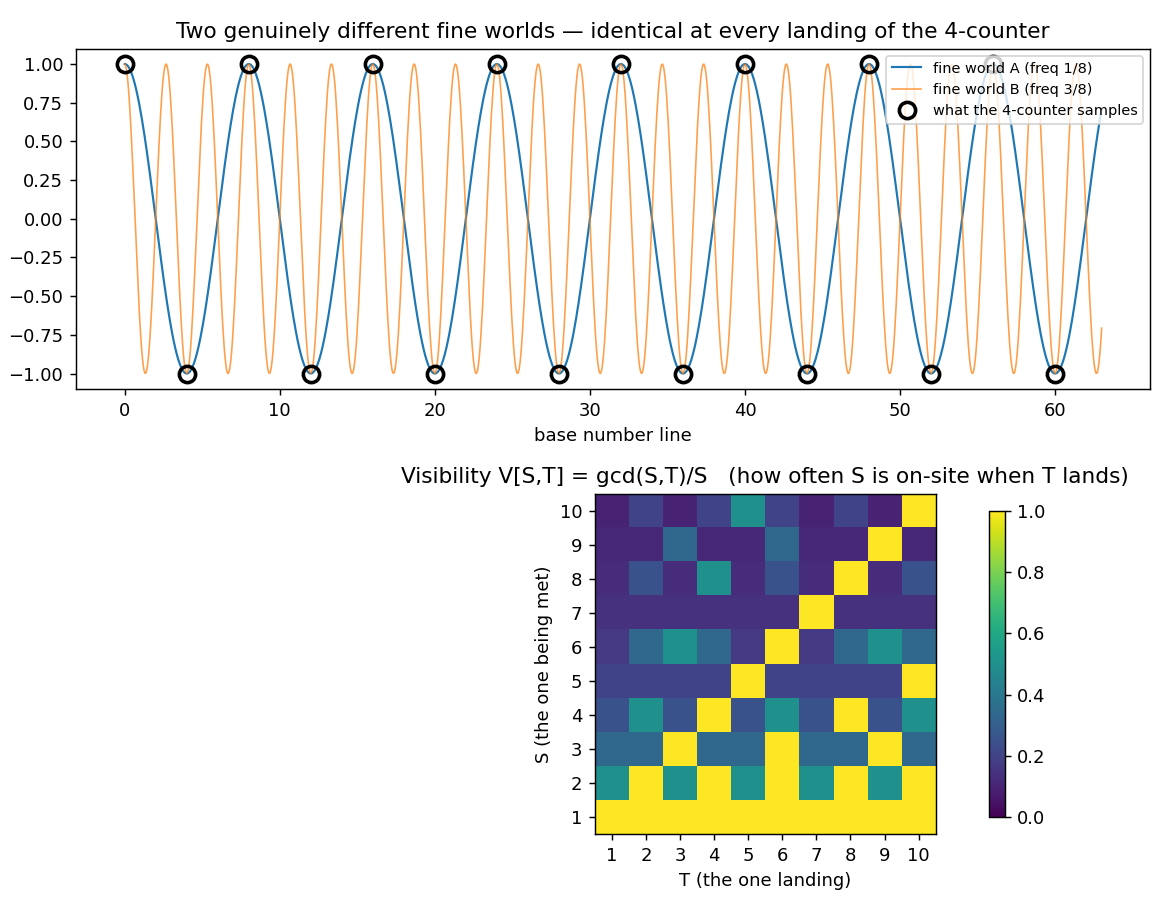
02_counting_becomes_space
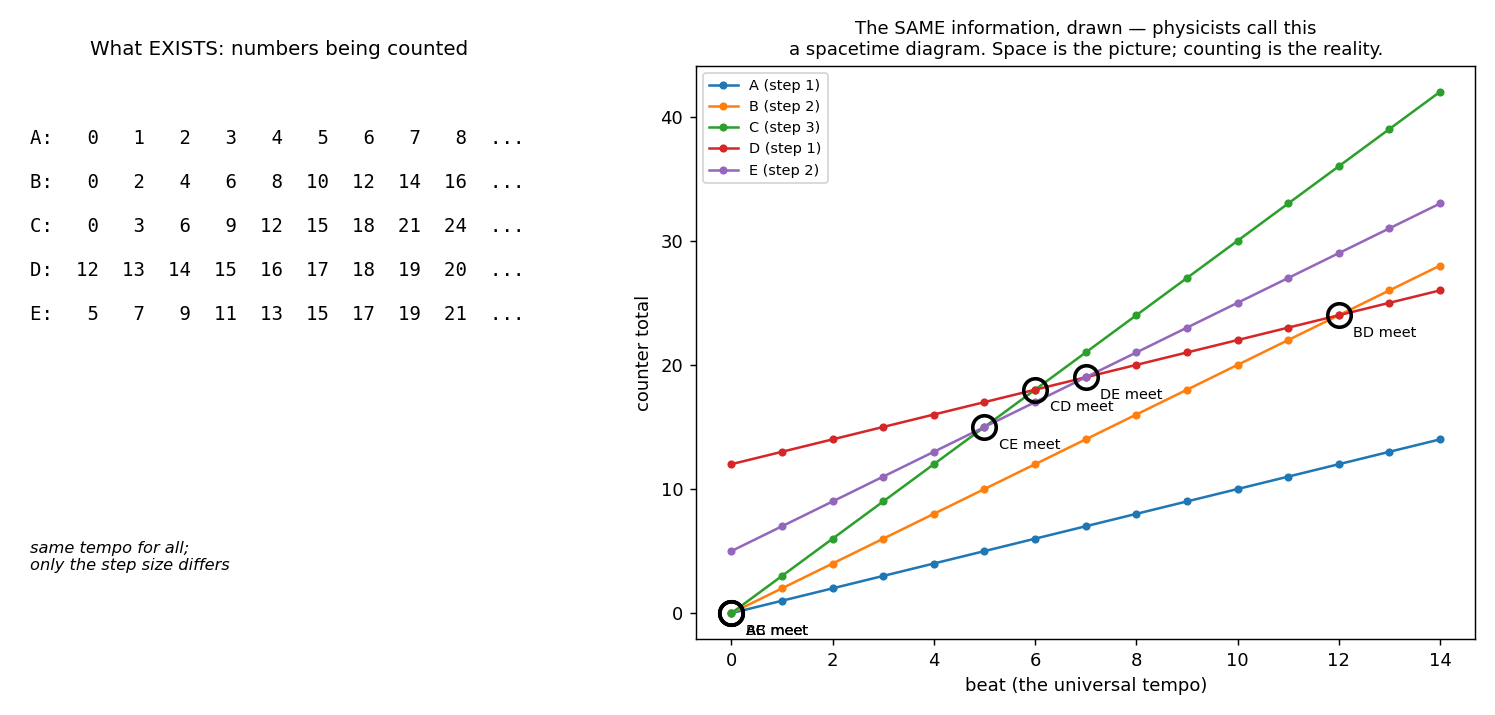
03_ring_world
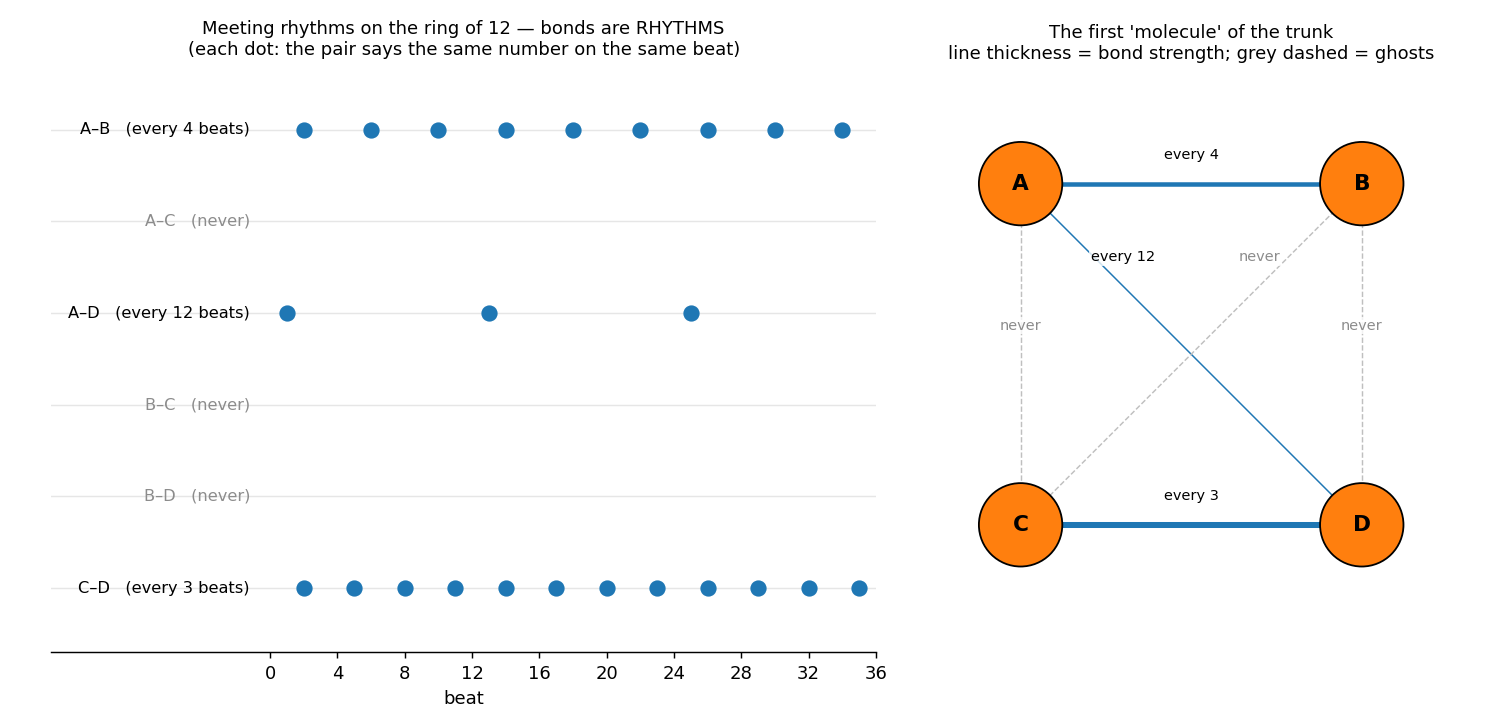
04_traces
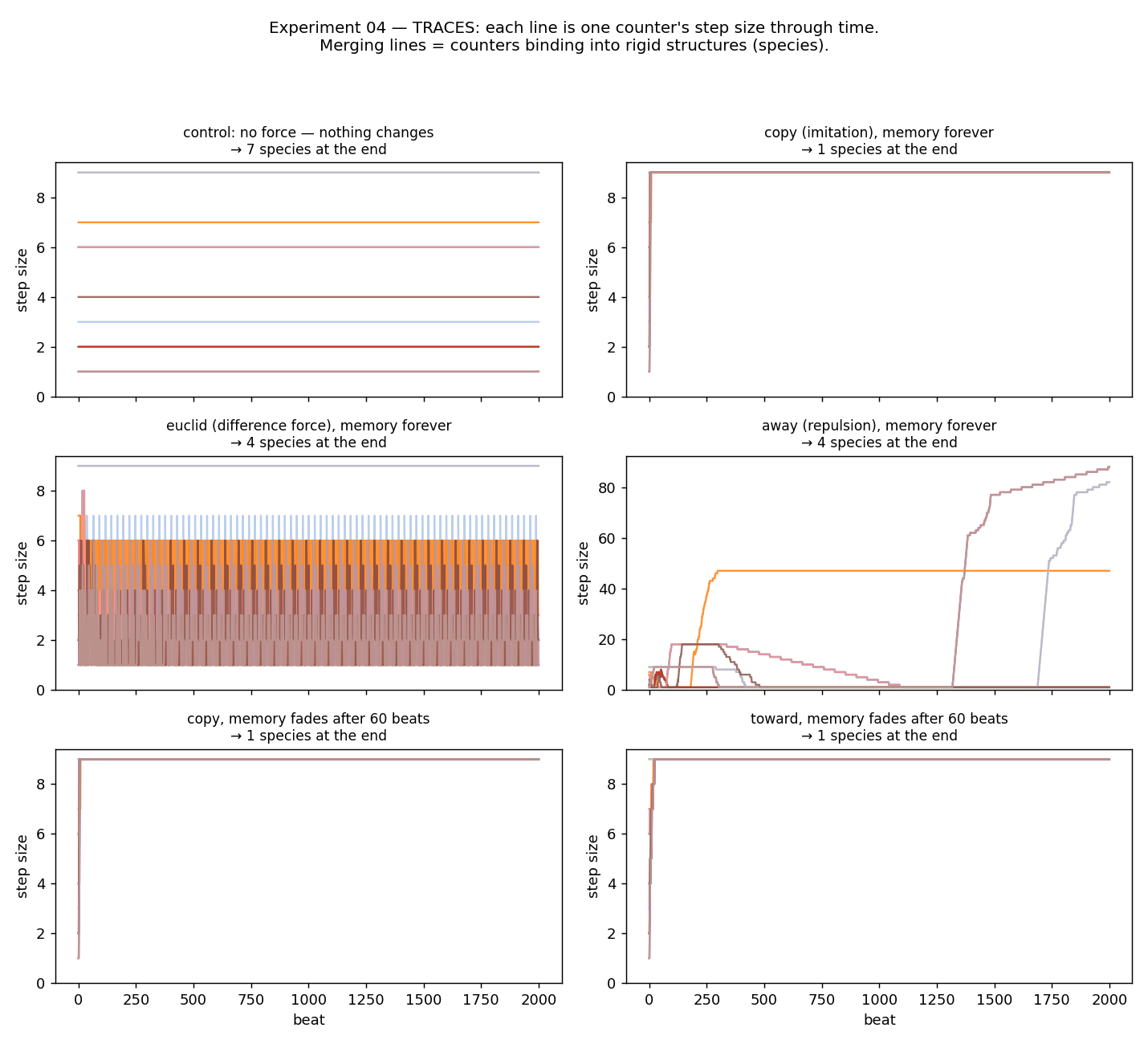
05_sweep
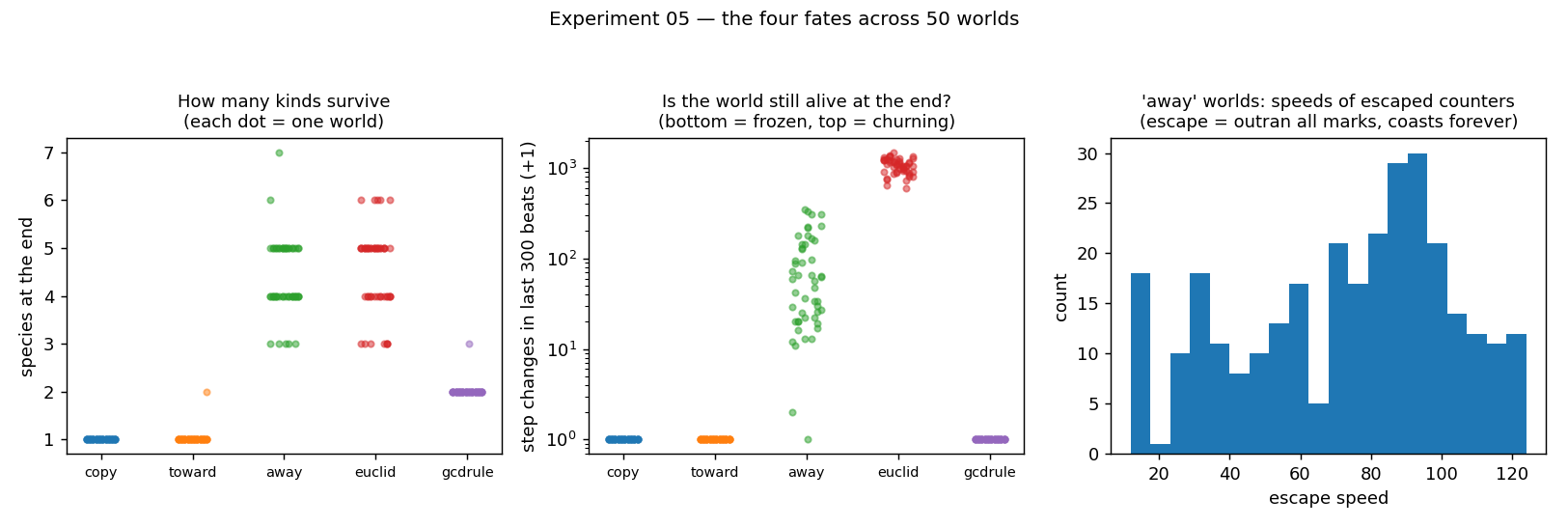
06_euclid_microscope
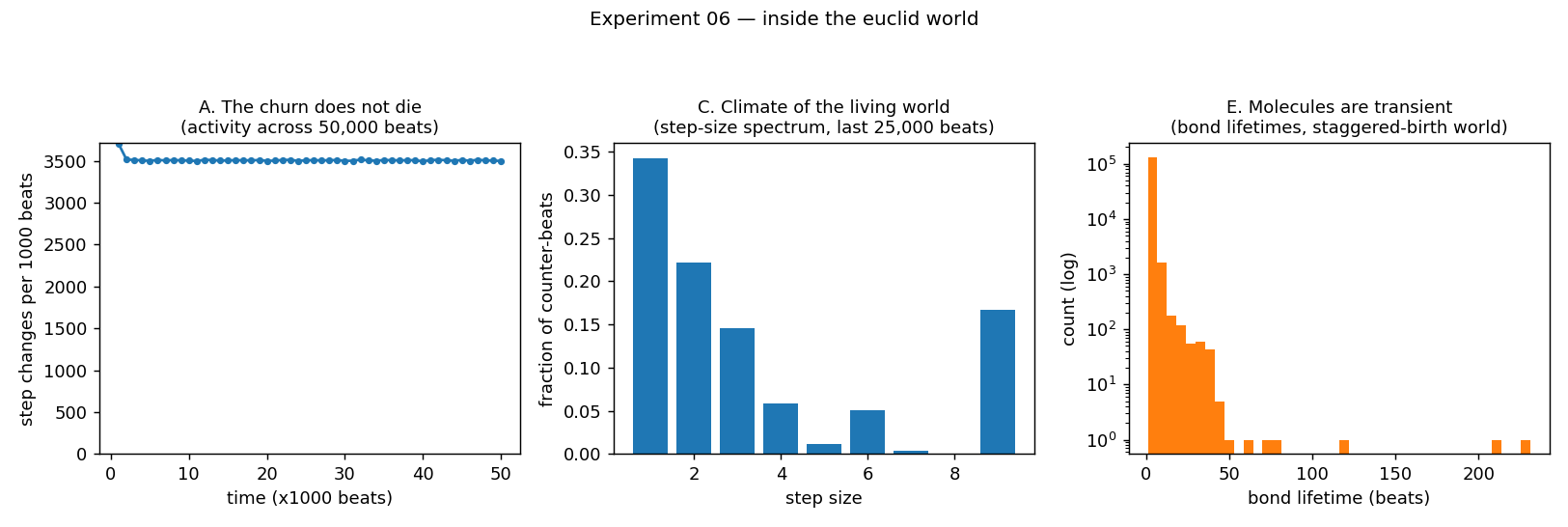
07_phase_boundary
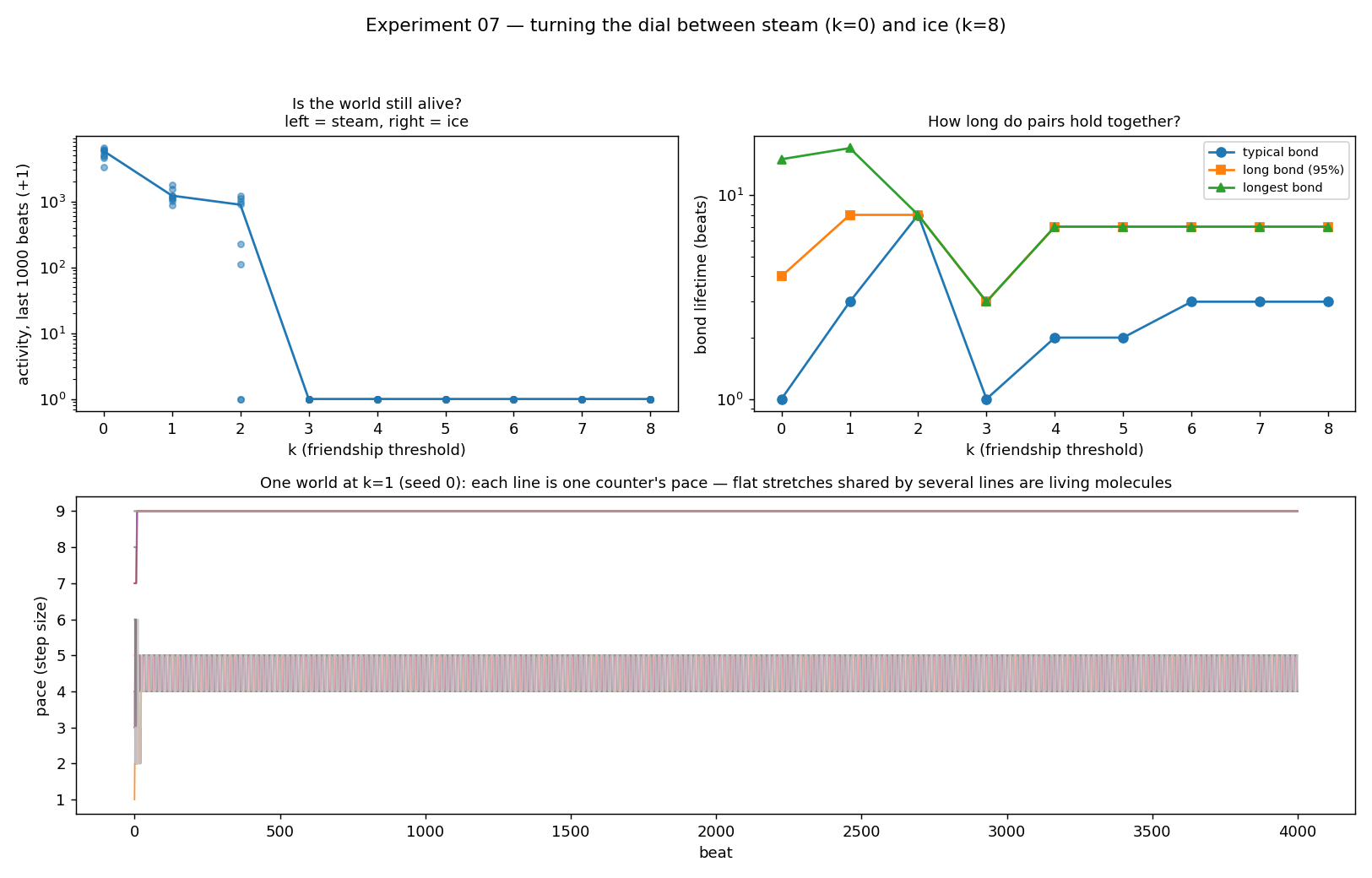
08_blob_physics
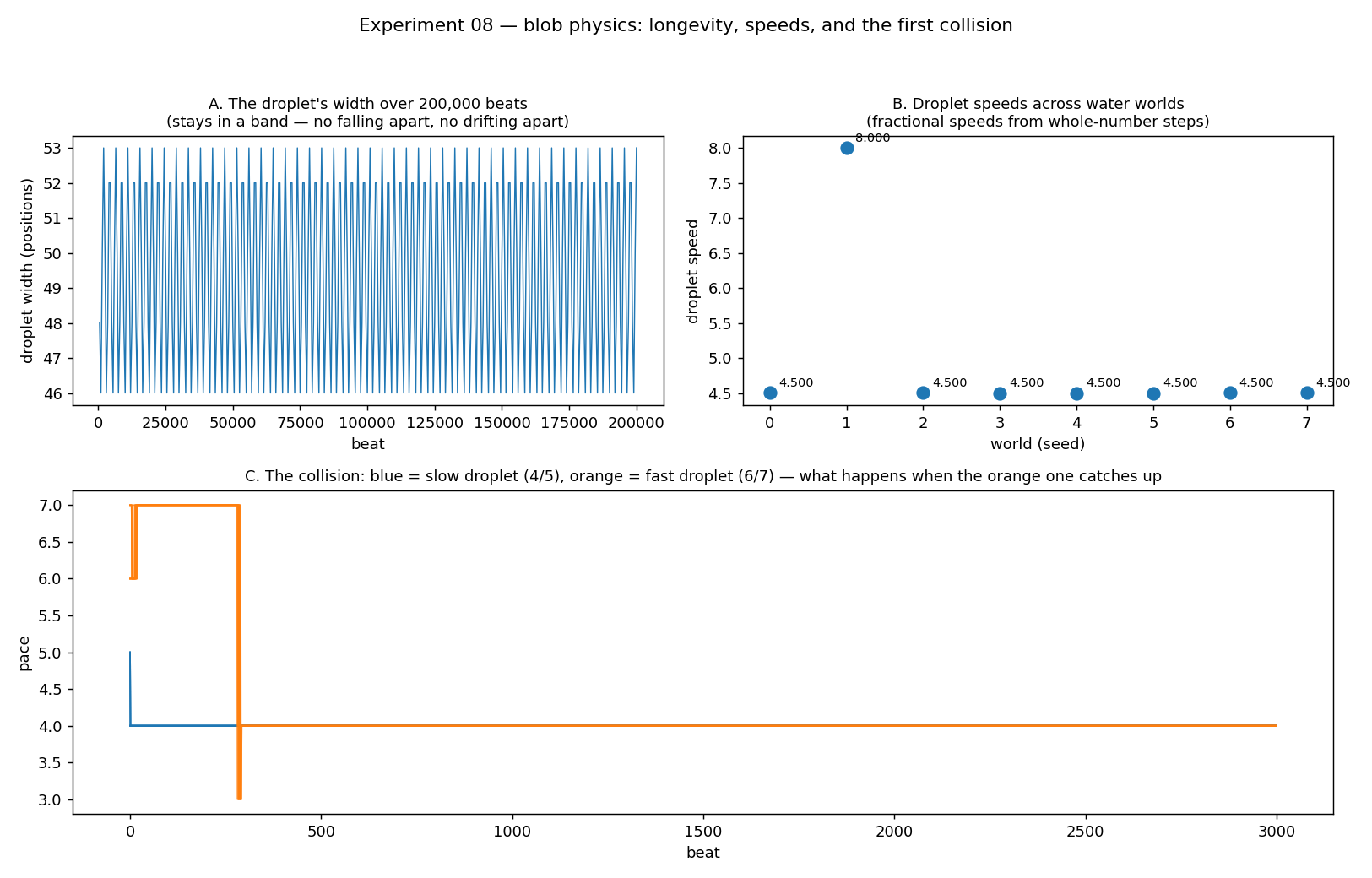
09_collision_chemistry
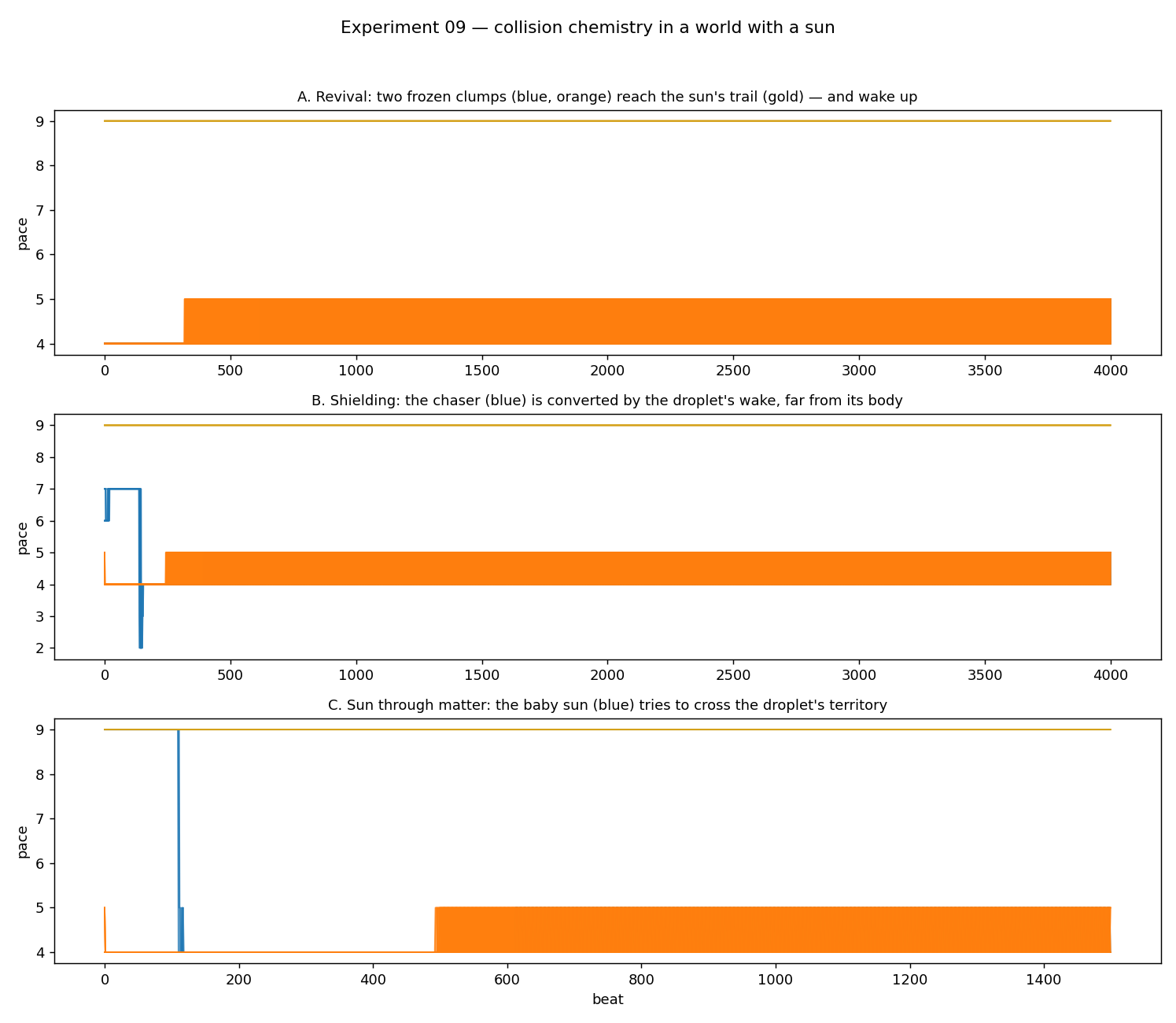
10_other_suns
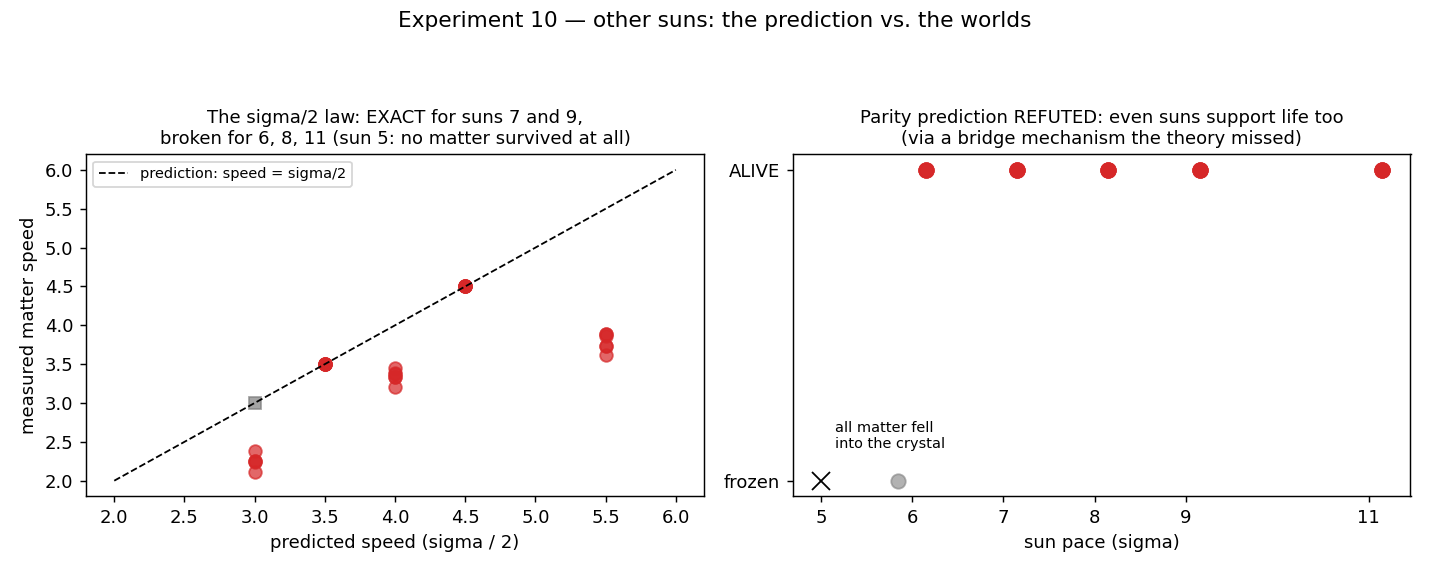
11_perceived_velocity
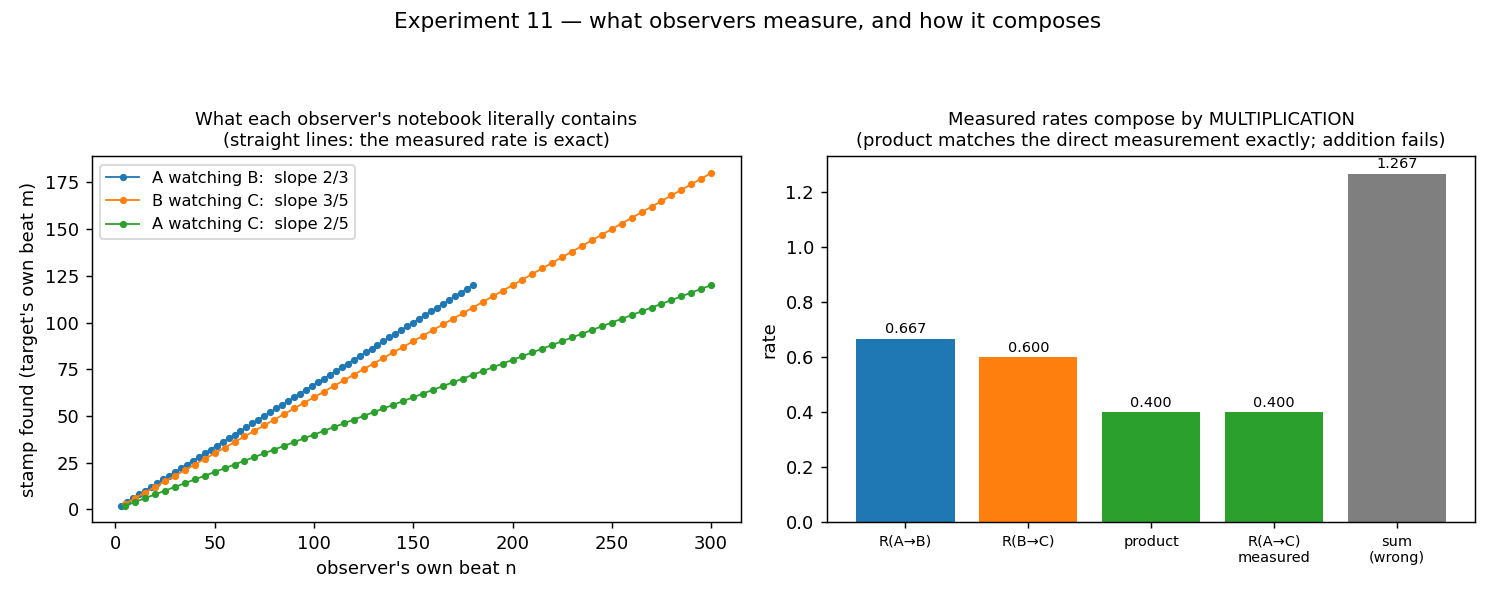
12_messengers
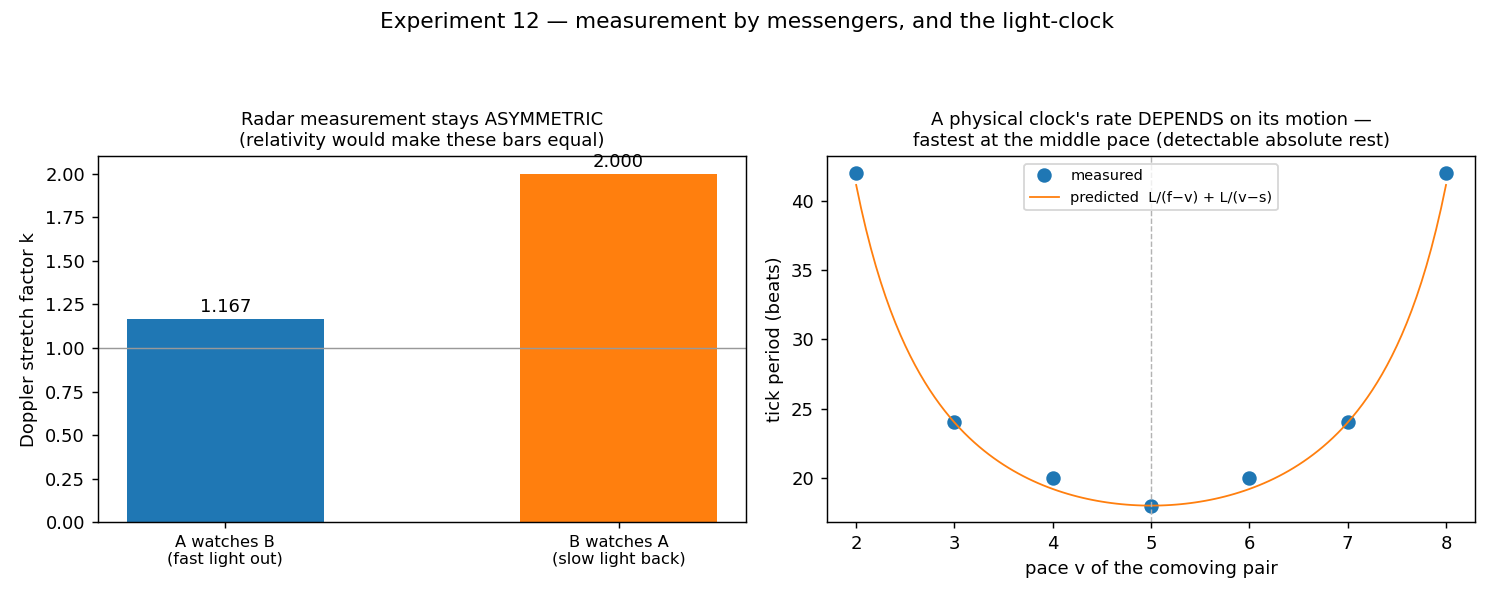
13_universality
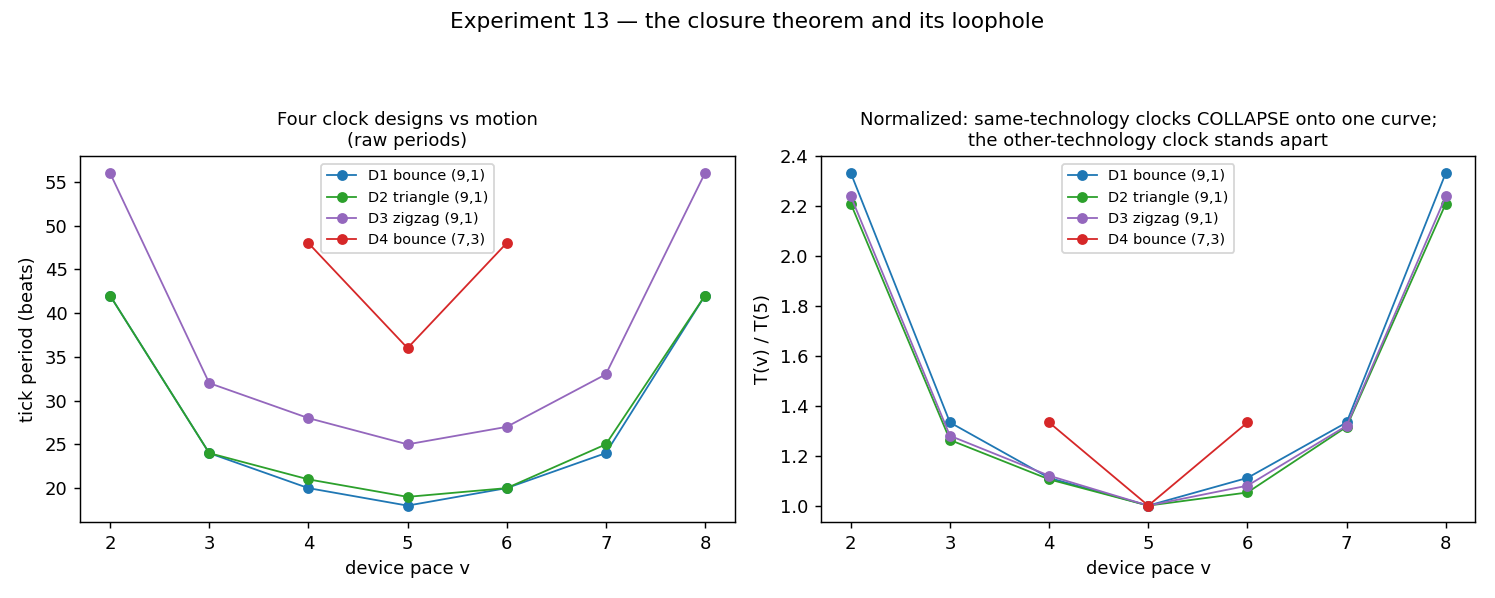
14_messenger_survival
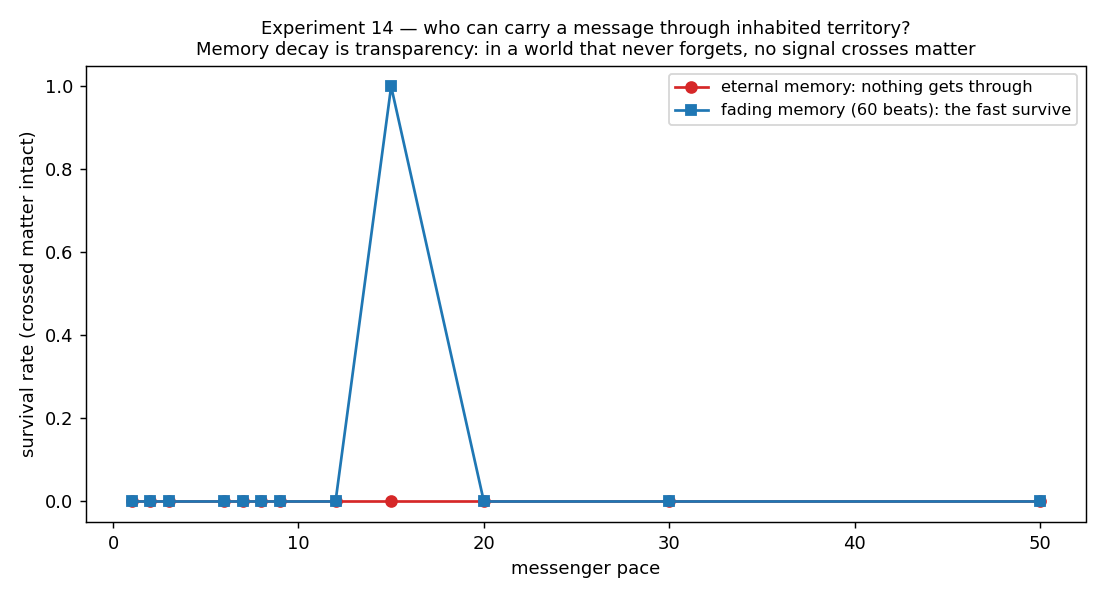
15_window_universality
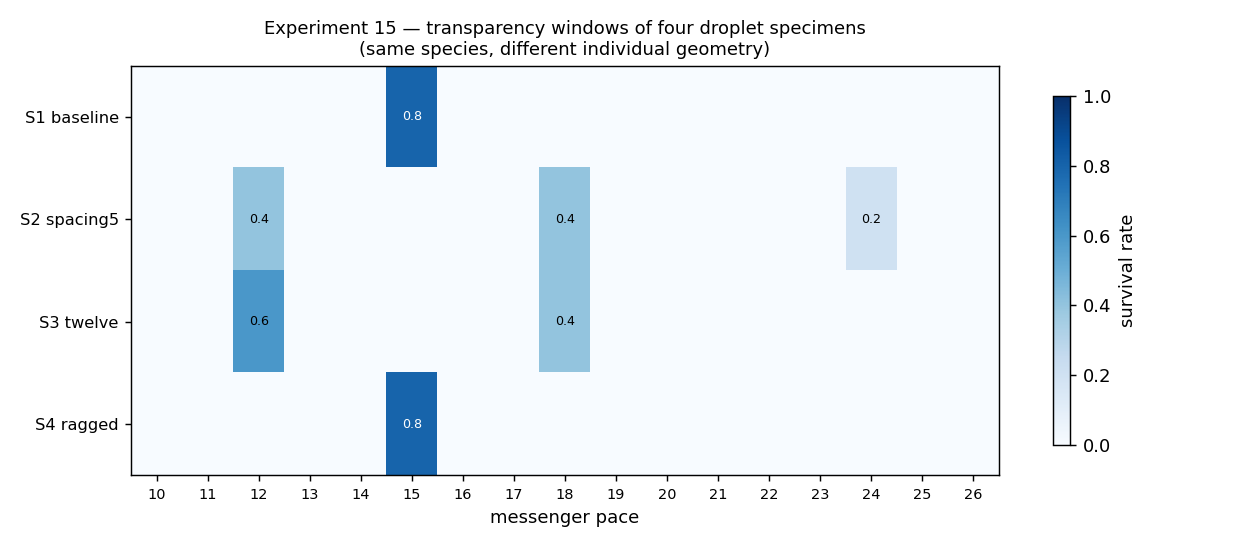
16_force_law
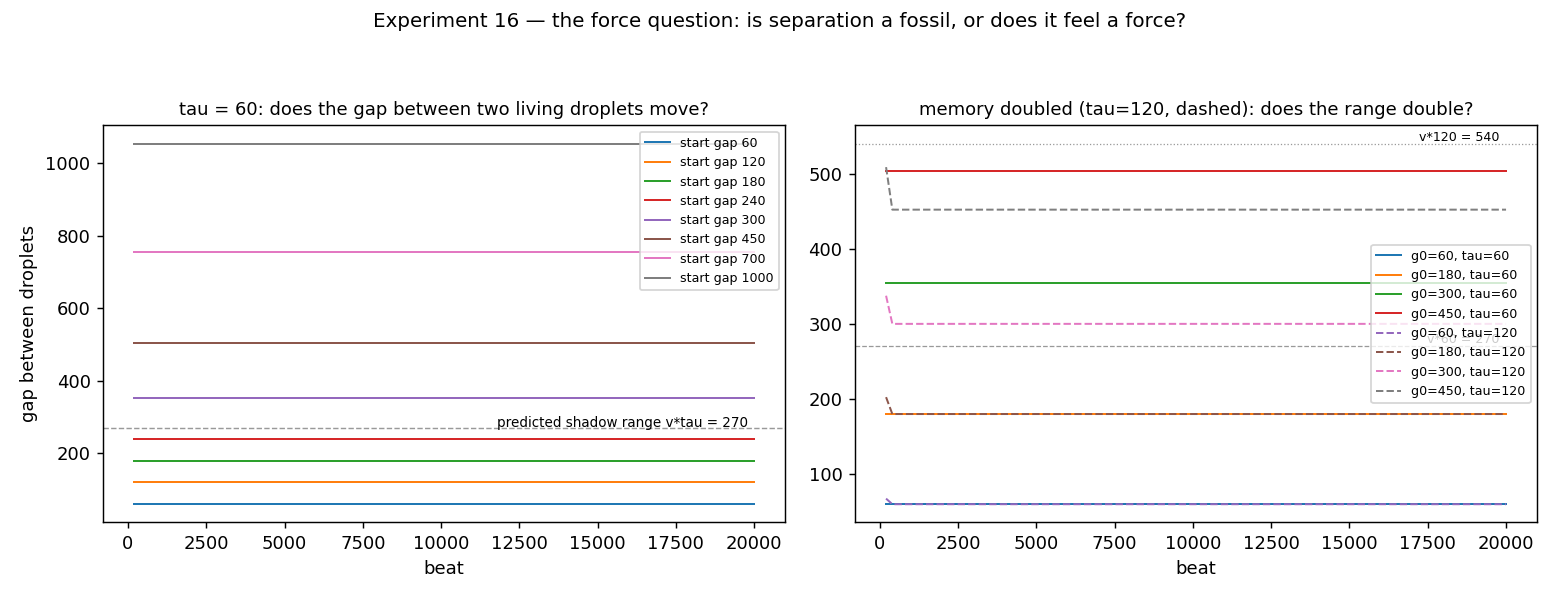
17_coarse_graining
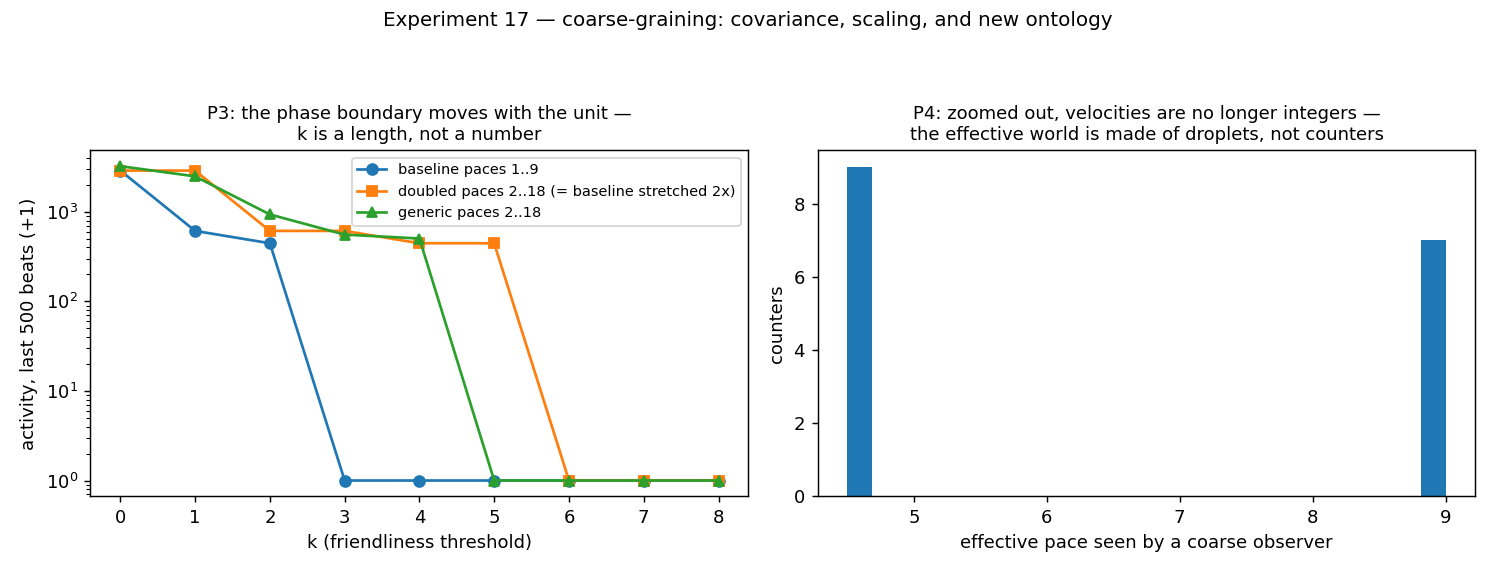
18_sizespace
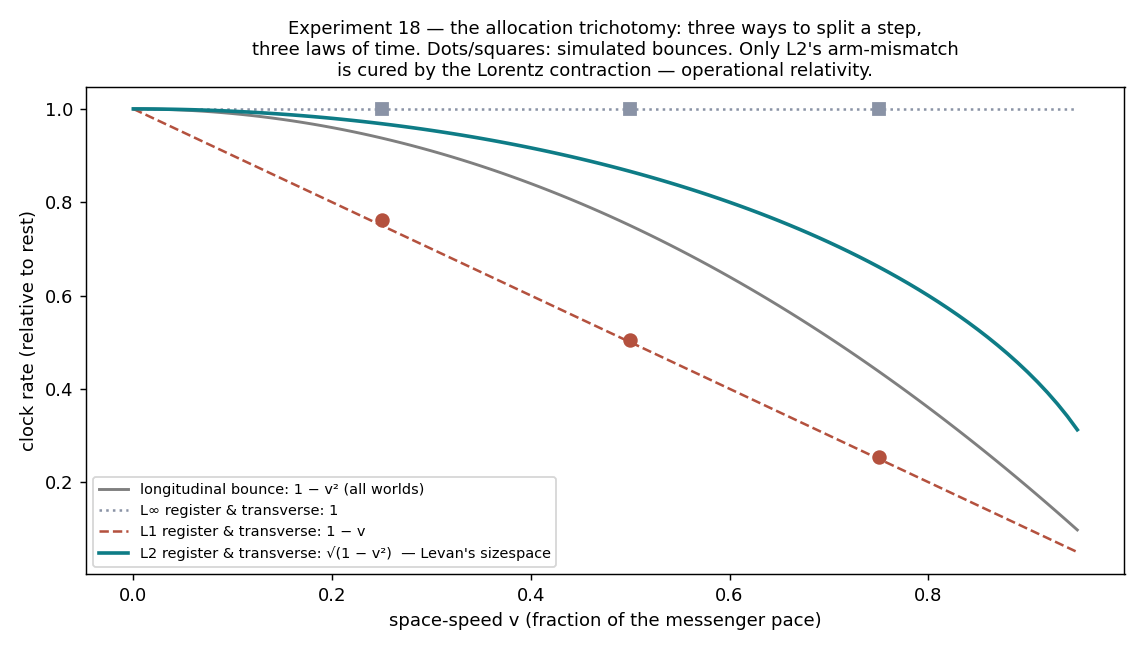
19_the_circle
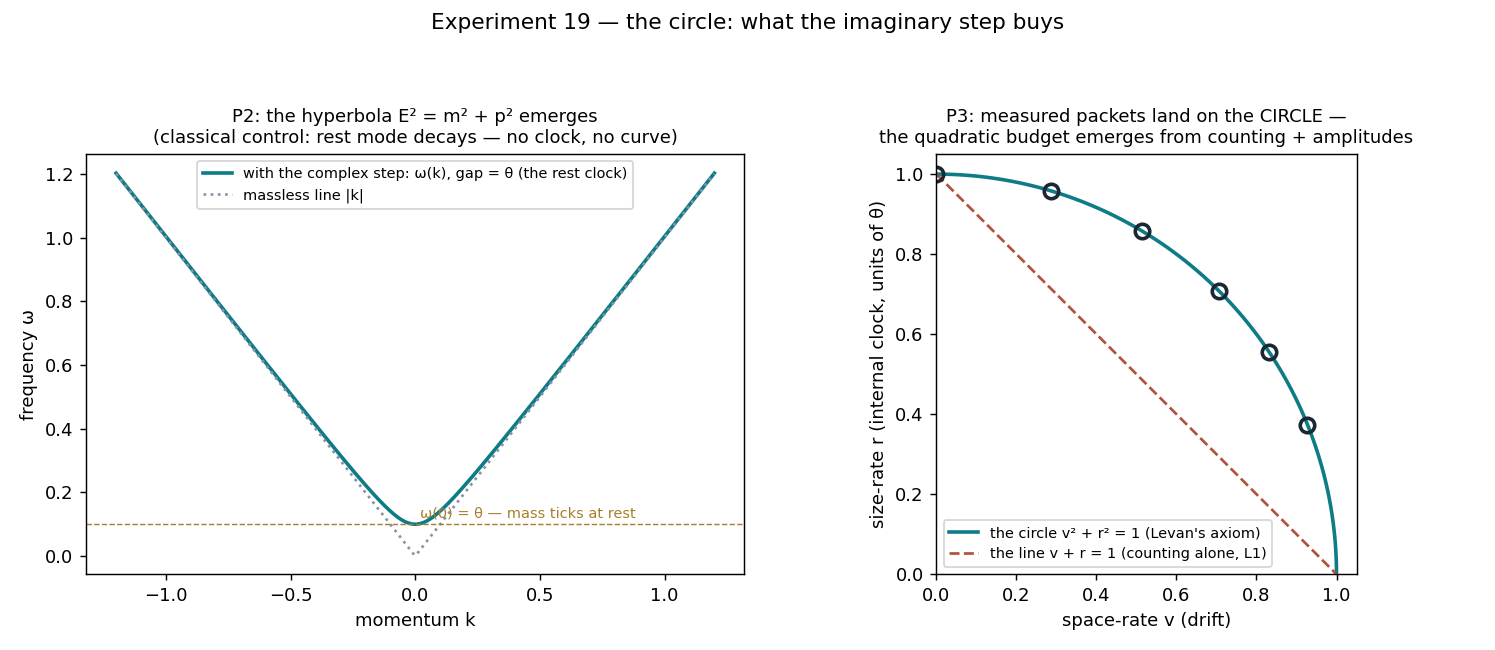
20_granularity_audit
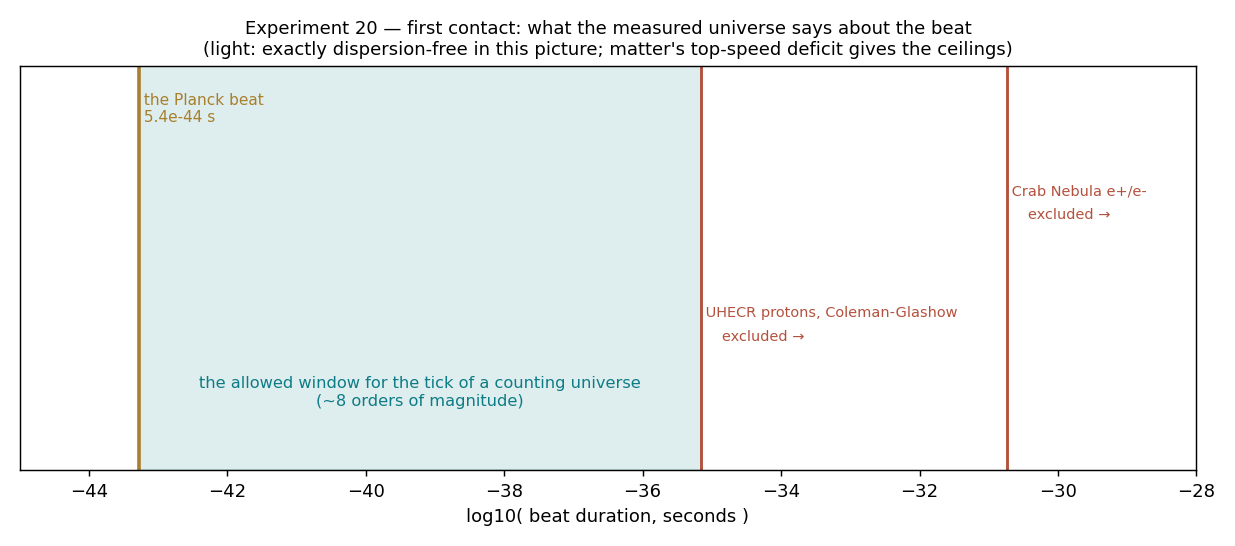
21_three_dimensions
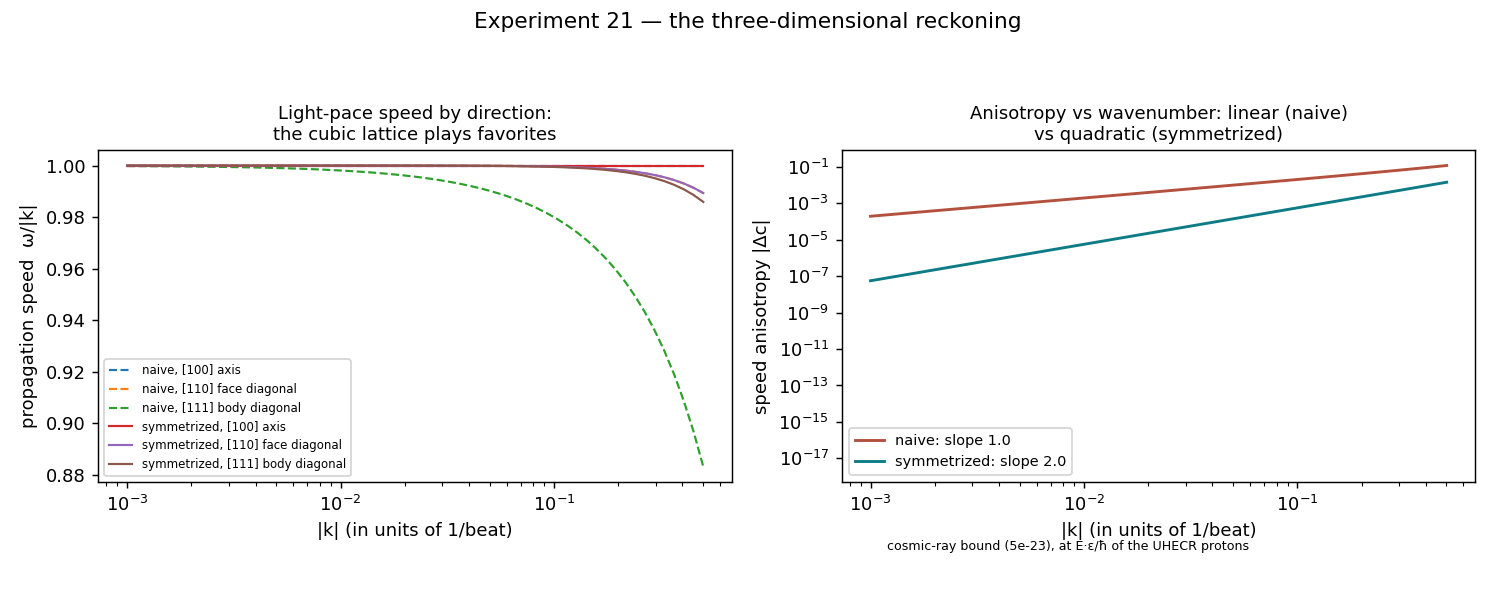
22_shuffled_lattice
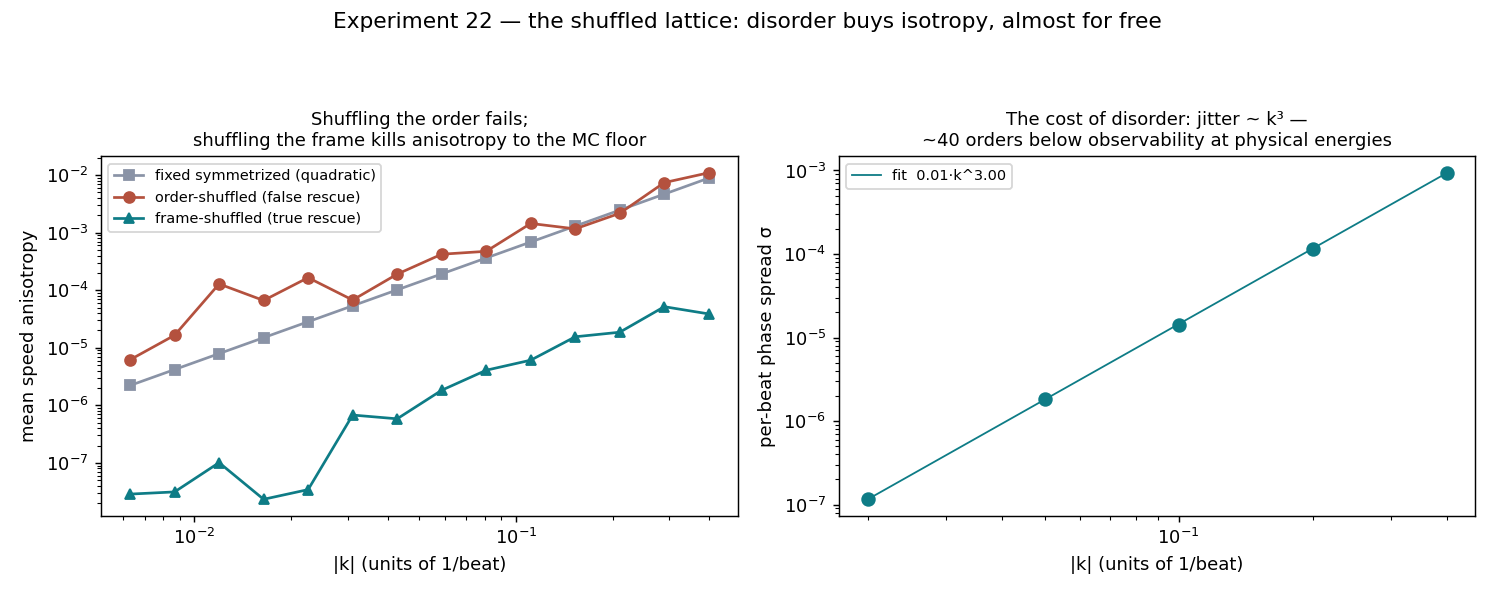
23_quasar_test
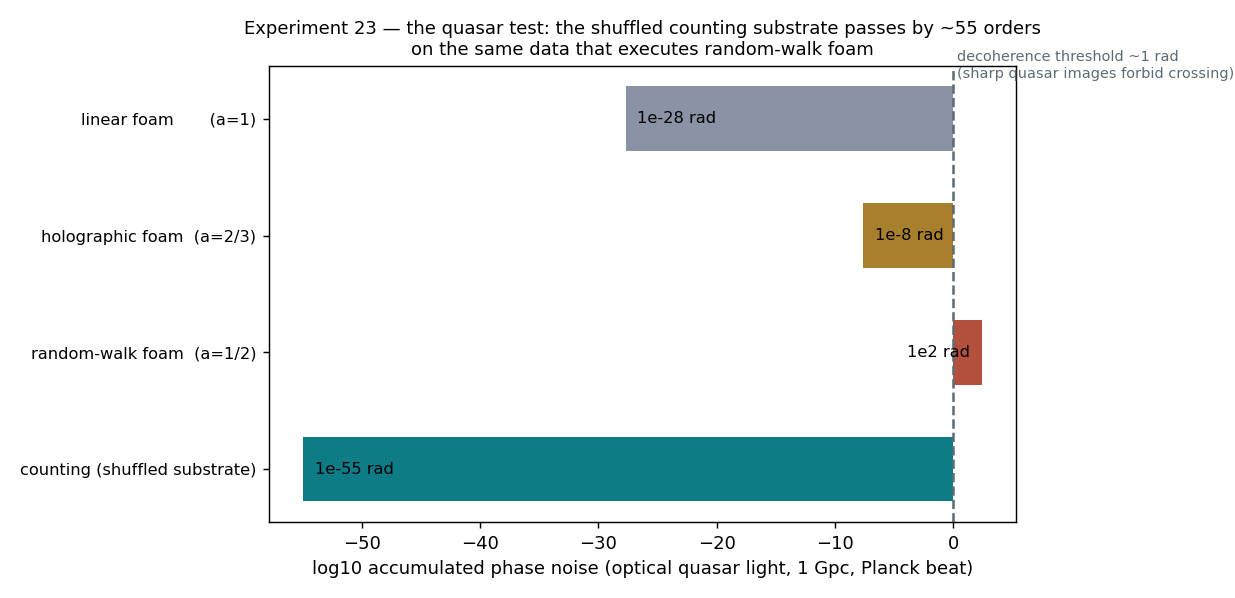
24_quenched_disorder
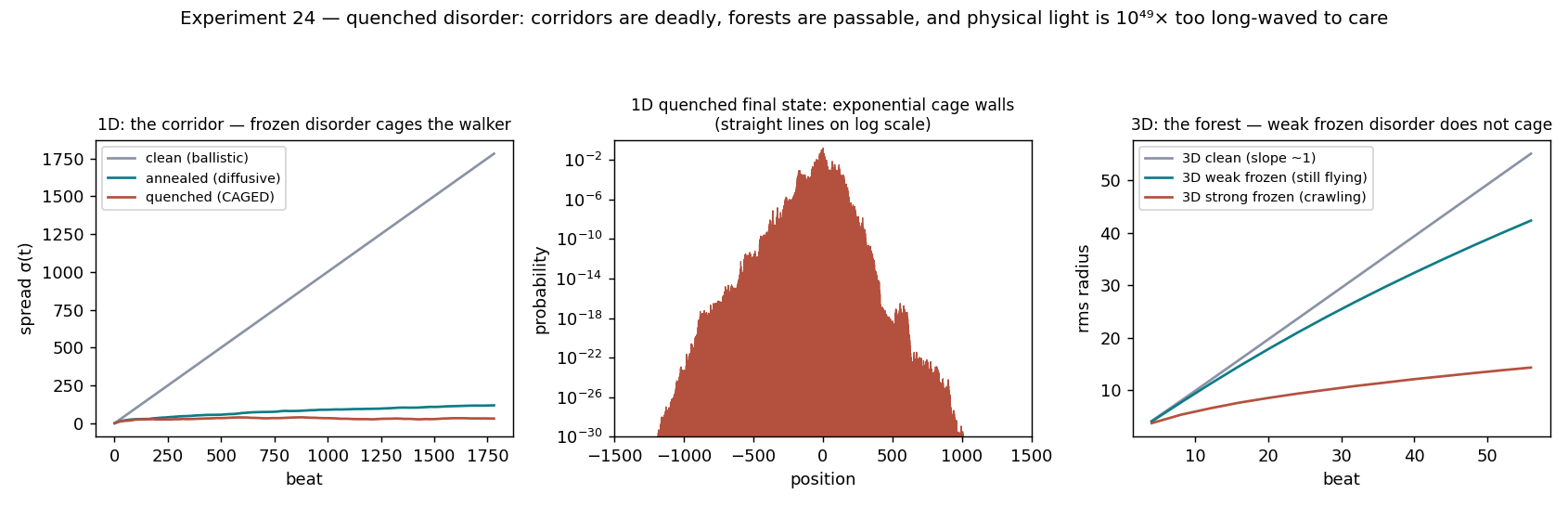
25_why_complex
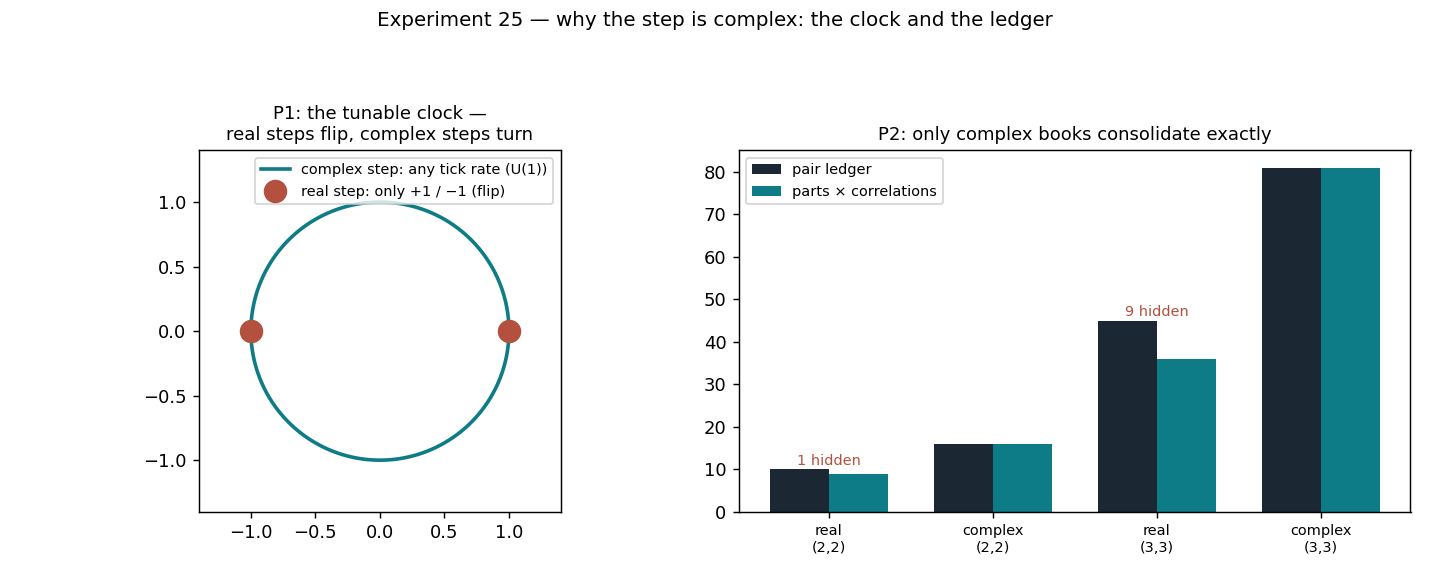
26_representation
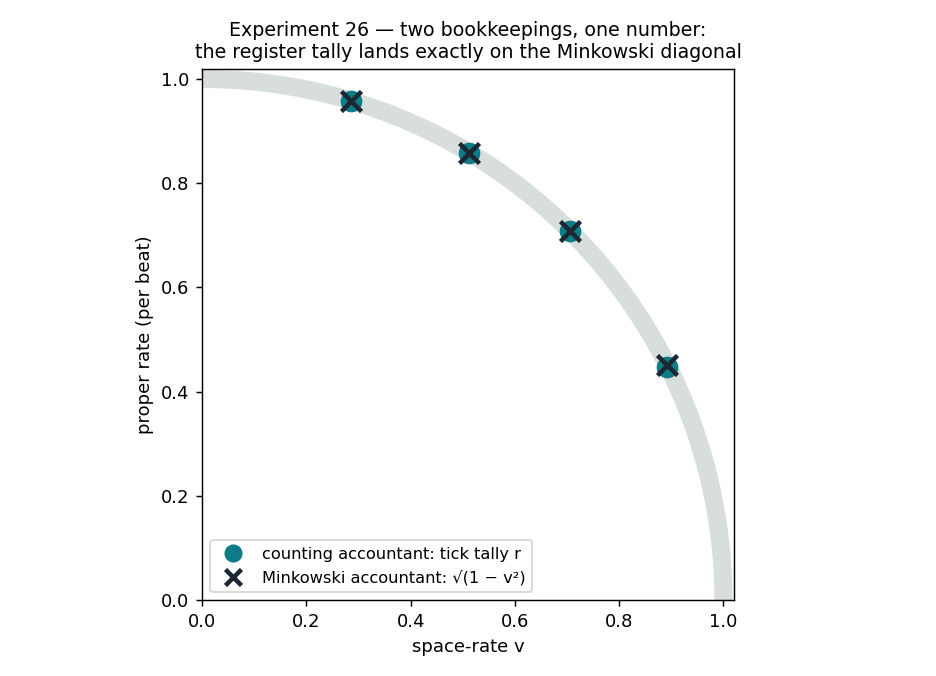
27_dimensions_question
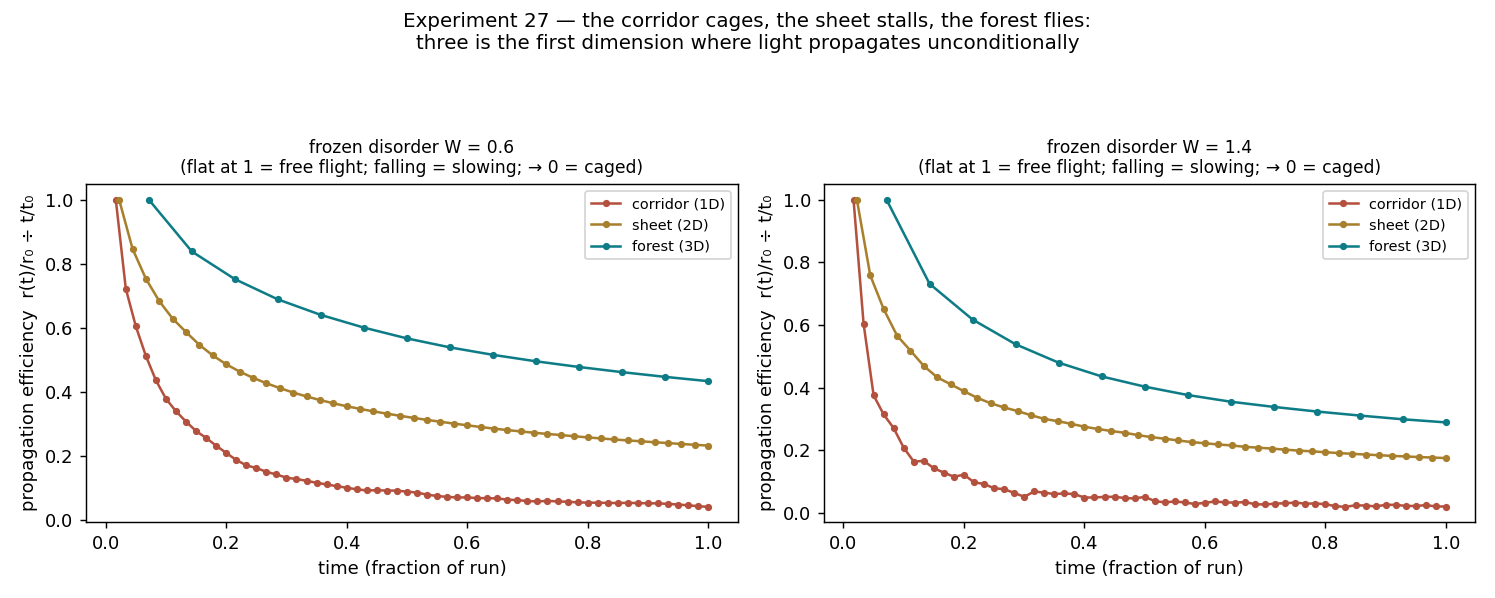
28_foam_fingerprint
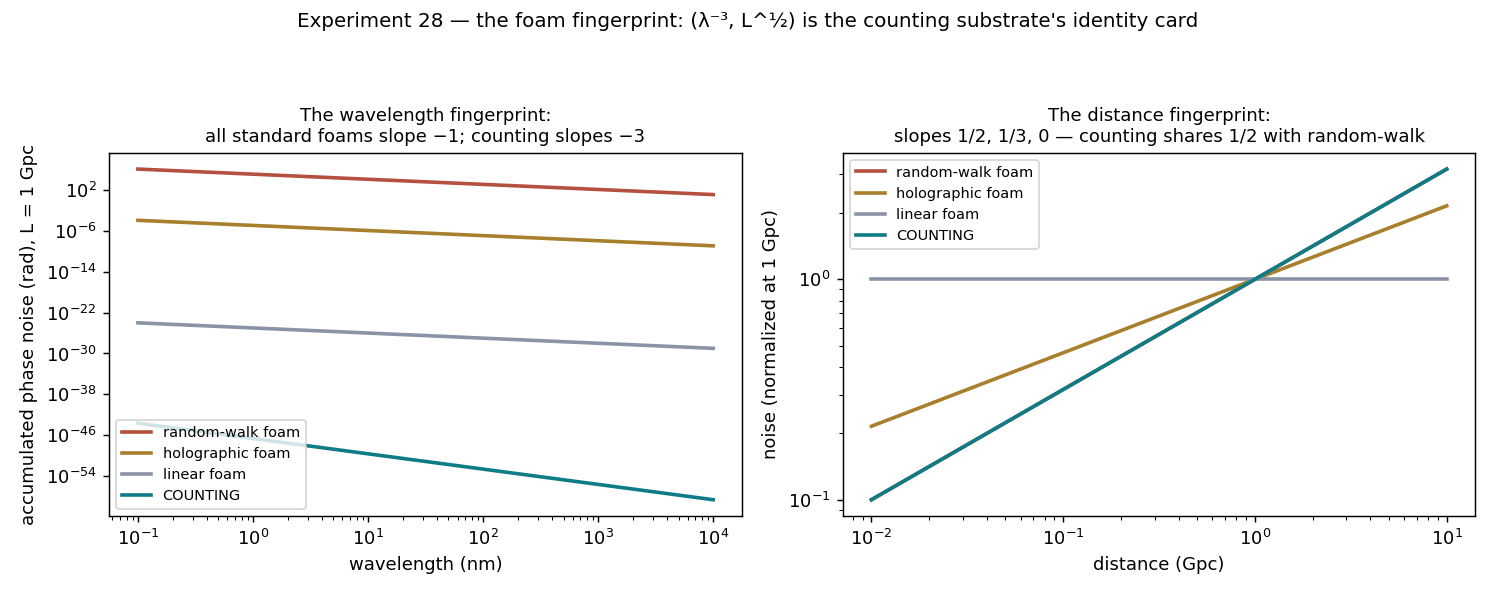
29_relativity_checklist
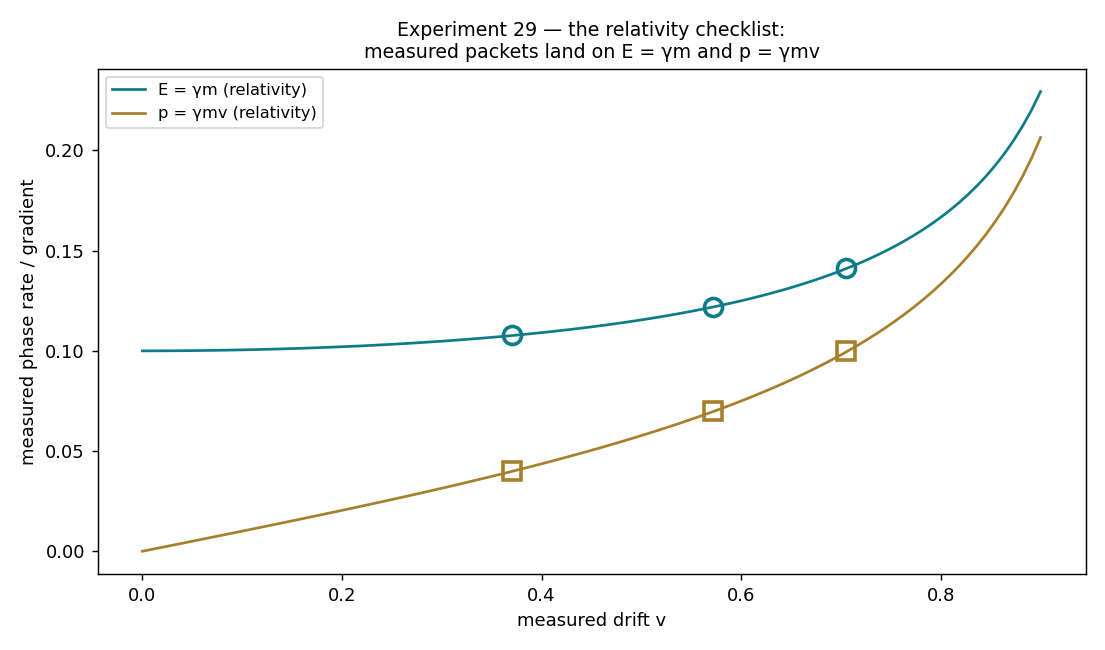
30_classicality
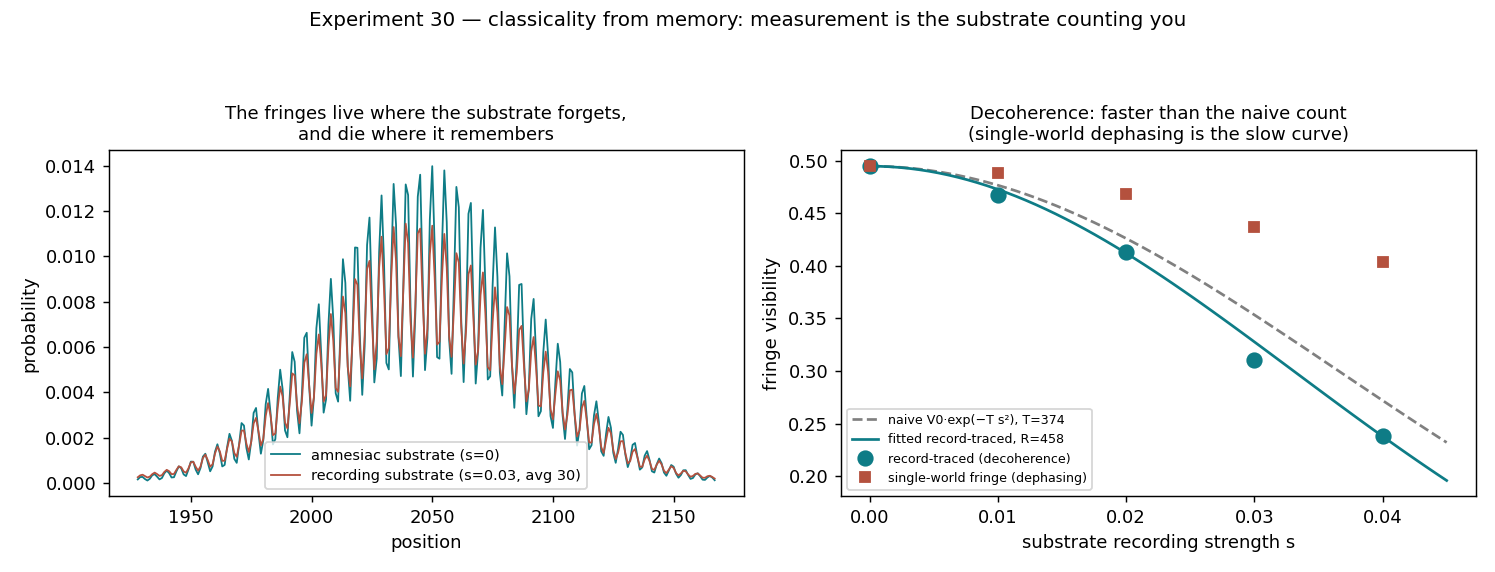
31_the_arrow
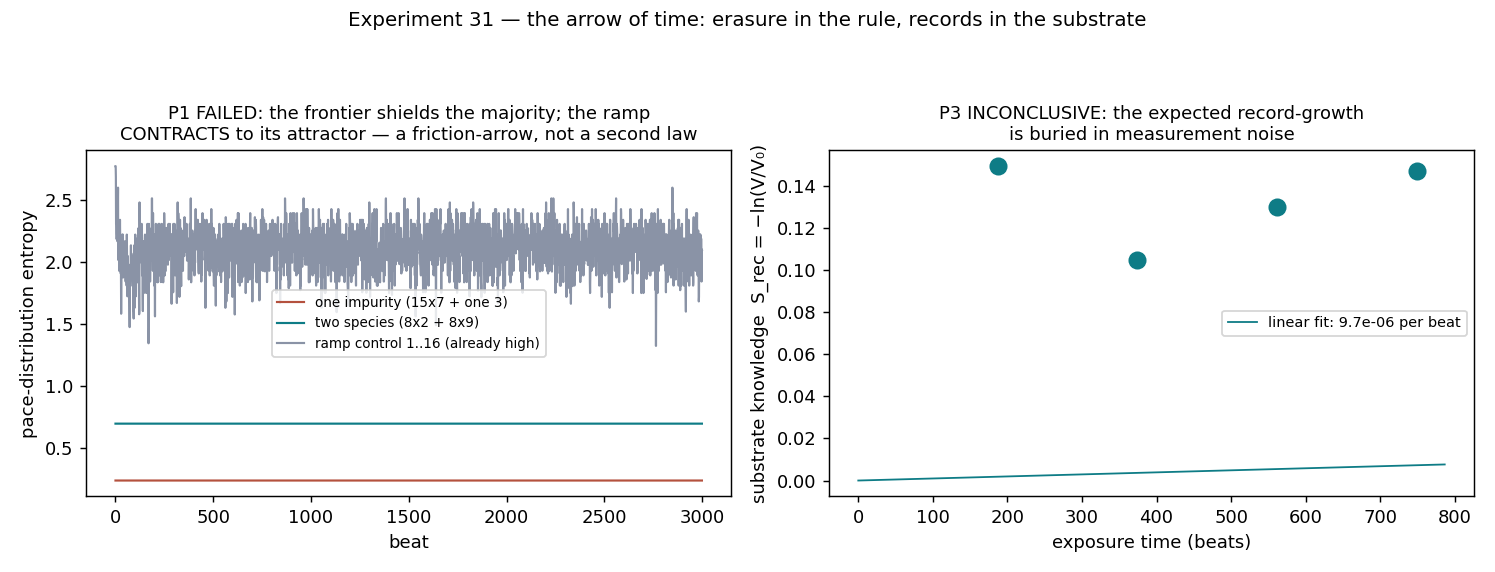
32_bell_on_the_lattice
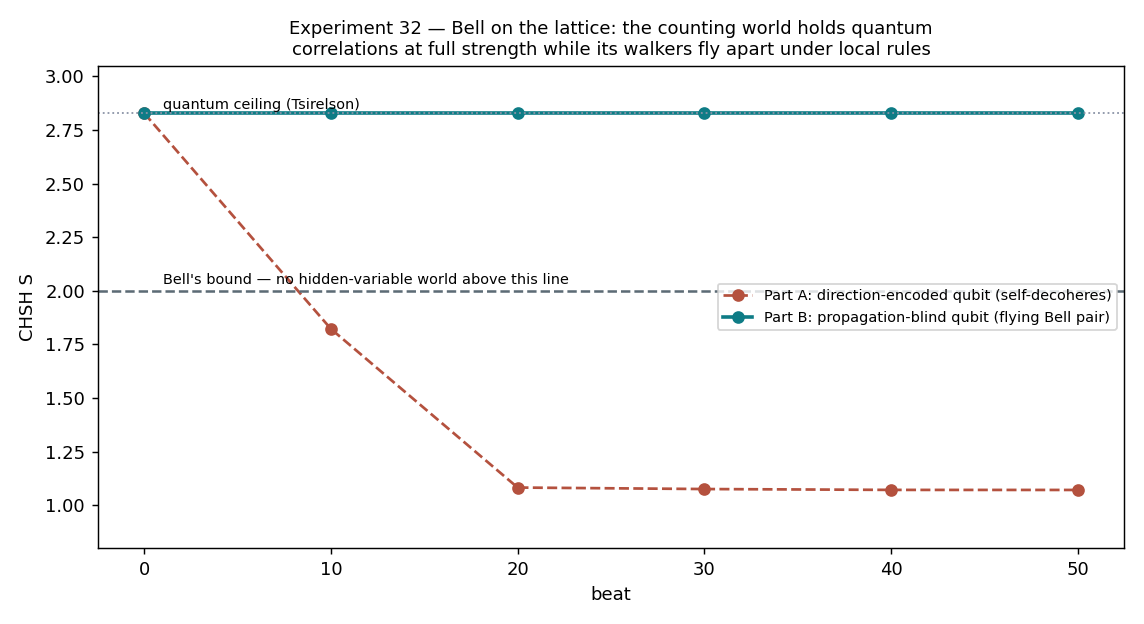
33_force_from_phase
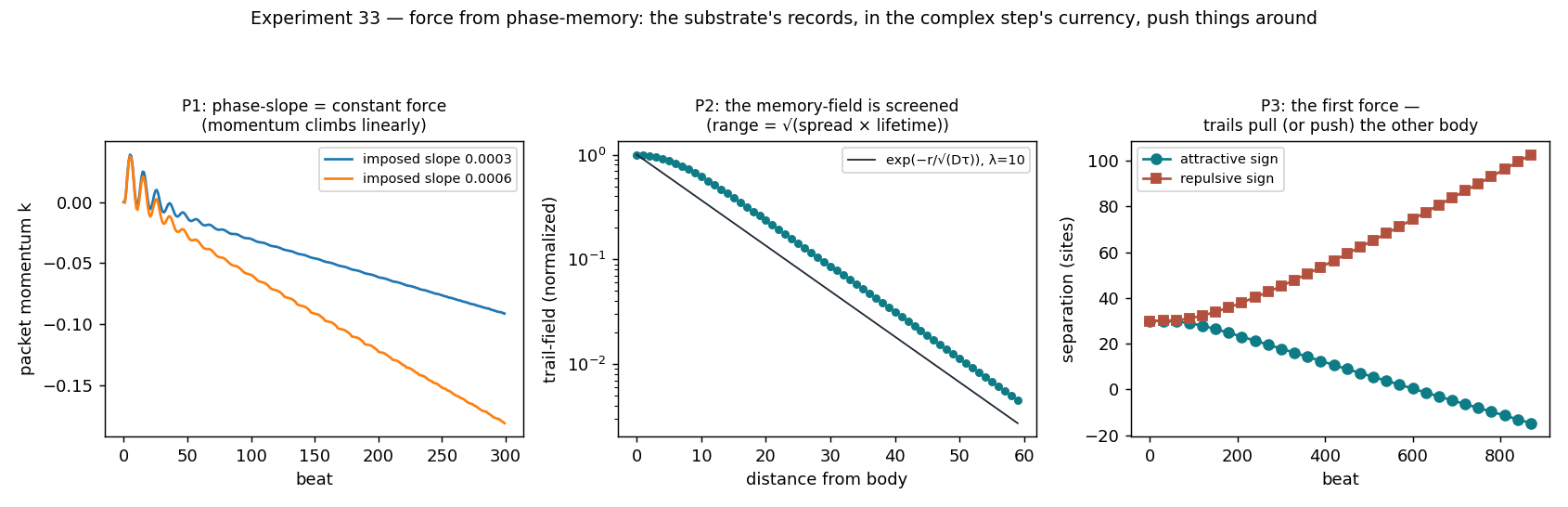
34_the_capture
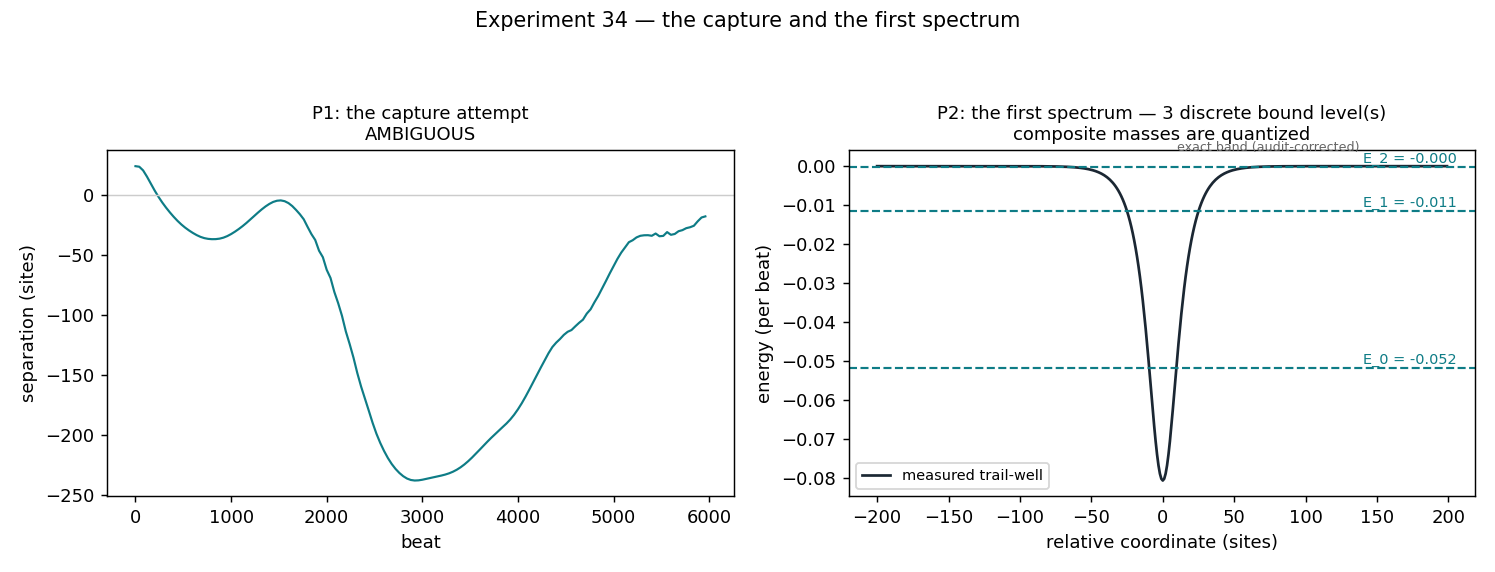
35_one_way_region
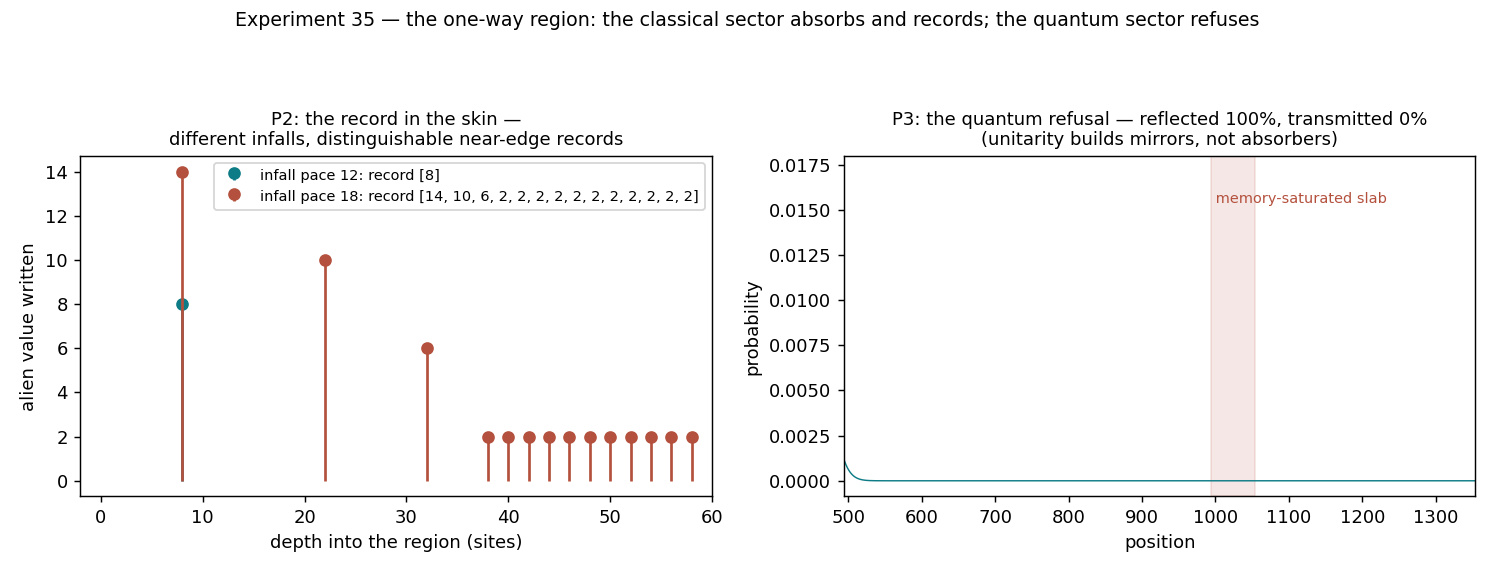
36_foam_bound
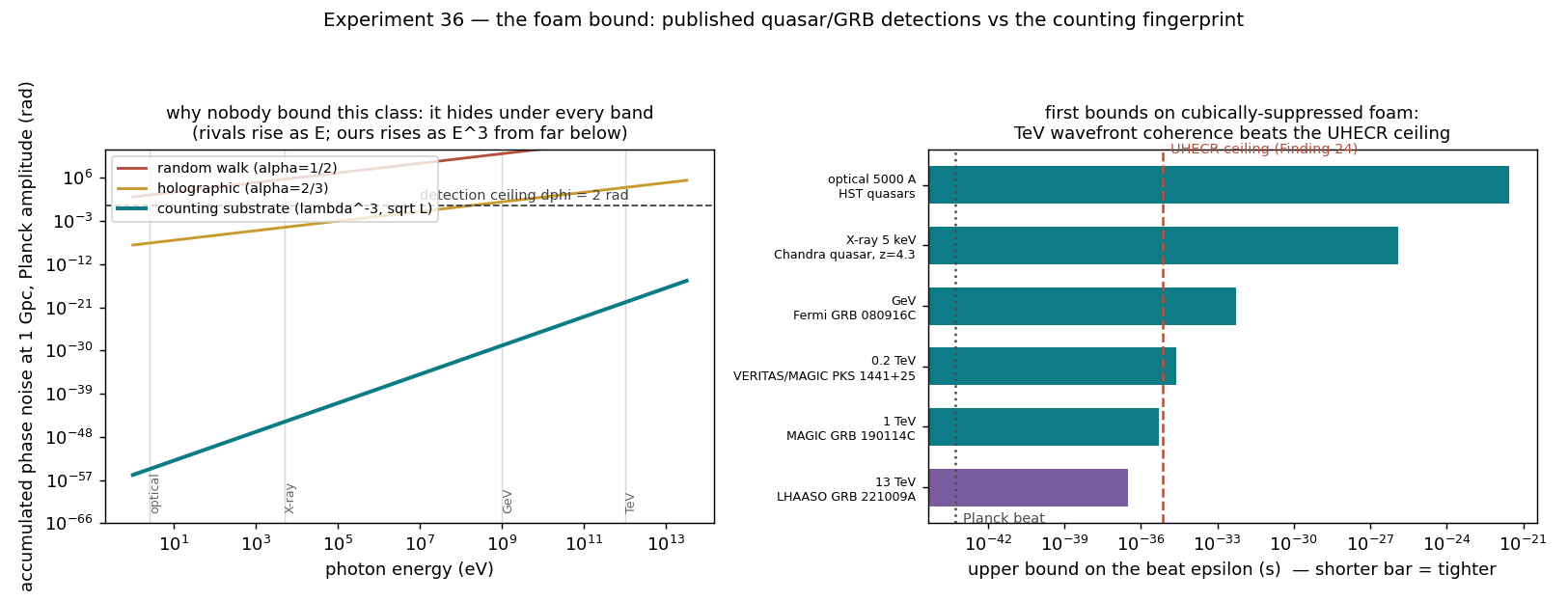
37_higgs_stake
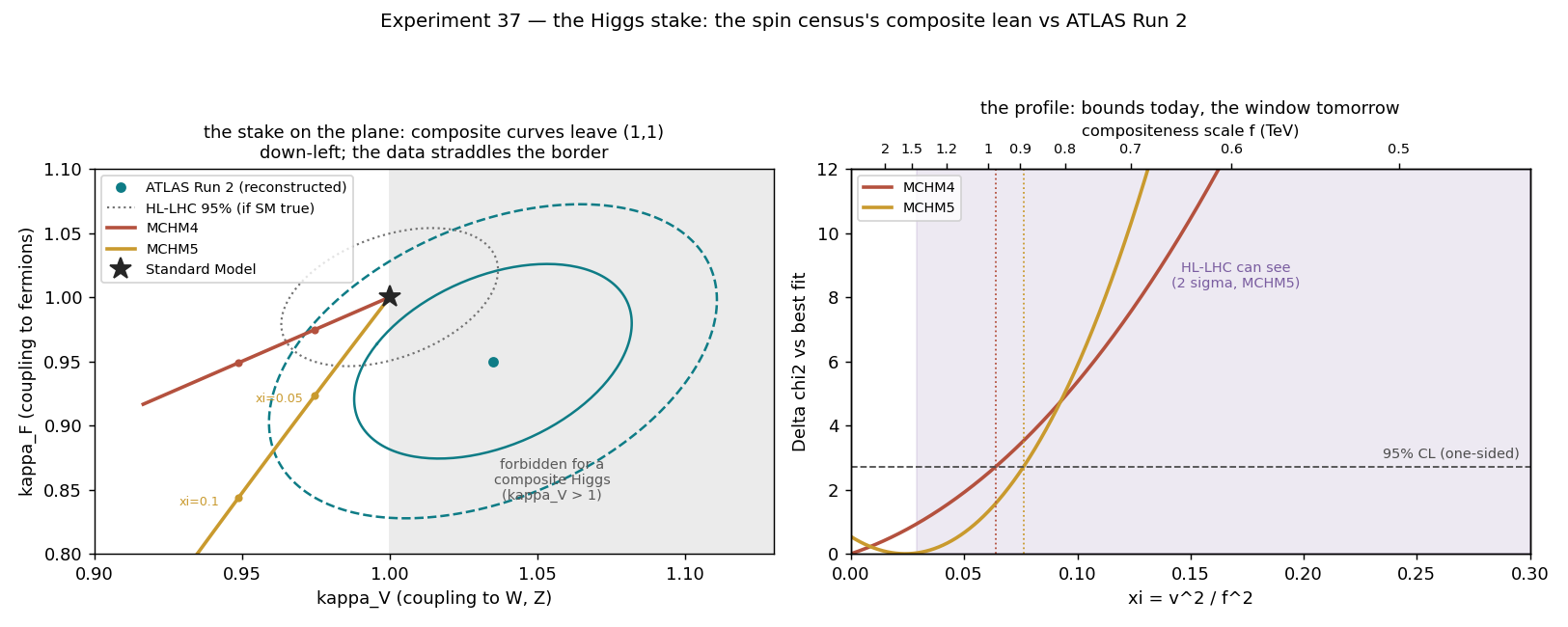
38_grb_jitter_stake
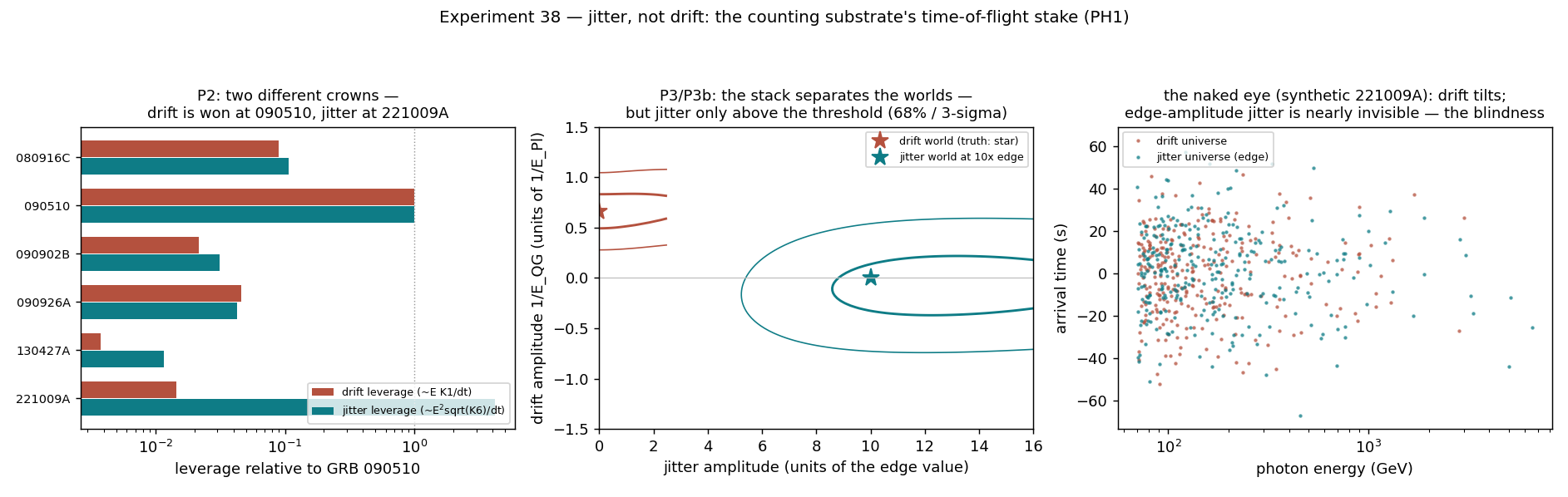
39_why_relativity
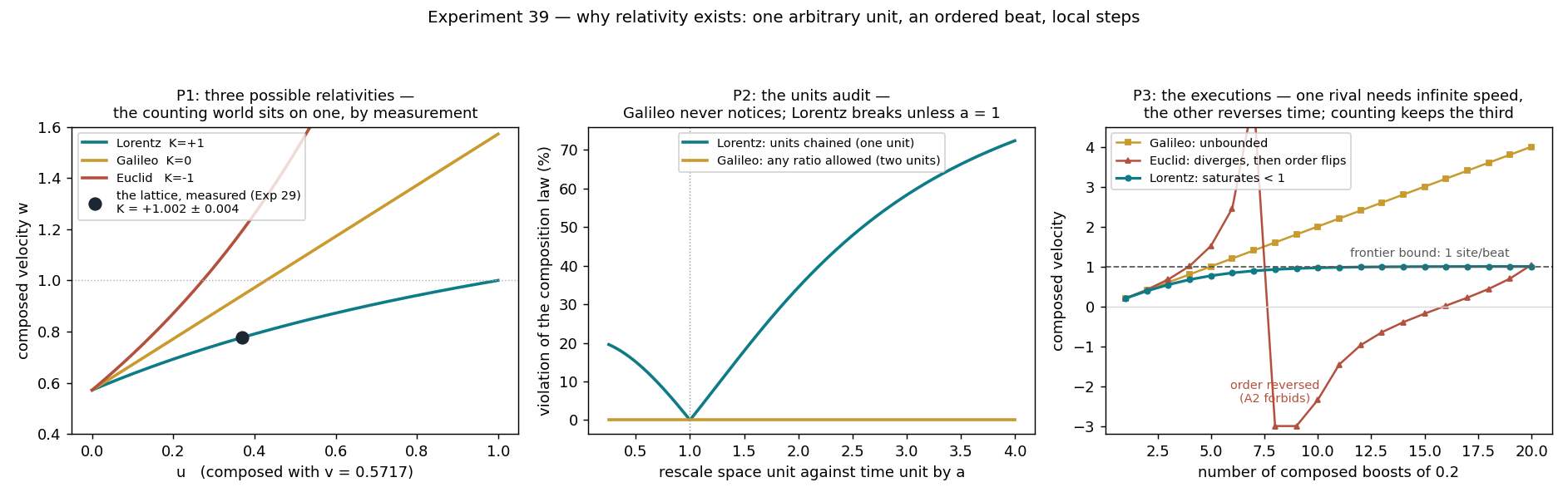
40_constants
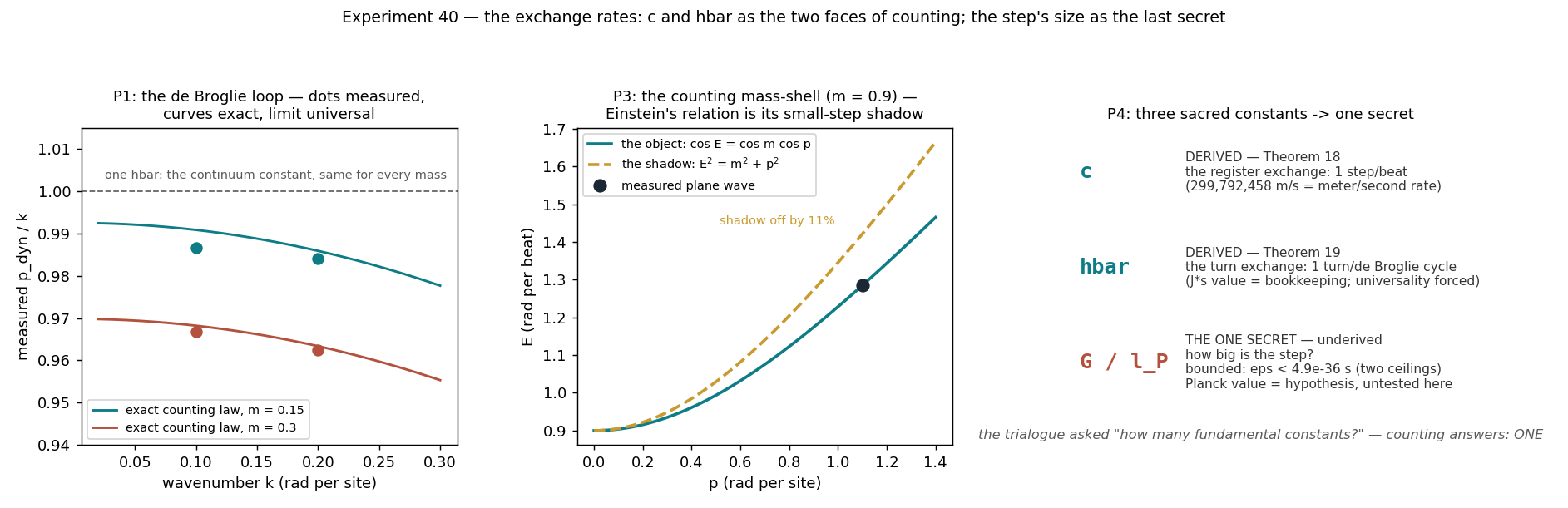
41_the_born_question
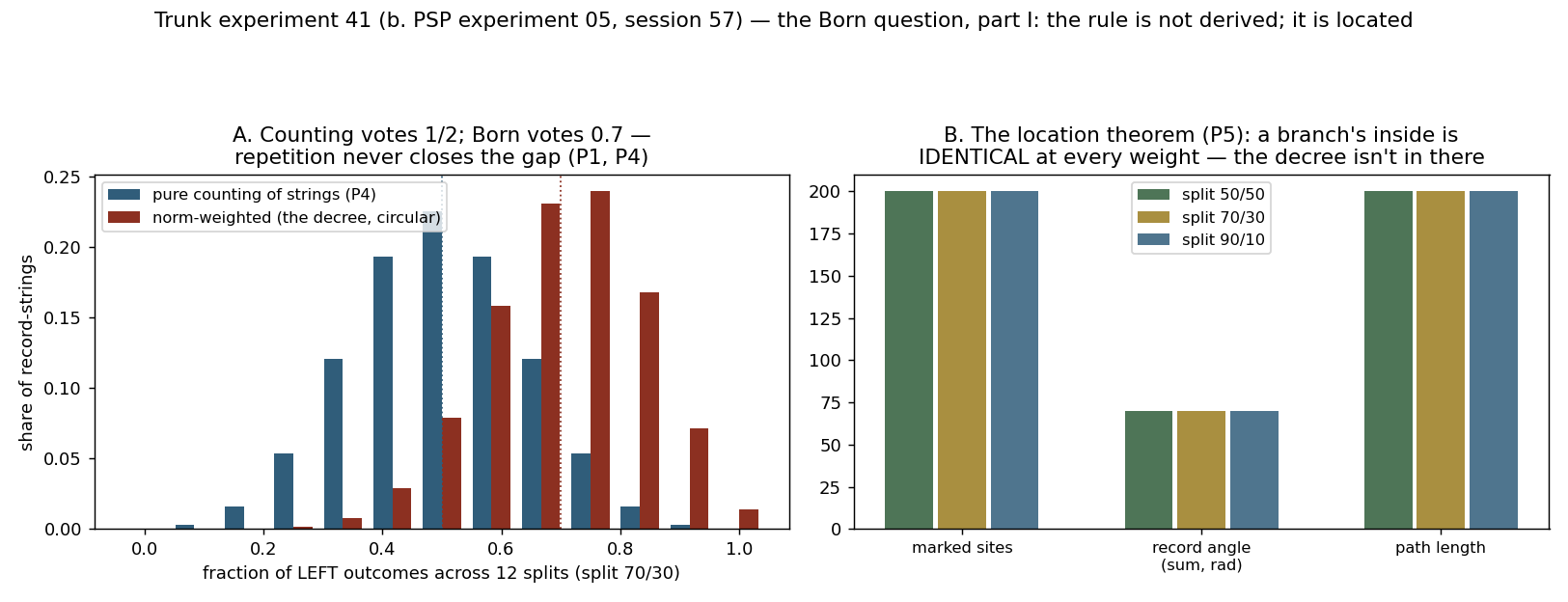
42_the_continuum_asymmetry
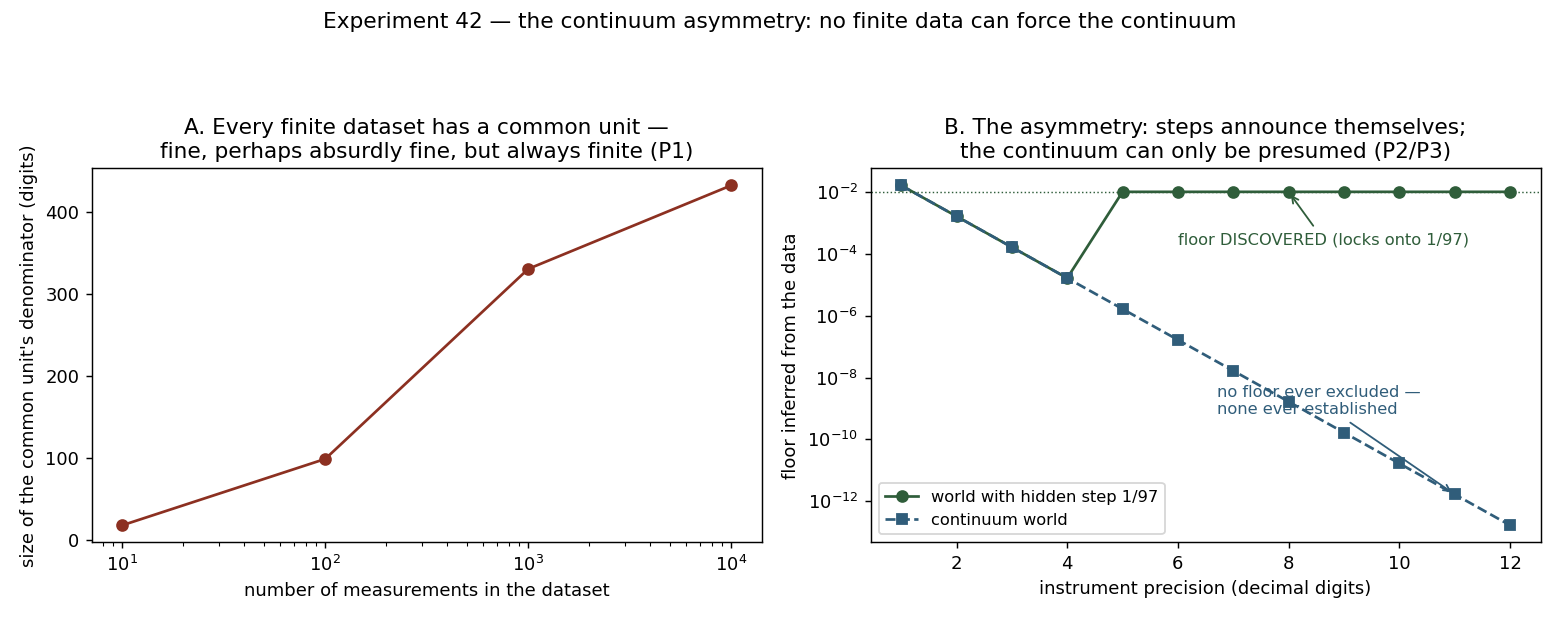
43_dimension_from_folding
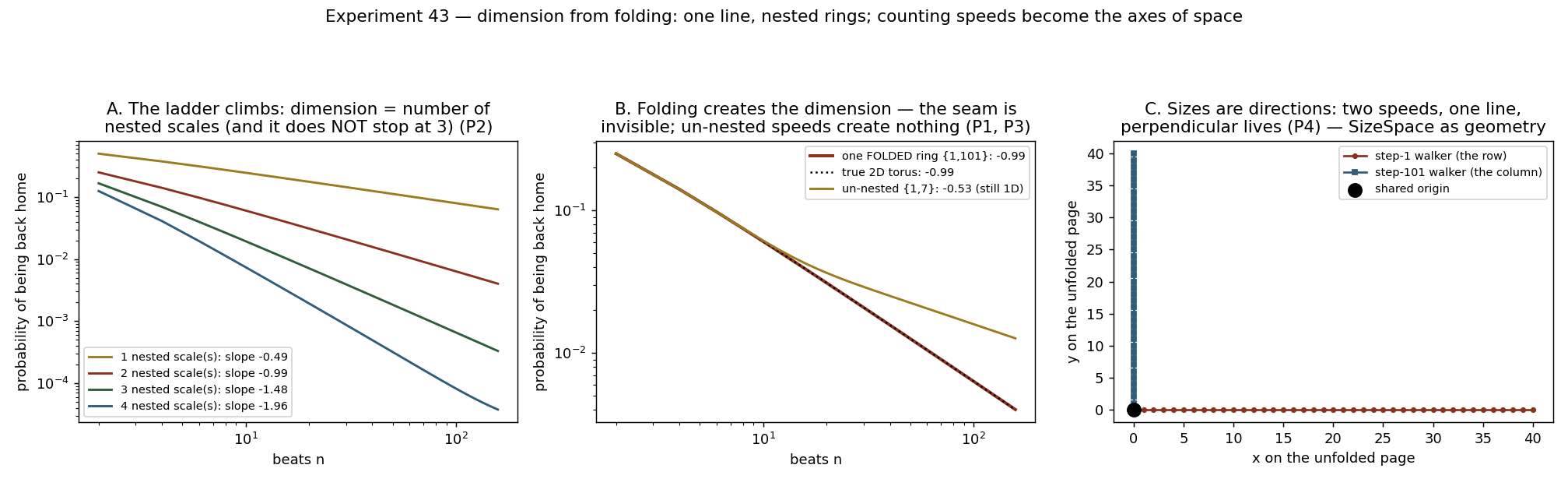
44_bending_paths
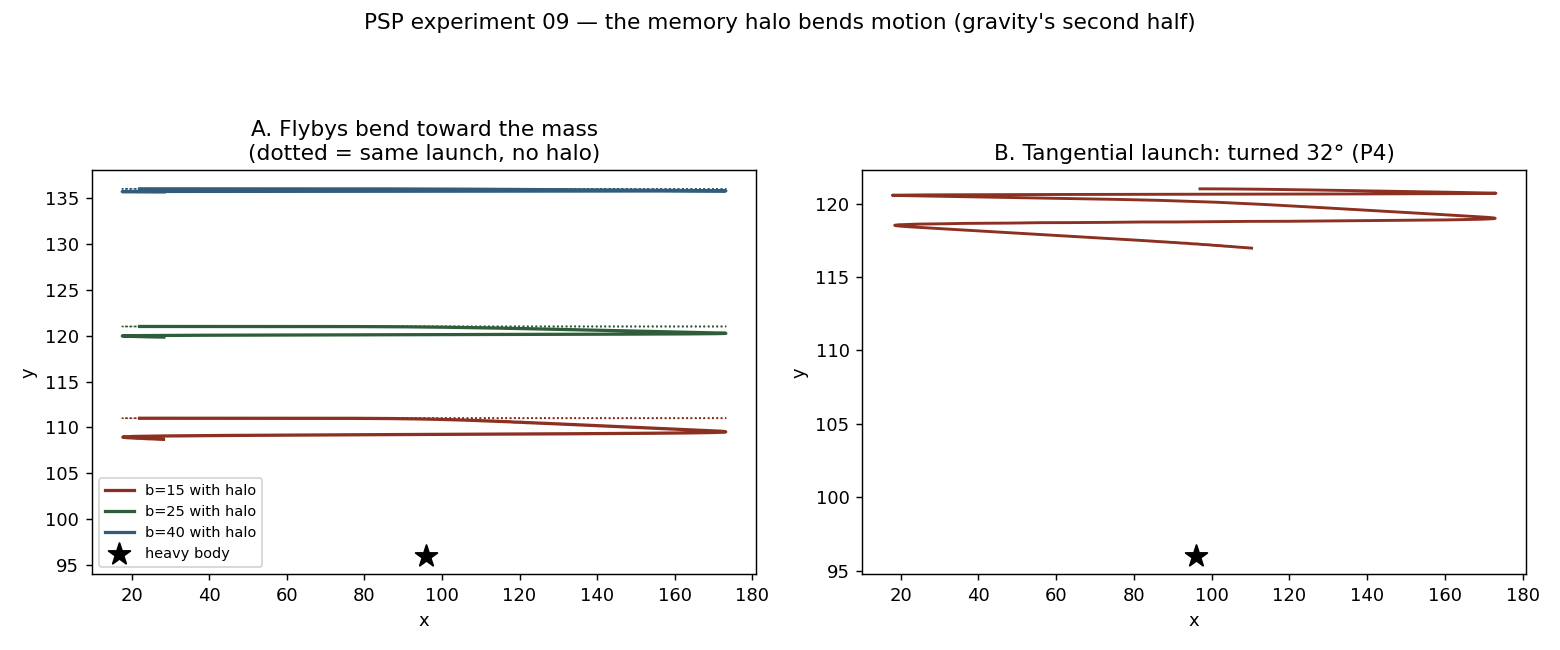
45_orbits
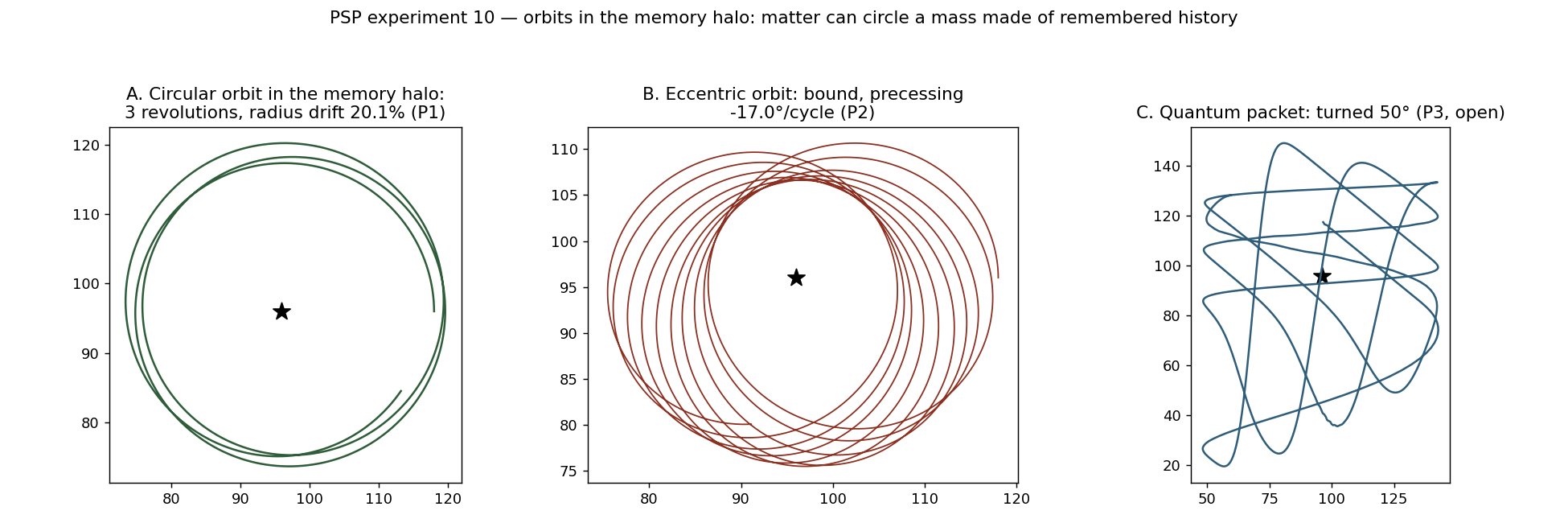
46_two_bodies
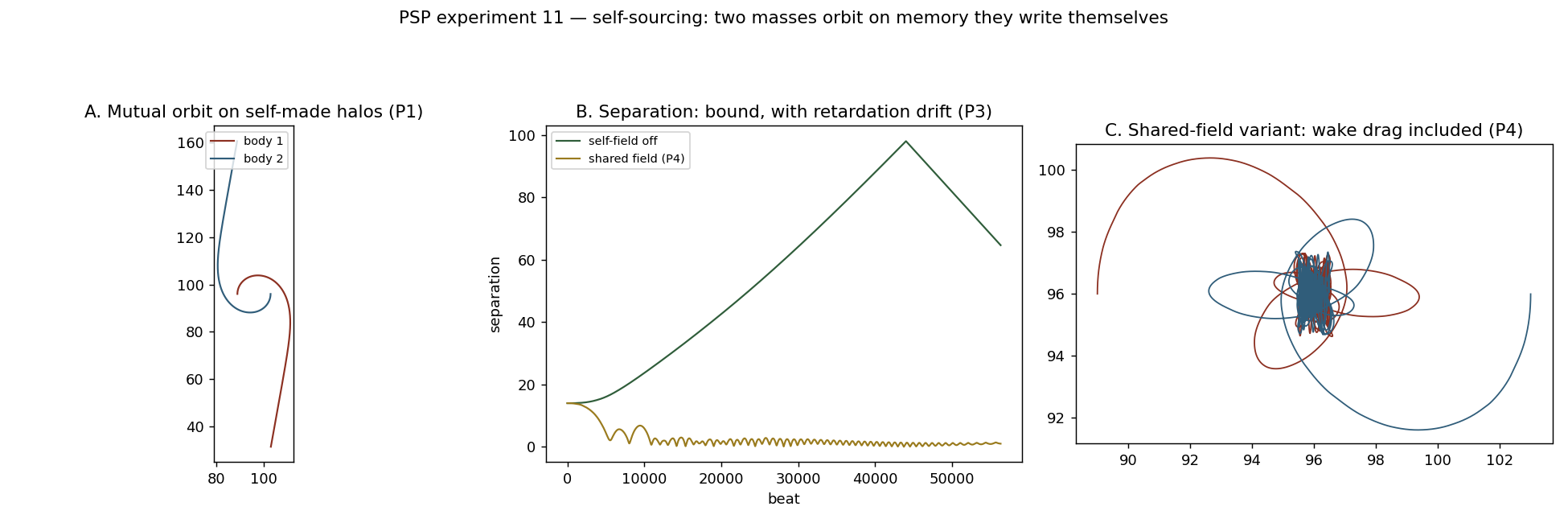
47_what_is_a_mark
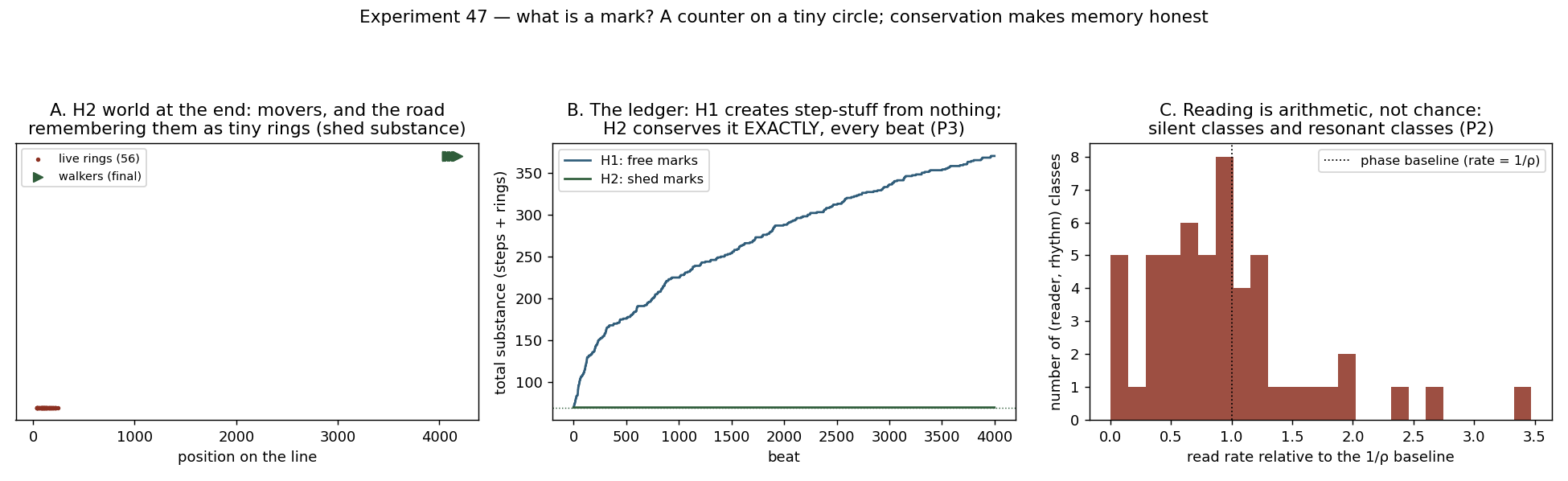
48_the_cooling
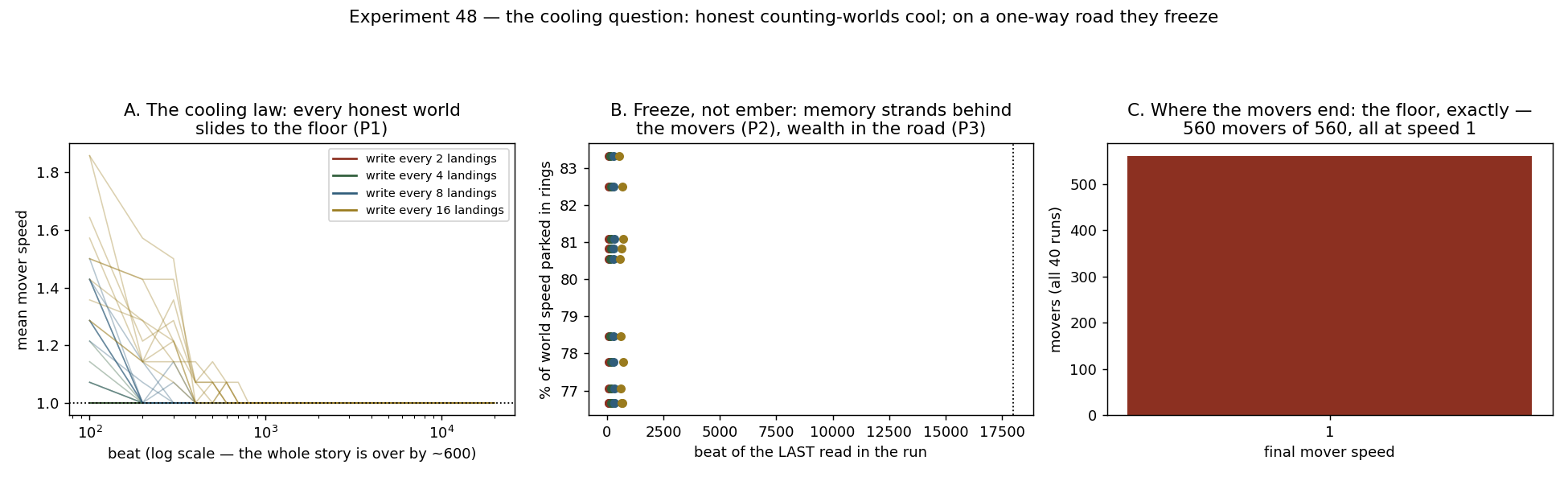
49_worlds_that_touch
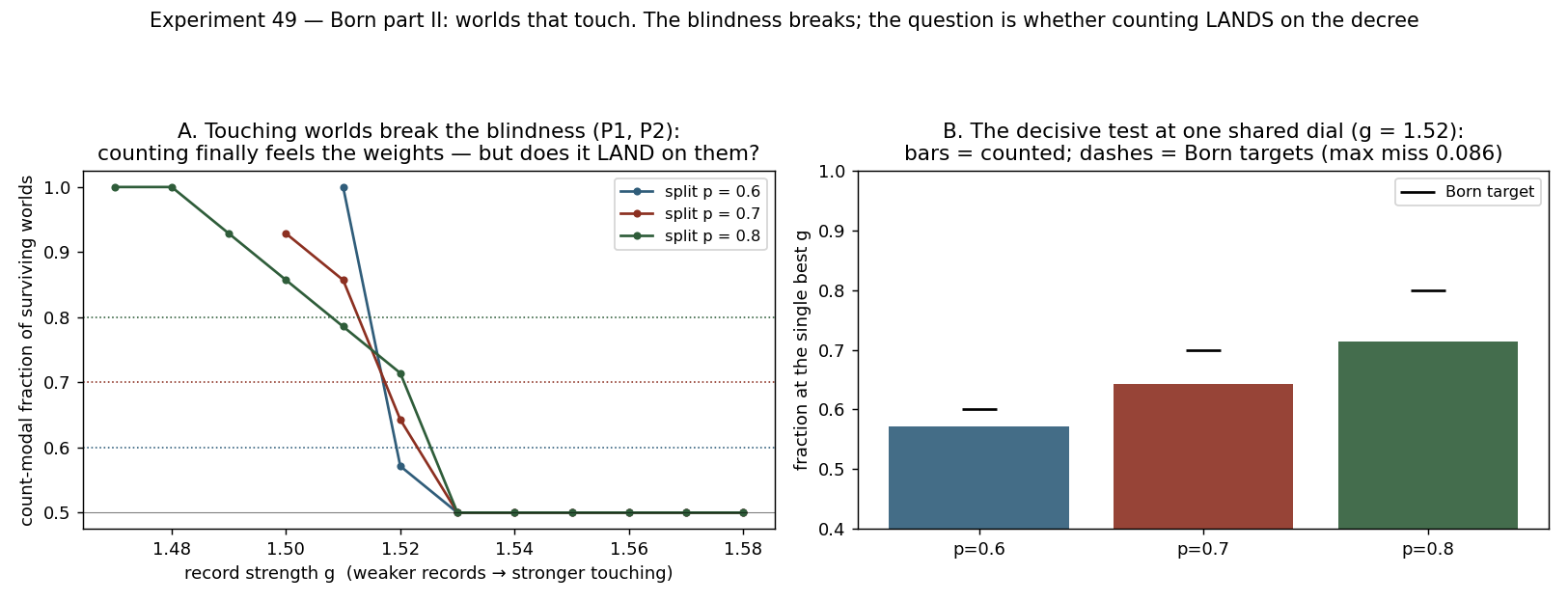
PART XI — BIBLIOGRAPHY
Every external reference used anywhere in the program, consolidated, with where-we-use-it notes.
BIBLIOGRAPHY — consolidated references of the counting-world program
Every external work cited anywhere in the program (documents and script headers), gathered once, with where-we-use-it notes. Assembled session 55.
Foundations of relativity and constants
- W. von Ignatowsky (1910), Einige allgemeine Bemerkungen über das Relativitätsprinzip — the trichotomy of kinematics from the relativity principle alone. Used: Theorem 18, Finding 44, script 39.
- J.-M. Lévy-Leblond (1976), "One more derivation of the Lorentz transformation," Am. J. Phys. 44, 271. Used: Theorem 18 lineage.
- J.-M. Lévy-Leblond (1977), "On the conceptual nature of the physical constants," Riv. Nuovo Cim. 7, 187. Used: Finding 45, Theorem 19.
- N. D. Mermin (1984), "Relativity without light," Am. J. Phys. 52, 119. Used: Theorem 18 lineage.
- E. F. Taylor & J. A. Wheeler, Spacetime Physics (the surveyor parable). Used: c-as-unit-conversion reading, Finding 44.
- M. J. Duff, L. B. Okun, G. Veneziano (2002), "Trialogue on the number of fundamental constants," JHEP 03, 023; arXiv:physics/0110060. Used: Finding 45's ledger ("counting votes one").
- M. Planck (1899), natural units. Used: Finding 45 lineage.
- A. Einstein (1905; 1915–16), special/general relativity; the point-coincidence argument. Used: throughout; FINDINGS anchors.
- H. Bondi, k-calculus. Used: Finding 15 (multiplicative composition).
- S. Coleman & S. L. Glashow (1999), "High-energy tests of Lorentz invariance," PRD 59, 116008. Used: Finding 24's beat ceiling, script 20.
Quantum foundations and the walk
- L. de Broglie (1924), thesis — the internal clock, phase counting. Used: Findings 23, 45; Theorem 19.
- S.-Y. Lan et al. (2013), "A clock directly linking time to a particle's mass," Science 339, 554 — the Compton clock, mass as tick rate. Used: AXIOMS' time-as-count anchor, Finding 30d.
- R. P. Feynman & A. R. Hibbs (1965), Quantum Mechanics and Path Integrals — the checkerboard. Used: the walk sector's mathematics, Finding 23, Theorem 14.
- D. A. Meyer (1996), "From quantum cellular automata to quantum lattice gases," J. Stat. Phys. 85, 551 — the scalar-walk no-go. Used: Finding 25 (spin-1/2 forced), Theorem 14.
- I. Białynicki-Birula (1994), "Weyl, Dirac, and Maxwell equations on a lattice," PRD 49, 6920. Used: walk lineage.
- E. C. G. Stueckelberg (1960), real-Hilbert-space quantum mechanics. Used: Finding 29 (why-complex).
- W. K. Wootters (1990), local accessibility of quantum states. Used: Finding 29 (the ledger argument).
- L. Hardy (2001), "Quantum theory from five reasonable axioms," arXiv:quant-ph/0101012. Used: Finding 29.
- G. Chiribella, G. M. D'Ariano, P. Perinotti (2011), informational derivation of quantum theory, PRA 84, 012311. Used: Finding 29.
- M.-O. Renou et al. (2021), "Quantum theory based on real numbers can be experimentally falsified," Nature 600, 625. Used: Finding 29's experimental anchor.
- P. W. Anderson (1958), "Absence of diffusion in certain random lattices," Phys. Rev. 109, 1492. Used: Findings 28, 40 (localization).
- J. S. Bell (1964); CHSH (1969); B. Tsirelson (1980) — the inequality, its experimental form, the quantum ceiling. Used: Finding 37, script 32.
Astrophysical confrontations
- E. S. Perlman, Y. J. Ng, D. J. E. Floyd, W. A. Christiansen (2011), "Using observations of distant quasars to constrain quantum gravity," Astron. Astrophys. 535, L9; arXiv:1110.4986. Used: script 23's premise (Finding 27).
- E. S. Perlman et al. (2015), "New constraints on quantum gravity from X-ray and gamma-ray observations," ApJ 805, 10; arXiv:1411.7262. Used: Finding 41's method and validation, script 36.
- E. S. Perlman et al. (2016), "New constraints on quantum foam models...," arXiv:1607.08551. Used: Finding 41 (α-limits, the Strehl criterion, the "averaged spacetime" caveat).
- Y. Chen, L. Wen, Y. Ma (2014), "Photons with sub-Planckian energy cannot efficiently probe space-time foam," PRD 90, 063011; arXiv:1504.07509 (posted 2015). Used: Finding 33a's λ⁻² caveat.
- R. Lieu & L. W. Hillman (2003), ApJL 585, L77; R. Ragazzoni et al. (2003), ApJL 587, L1 — the original phase-coherence tests. Used: script 23's premise (Finding 27); Finding 41 lineage.
- A. A. Abdo et al. (2009), "A limit on the variation of the speed of light arising from quantum gravity effects," Nature 462, 331 — GRB 090510, the 1.19 E_Pl record. Used: Finding 43 validation, script 38.
- A. A. Abdo et al. (2009), Science 323, 1688 — GRB 080916C. Used: script 38's burst table.
- M. Ackermann et al. (2014), Science 343, 42 — GRB 130427A (95 GeV). Used: script 38's burst table.
- J. M. Ellis et al. (2006), Astropart. Phys. 25, 402 — 35-GRB drift stack. Used: Finding 43 (prior-art hedge).
- V. Vasileiou et al. (2013), PRD 87, 122001 — multi-burst Fermi LIV limits. Used: Finding 43 (drift-stack prior art).
- V. Vasileiou et al. (2015), "A Planck-scale limit on spacetime fuzziness and stochastic Lorentz invariance violation," Nat. Phys. 11, 344. Used: Finding 43 (nearest stochastic neighbor).
- LHAASO Collaboration (2023), Science 380, 1390 — GRB 221009A TeV photons. Used: Findings 41/43, scripts 36/38.
- Y. Piran-group / H. Li et al. (2024), "Lorentz invariance violation limits from GRB 221009A," PRD 109, L081501; arXiv:2308.03031. Used: Finding 43 (published drift record E_QG,1 > 5.9 E_Pl).
- U. Jacob & T. Piran (2008), "Lorentz-violation-induced arrival delays of cosmological particles," JCAP 01, 031. Used: script 38's time-of-flight formula.
- UHECR/Auger spectrum data via the Coleman–Glashow bound δ < 5×10⁻²³. Used: Finding 24, script 20.
Collider confrontation
- ATLAS Collaboration (2022), "A detailed map of Higgs boson interactions ...," Nature 607, 52; arXiv:2207.00092 — κ_V = 1.035 ± 0.031, κ_F = 0.95 ± 0.05, ρ = +0.39. Used: Finding 42, script 37.
- CERN Yellow Report (2019), "Higgs physics at the HL-LHC and HE-LHC," arXiv:1902.10229 — projected coupling precisions. Used: Finding 42d.
- K. Agashe, R. Contino, A. Pomarol (2005), "The minimal composite Higgs model," Nucl. Phys. B 719, 165 — MCHM4/5 coupling curves. Used: Finding 42, script 37.
Genre and methods
- J. Conway (1970), the Game of Life — the genre's founding legend. Used: FINDINGS anchors, monograph §9.
- Bounded-confidence opinion dynamics; sampling/aliasing theory; KAM and mode-locking theory — named as known-mathematics anchors in monograph §9 and FINDINGS' "Anchors in existing science."
- L. Nottale (scale relativity); J. Barbour (time as change) — kinship programs, cited as orientation, not authority.
Entries are as cited in the program's documents and script headers; where a document gave only partial bibliographic detail, the entry above carries the fullest form used anywhere in the corpus.
PART XII — THE COMPANION
The whole theory again, told start to finish in Levan's logic, his order, his words — composed one approved thought at a time with the record as referee (rules in PSP/CLAUDE.md). Companion experiment numbering maps to record scripts: PSP-01→42, 02→47, 03→48, 05→41, 06→49, 08→43, 09→44, 10→45, 11→46; PSP-04 (the ember) is reserved, queued.
PSP — Proportional Stepwise Progression
Levan Bakhia, with Claude as referee — started 2026-07-10.
This document is built one thought at a time, in my logic and my
language. Every claim carries a mark: ✓ the checked record confirms it,
✗ the record corrects it (and the note says how), ○ open — untested, or
philosophy. The rules of the room are in CLAUDE.md beside this file.
1. The question: what is truly a size?
Every idea in this document grows from one question, asked plainly: what is truly a size?
We think we know. A meter, a centimeter. But look closer and the ground gives way: a meter is not a thing in the world. It is a comparison — an agreement about proportion. No object carries its size as a private property; it carries only its relations to other objects. I am proportional to this house. The leaf is proportional to my hand. Follow this honestly and you arrive at a radical simplification: everything that exists is proportion. Space itself — distance, nearness, the whole three-dimensional world — can be built out of proportion alone, and nothing goes missing. A world made only of proportions needs no ruler, because there is nothing a ruler could add.
✓ The record confirms this — all the way down. What any observer in the counting world can even see of another is a proportion (Finding 1); two worlds that differ in everything except their proportions are indistinguishable from inside (Finding 2); rescale the whole world together with its observer and nothing observable changes at all (Theorem 9). Pushed to the very end, the same idea reaches physics' own constants: the speed of light and Planck's constant turn out to be exchange rates between human units — like meter to centimeter — not facts about light or quanta (Theorems 18–19).
Then when does size appear at all? Only when there are two worlds to compare. Imagine world number one and world number two, identical in every proportion — two frames of a film. In the first frame my hand is down; in the second it is up. If reality is one space, where does that difference live? I picture a larger container, in which frame one and frame two of the whole world differ in exactly one way: size. From outside, every proportion is unchanged; only the smallest unit that builds everything has grown. And that is what time is. Time is not a road the world travels down. Time is the growing of the unit, frame by frame.
Picture the whole world as balls on a shelf — each ball one frame, each slightly larger than the last, and inside each the world arranged a little differently: hand down in this one, hand up in the next. Now walk along the shelf with a camera that grows with the balls, locked to the proportion. The growth vanishes from view — locked to proportion, every ball looks the same size — and what remains visible is the difference between them: the hand lifting. That is the animation. The growing of the unit is what strings the frames apart; the camera's lock on proportion is why we never see the growing, only the motion.
✓○ The record gives this picture the strongest status logic allows. The counting book and the spacetime book produce identical numbers for every observable — proven (Theorem 16). So this picture can never be proven right, and never proven wrong, by anyone, ever — that impossibility is itself one of our theorems. What tips the scales is economy (Theorem 17): this reading needs fewer assumptions, because time never has to be assumed as a dimension — it is bookkeeping of the count.
This also says what measurement really is. Whenever we measure anything, we count how often against how often — frequency against frequency. Frequency is the proportion, and it is the real thing; size is only the label we invent so one frame can be told from another. Take away the comparison, and the frames collapse into sameness.
✓ Confirmed in the model: what observers measure composes like frequency ratios — by multiplication, not addition (Finding 15). Proportion again.
One more consequence, and the boldest. If size is the container of space, then the dimensions form a ladder. At the bottom, a point: the dimension where the barest binary lives — nothingness, on or off. Points live in a line; lines live in a plane; planes live in space; and space lives in size. And there the ladder ends — not from lack of imagination, but from lack of anything left to contain: there is nothing to put size into. If that is right, it answers a question physics rarely thinks to ask — not why the world has the dimensions it has, but why the tower of dimensions stops at all.
○ Open — filed as a named conjecture on the record's frontier, right behind the Born rule. The record proves much less so far: at least two dimensions, at least three with borrowed theory, and "why exactly three" stands as the program's hardest open question. The ladder is not yet a theorem — the first task is to say precisely what "a dimension of X" means, so the claim can be attacked. If it survives, it answers why the tower of dimensions stops.
2. The game: counting, and nothing else
Before anything can be claimed, the ground must be honest. This document does not begin with the world. Not with space, not with matter, not with physics — not even with mathematics as usually taught. It begins with one activity, the simplest that exists: counting. Everything that follows will be built from counting and from nothing else — and whatever appears in these pages later (space, time, matter, motion) must be earned from counting, or not claimed at all.
✓ This is exactly the discipline of the checked record. Its entire working model is six axioms, every one of them a statement about counting — and its one standing rule is that nothing may be smuggled in: whatever was not earned from the axioms had to be declared imported, or die.
So the first words must be defined, and there are only two.
A step is a step. A step is the act of counting once: one, then two, then three. Steps come whole — you take a step or you don't; there is no half-taking. A step is not a distance, not a duration, not a movement through anything. It is the bare event of the count advancing.
A step is a step for everyone. Counting is not private. When the count advances, it advances for all that counts — one shared beat, like a music the whole world keeps. Nobody experiences a fraction of a step, and nobody skips one: from inside, a step always feels like exactly one step.
✓ Confirmed — with the record's honest scope. "A step is a step; steps are counted in whole numbers; there is no step below 1" stands verbatim among the vindicated founding claims. The shared beat survives in its careful form (axiom A2): from inside the world, only ratios of counting rates are ever observable — the beat is bookkeeping, and its known leaks are suppressed beyond any achievable measurement.
These are the rules of the game, and they fit in three short sentences: the world counts; a step is whole; a step is a step for everyone. Everything else in this document has to be earned.
3. One: the proportion that cannot break
The first act of counting is not counting something. It is the count meeting itself: one against one. 1/1 = 1. This looks like the emptiest statement in mathematics, and it is the opposite — it is the first proportion, the ground on which every other proportion stands. Chapter 1 said everything that exists is proportion; here is the proportion that exists before everything.
Why this one? Look at what other proportions are made of. Five against five is also one — but it is a built one: a pole assembled from five parts. It is whole, and it can break. And five against three? Notice something first: five against three and three against five are not two proportions — they are one relationship seen from its two ends. From one end there is excess: more held against less, overfull, stiff — the kind of tension that snaps. From the other end there is shortfall — slack in it, the kind that bends. Every proportion between unequal counts has these two unequal faces, a rigid one and a flexible one, depending on where you stand. Only one against one is the same from both ends. It is the one proportion that is its own reflection: turn it around and nothing changes. Nothing asymmetric to lean, nothing composite to come apart: 1/1 does not bend and cannot break. It is the most stable structure there is — and that stability is why it can carry a world.
○ Yours — kept, with one true mathematical fact and two rhymes standing under it. The fact: 1 is the only proportion equal to its own reverse (if a ratio equals its flipped self, it can only be one). The first rhyme, measured: every relationship in the counting world really does come as a reciprocal pair — one side reads it as more-than-one, the other as less-than-one (Finding 15); only 1/1 reads the same from both sides. The second rhyme: in the model every composite thing can break apart — clumps split, compounds dissolve — while the unit alone cannot, and needs no protection: "the unit rules by being the unit, not by being a wall."
And the unit cannot be divided — not because something forbids the knife, but because the knife has nothing to cut. Try it: take what you call a half step. The moment you take it, that half is the step. You have not divided the unit — you have re-chosen it: named a smaller thing "one" and started counting again. Division never breaks the floor; it only moves the name. What looks like cutting the world is only re-deciding what to call one.
✓ A vindicated founding axiom. "1 is the smallest indivisible unit" and "every number is just a count of how many ones" stand among the founding claims the mature program later proved out — surviving as axiom A1, whose full statement already contains this chapter's equation: all quantities are counts of the unit and ratios of counts, 1/1 = 1.
Once the floor exists, everything above it becomes a count. A quantity is not an amount of stuff; it is a number of steps. Five is five ones. A ratio is a count against a count. The world does not measure — the world counts. And I will say one thing more, beyond physics: I believe mathematics itself should be built this way — with 1 as its base unit, counting up, never dividing down. Without the indivisible one at the bottom, I do not think mathematics makes sense.
○✗ Yours — and here the record draws its line, visibly. The excavation judged the physics reading of this claim confirmed (1 as the operational ground of measurement — what a measurement can mean), but the mathematical reading only transformed: the record explicitly does not claim standard continuum mathematics is wrong. And the boldest hope once attached to it — that basing everything on 1 would cure physics' infinities — was tested and refuted: the counting version of the vacuum-energy sum reproduces the famous discrepancy rather than repairing it. The corpse is on display, as always. The claim above stays in this document as its author's philosophical position, so marked.
Now set the two pillars side by side, because together they are the whole foundation. Size is arbitrary: call the unit a meter or a centimeter, and every proportion stays — nothing observable changes (Chapter 1). But the unit is not arbitrary: there must be a one, or nothing is a count at all. Nothing has a size; everything has a count. And the record's deepest sentence about relativity is exactly this pair: relativity exists because size is arbitrary — and the step is not. Forced, not found (Theorem 18).
One last thing about the step, and it is the strangest. In a world where every size dissolved into proportion, exactly one size survives with meaning: the size of the step itself. Real telescopes and real cosmic rays already bound it from above — two ceilings, reached by completely different physics, converging. Whether our own universe truly counts is open, falsifiable, and so far undefeated.
○ Layer 3 — the open fight. The step's duration is bounded: shorter than 7×10⁻³⁶ seconds (from the fastest cosmic-ray protons) and shorter than 4.9×10⁻³⁶ seconds (from the sharpness of starlight after billions of years of flight). The Planck beat sits 7–8 orders below both ceilings — alive and silent. Everything else in physics turned out to be an exchange rate. The step is the one thing left that is truly some size — and nobody knows what size.
4. No one has ever seen the continuum
Now I will make the accusation this whole document has been building toward. Infinite division is the great error — not an error of mathematics, but an error in how mathematics is used. Mathematics is free to play its own games; inside mathematics, dividing forever is legal, a gimmick that makes some calculations easier. The error begins at the border: the moment you use infinitely-divisible mathematics to measure anything that exists — the physical world, a physical structure, even an existing abstract thing. Whatever exists is measured by counting, and counting has a floor. Use the gimmick on reality, and the gimmick breaks things.
Before you dismiss this, notice that mathematics itself secretly agrees — twice.
First: mathematics is already built from 1. In the official foundation of arithmetic, every whole number is constructed from the unit by one operation — count one more. Two is defined as one-more-than-one. Five is five ones; there is no independent "five" that exists apart from being five ones. There cannot be 2 if there is not 1. One of history's great mathematicians, Kronecker, said it plainly: "God made the integers; all else is the work of man."
✓ Established mathematics — this is the Peano construction, the floor of the official building, in every foundations textbook. The position that mathematics should stop there has a name and a lineage (finitism). Note the difference, though: finitism bans the infinite games outright; this document only bans mistaking the games for the world.
Second, and better: mathematics never actually divides the one. Watch how fractions are officially constructed: a fraction is defined as a pair of whole numbers. 0.7 is not a wounded one — it is literally the pair (7 against 10): seven counts held against ten counts. In the formal construction, no object smaller than the unit is ever produced by division. Fractions are built by pairing counts — which is to say: a fraction is officially a proportion, not a piece. The cutting-the-pie picture that school teaches is an illustration; the machinery underneath is pure counting. So the question "0.7 of what?" has an exact answer: there must be a 1, and 0.7 is seven counts of its tenth — the unit re-chosen, never broken. The knife from Chapter 3, again: division is re-deciding what to call one.
✓ Established mathematics — the standard construction of the rational numbers as pairs of counts. The "cutting" is interpretation; the definition is proportion.
And my bigger apple from Chapter 3 sharpens into a claim: 1 + 1 = 2 can be read as two apples — or as one bigger apple, one "2," a fused unit. Inside arithmetic, these two readings produce identical numbers everywhere and can never be told apart. The choice of unit is invisible from within. This is the same undecidability the record proved for time and the size register — appearing inside mathematics itself.
✓ Demonstrated (PSP experiment 01, part 3): the same world counted in ones and counted in twos produced identical observable ratios — thirty-six of thirty-six. "Two ones" and "one two" cannot be distinguished by any proportion.
So the continuum cannot be told from inside. The next question is the decisive one: could it at least be measured? Could any data ever force us to believe in infinite division? We tested it — and since this document must be understandable to its author, here is exactly what we did, in plain words.
What we did, what we checked, and how (PSP experiment 01).
Part one — can data ever demand the continuum? We invented ten thousand measurements. The quantities being measured were drawn from a perfectly smooth continuum — the most hostile possible source for my claim. But the measuring was honest: a thousand different imaginary instruments, and each instrument can only do what every real instrument does — count ticks. One device counts in 17ths, another in 356ths, another in 999ths. Then we checked, with schoolbook arithmetic: is there one common tiny unit that measures all ten thousand results evenly, nothing left over? (How: collect every instrument's tick size and compute their common denominator — a gigantic number, hundreds of digits, but a finite one.) The answer: yes — always, exactly, remainder zero. Even data born in a continuum never contains the continuum. Infinite division is never in the measurements; it is added afterward, by belief.
Part two — the asymmetry. We built two toy worlds. World A has a secret
smallest step: every quantity in it is a whole number of steps of size
1/97 — a number chosen to be nothing special. World B is genuinely
smooth. We then measured both worlds with instruments of growing
fineness — one digit of precision, two digits, three, up to twelve — and
at every stage asked: what floor does the data itself suggest? (How: take
the smallest gap between measured values as a first guess at the step;
refine the guess against all the data; then — the crucial rule — certify
it only if two independent instruments with different tick sizes
agree.) The result is the picture beside this chapter
(figures/01_common_unit.png): World A's floor was discovered — at
five digits of precision the data locked onto 1/97 and never moved again,
no matter how much finer the instruments became. World B's supposed floor
just followed the instrument downward, ten times smaller with every
digit, forever — announcing nothing.
Steps announce themselves. The continuum never does. A stepwise world is a findable fact; a continuum world is only ever a presumption. The burden of proof — which everyone assumes lies on whoever doubts the continuum — actually lies on whoever asserts it.
✓ Proven and demonstrated (PSP experiment 01, parts 1–2): all four pre-registered predictions confirmed. And three failed measuring instruments are kept in the experiment's file with their autopsies, each with its moral: the first measured its own noise; the second measured its own ruler — one instrument alone can only ever certify the echoes of its own grid (the aliasing law of Chapter 1, biting the auditor); the third showed a guessed floor is worthless — hypotheses must be derived from the data and refined, because a floor guessed 0.1% wrong drifts a full step of error across a thousand steps. A floor is certified only by independent instruments agreeing. Failures on display, the house way.
Where does this leave the claim that the gimmick breaks things? On real ground, with one honest boundary. The famous infinities of physics — the vacuum-energy catastrophe, the divergences that plague field theory — arise exactly at this border: calculations that trust the continuum down to infinitely small pieces. And mainstream physics already patches them by quietly installing a floor (a "cutoff") and admitting the continuum below it is not to be trusted. The breakage is real, and the repair everyone actually uses is the floor.
✗ But the corpse stays on display. The founding hope that counting would compute the right answers where the continuum fails — fix the infamous vacuum-energy number, tame the divergent sums — was tested and refuted: the counting version reproduces the discrepancy rather than repairing it. The honest claim is smaller and still large: the floor un-asks the broken questions. It does not answer them.
And whether our own universe has the floor — that is the open fight, the one worth a lifetime.
○ Layer 3, standing. The step of our world, if it exists, is already bounded from above by two independent ceilings (Chapter 3). Its fingerprints are filed in advance. Nothing found yet; nothing excluded yet — and by this chapter's asymmetry, only one of the two hypotheses can ever be found.
So I end the accusation where the experiment left it. The question was never "can you prove the world is stepwise?" The question is the reverse: why do you believe in the continuum — which no one has ever seen, and no one ever could?
5. Distance, speed, and time — before there is a world
Now an experiment in pure thought. Take a proportion and watch it through the steps — a value z at step n, built from a count a held against a count b. Nothing else. No space, no clocks, no world. Just a proportion, stepping.
Three things can happen.
First: a equals b, always. Then z is 1 at every step — at step one, at step fifteen, at step a million. 1/1, 5/5, it does not matter: z = 1, forever. Nothing happens. And "nothing happens" is not a failure of the case — it is a concept being born. This is rest. This is what it means for something simply to be. And look at which proportion is doing the being: one against one — the unbreakable One of Chapter 3. The proportion that cannot bend or break is exactly the state in which nothing changes. Identity and stability are the same object.
Second: the top grows with the steps. Now z climbs: 1, 2, 3, 4… a progression. And inside this bare climb, three concepts appear that nobody put there:
- Distance. Between the value 2 and the value 8 there is a separation: 6, counted in true units. Between 5 and 15: 10.
- Speed. How much the count advances per step — the size of the step. Speed with no kilometers and no hours: pure rate of counting.
- Time. How many steps it took to get there — the duration, as a count.
And the three are locked together by nothing but multiplication: from 5 to 15 the distance is 10; if the step is 5, the time is 2. Ten equals five times two. The physicist's most basic law — distance equals speed times time — is sitting inside whole-number arithmetic, before there is any world for it to be a law of.
✓ This is the record's kinematic floor, exactly. Its counters are this progression made literal: a counter of step S has, after n beats, the count S·n — speed is the step size, time is the beat count, distance is the difference of counts. And it is a filed finding that "space is a picture of counting" (Finding 4): the spacetime diagrams physicists draw are redrawings of exactly this progression. Distance, speed, and time from pure counting is not a hope of this document; it is proven ground.
Third: the bottom grows with the steps. Then z shrinks: 1, ½, ⅓, ¼… And this case is not new — you have met it twice. It is the growing unit of Chapter 1: watch the world while the unit that builds it grows, and everything shrinks in exactly this way. And it is the second face of Chapter 3: the climb and the shrink are one relationship seen from its two ends — from outside, the thing grows; from the thing's own point of view, everything else shrinks. Frames on a shelf, reciprocal faces, and motion: one picture.
Now the deepest thing in this chapter. Ask: when are time and distance equal? From 5 to 15, distance is 10 but time can be 2, or 5, or 10 — they differ. They coincide in exactly one case: when the step size is one. For the unit-stepper, and only for it, the count of steps taken and the count of ground covered are the same number, always.
Hold that, and recall who the unit-stepper already is. Chapter 4's law crowned it the all-toucher — the only counter that can visit every place in the world. Now this chapter crowns it again: the thing whose time equals its distance. In real physics there is exactly one entity with both credentials — it touches everything, and its elapsed time equals its traveled distance (that equality is what physicists mean when they set c = 1). Its name is light. We found light twice, from two different directions, without ever looking for it.
✓ Confirmed on both counts. The visibility law gives the unit-stepper access to every landing place of every counter (Finding 1). And the famous number 299,792,458 meters per second is, by the record's exchange-rate theorems (18–19), nothing but the conversion rate between the second-count and the meter-count — Chapter 1's meter-and-centimeter thought, closed into a loop. Measured in counting's own units, light's speed is the number one: time and distance in lockstep.
One step remains, and it is the step where relativity enters — I will only point at it here. In this chapter, time meant the outside count: total beats, as tallied by us, the bookkeepers. But a counter inside the world cannot see our tally. It measures time with the only thing it has — its own counts. And the gap between beat-time and lived-time is precisely where the strange clocks of relativity live.
✓ And the record holds a vindicated correction here. The founding notes first guessed the naive ratio (a counter of step S lives 1/S of the moments) — and later corrected themselves: the naive ratio is NOT the true time dilation; the square-root budget is. The excavation lists that self-correction among the founding record's confirmed sightings, proven years later by the circle of Finding 23. The doorway this chapter stops at is the doorway the rest of the record walks through.
6. Time from the inside
In Chapter 5, who was counting the steps? We were. We watched from outside, like readers holding the whole shelf of frames, and we could see the world's beat: tick, tick, tick. "Time is the number of steps" meant our tally — the bookkeeper's time.
But a counter lives inside the world. There is no clock on the wall of the universe; the world's beat cannot be seen from within it. The only clock any inhabitant can ever have is its own counting. Your steps are your seconds. Your heartbeats are your hours.
So run the story. Two counters travel from 0 to 60:
- Anna counts in ones: 1, 2, 3, … 60. The journey takes her sixty of her own steps.
- Boris counts in fives: 5, 10, 15, … 60. The same journey takes him twelve of his own steps.
Same road, same start, same end — and Anna's life contained sixty moments along the way, while Boris's contained twelve. Now the strange part: both feel completely normal. A step is a step, for everyone — the rule of Chapter 2. Anna does not feel slow; Boris does not feel fast; each just counts "one, two, three…" of their own steps and feels ordinary. Boris cannot even know he is "a five": from inside, there is no way to feel your own size. Size becomes knowable only by comparison — proportion again, Chapter 1's camera now lived in rather than looked at.
So from counting alone — no rockets, no light-beams, no physics — we have: the same journey holds different amounts of lived time for different travelers, and every traveler feels normal. That is the seed of the famous strangeness of relativity, sitting in bare arithmetic.
And the base counter gives everyone a common measure. The unit-stepper — already crowned twice, as the all-toucher and as the thing whose time equals its distance — is the natural yardstick: Boris advances five base steps per step of his own, Anna one. Every pace in the world can be stated against the finest pace, the way every real velocity can be stated against light's.
✓ Run and measured (the record's Experiment 11, pre-registered; Finding 15). Observers using only their own counts and the marks they find measure each other's rates as exact proportions — and the proportions compose by MULTIPLICATION, precisely the grammar of real relativity's honest bookkeeping (Bondi's k-calculus, where Doppler factors also multiply). Confirmed exactly, all four pre-registered expectations.
With the record's honesty attached, both ways. First: this simple world also shows one anti-relativistic signature — Anna sees Boris slowed while Boris sees Anna sped up (one up, one down), whereas real relativity has each seeing the OTHER slowed. The record measured that gap and named its cause: the shared beat betrays itself. In the model's richer sector (the complex step, far ahead of this chapter), the gap closes and the textbook formulas emerge to three and four decimals — time dilation, E = γm, velocity addition, the twins. Second: the base counter's trail actually hands every inhabitant a way to detect its own pace — a universal background reference, which strict relativity forbids; and yet real physics carries an eerie cousin of it (the cosmic background glow, against which our own galaxy's motion is in fact measured). Doorways, not failures — and all of them measured, named, and kept.
Notice, finally, what this chapter did not need: no marks, no memory, no matter, no world. The strange clocks of relativity begin in counting alone.
7. The world of strangers, and the door that opens
Take stock of what we own. Motion, distance, speed, two kinds of time, even light. Now notice what does not exist: things. Nothing in our world holds together — and that is not an oversight. It is provable.
Picture two runners on an endless straight road, each with a fixed stride. If one is faster, he catches the other exactly once — passes him — and they never meet again, for all eternity. If their strides are equal and they started apart, they never meet at all. That is the entire proof. On a straight line, with fixed steps, any two counters meet at most once, ever. And one meeting builds nothing: no pair, no bond, no molecule, no body. A world of pure counting is, provably, a world of strangers.
✓ The record's loneliness lemma (Theorem 3) — proven, and verified by brute force over ten thousand beats in its second experiment. Its monograph calls the consequence by name: binding requires beating this lemma.
So the world needs something more. State the demand precisely, because everything turns on it: we do not merely want things to meet again — we want a world where things can affect each other, lastingly. Physics is not a calendar of appointments; it is influence.
Three doors offer themselves.
The circle. Bend the road into a track, and the faster runner laps the slower one: meetings recur forever, in a rhythm set — once again — by their proportion. This door is real and proven. But watch closely what a meeting is: co-presence, one beat long. You meet… and nothing carries over. Nobody is changed. Circles give calendars.
Changing strides. Runners whose stride changes by an inner program can arrange endless re-meetings — but each follows its own script. Nobody responds to anybody. Choreography, not interaction.
Memory. The road remembers. When a counter lands on a number, the place keeps a note; when another counter lands there later, it reads the note — and changes because of it. Something finally crosses from one moment to another, from one being to another.
And here the record closes the question — this is a theorem, not a preference: for lasting influence, memory is forced. Recurring meetings without residue leave nothing behind; scripts respond to nothing. Only a kept trace lets one thing matter to another.
✓ The mediation theorem (the record's Corollary 4): lasting interaction requires substrate memory. The circle door is not refuted — it stays open as geometry (filed on the record's frontier as fork F1, genuinely under-explored), and reality itself winks at both doors: real forces travel as fields — memory — while real gravity literally is curved geometry. But for interaction, the conclusion is closed.
How memory works is almost embarrassingly small. Three lines: a counter landing on a number leaves a note ("someone of step 5 was here"). A counter landing there later reads it, and the world's one rule says how its step responds — copy it, flee it, take the difference. Notes fade after a while. That is the entire mechanism. And notice what it means for motion: in this world, the only thing that ever changes a step is a read mark. Nothing accelerates by itself; influence and memory are the same event. The record says it in four words: the memory is the force.
The fading is not a convenience — it is a second theorem, and a beautiful one. The record tested a world whose memory never fades, and found the blackout law: with eternal marks, territory once visited becomes impassable; nothing can ever cross inhabited ground; no signal can exist at all. A world that forgets nothing is a world where nothing can reach anything. Memory must fade — not for tidiness, but for signals to be possible. Forgetting is a condition of contact.
✓ Derived and measured (Finding 18): with eternal memory, nothing crossed matter at any pace — zero out of sixty attempts; with fading memory, survival became possible, and selective. Verified in the record's re-runs, twice over.
Now the honesty box, in full view. Derived, with receipts: that influence requires mediation (theorem); that memory must fade (theorem + measurement); and everything that grows behind this door — forces, matter, the droplets and suns of later chapters — computed, re-run, and verified. Added by hand, openly: the capacity itself. That places can hold notes is an axiom of the record (its A4), listed without blushing in its what-was-put-in-by-hand ledger. Memory was never derived from counting. It is the one declared debt of this whole story.
Which raises this document's first officially open problem — mine now, filed:
○ PSP Open Problem 1 — what constitutes memory? In a world that contains nothing but counters counting, what could a mark be made of? A hint sits in the record itself: a mark stores the step of whoever wrote it — like a small fossil copy of the writer. And in the record's deepest sector, the marks that carry its one derived force are not notes at all but angles — settings of a tiny circle. Could memory be counters all the way down — could a mark BE a counter? The next chapter of this document goes hunting.
8. What a footprint is made of
Chapter 7 ended with a debt: memory works, memory is forced — but memory was added. In a world that contains nothing but counting, what could a mark possibly be made of? This chapter is the hunt, and it begins with an objection I raised myself, which turned out to purify everything.
The objection: we keep saying "walker," "runner," "leaves a piece of himself" — but there is no walker. Count 1, 2, 3, 4; count 1, 3, 5, 7; count 5, 10, 15, 20 — each of those sequences IS the whole thing. There is no little man doing the counting. A being of this world has exactly one property: its speed. So whatever a footprint is, it can only be made of the one material that exists — counting-speed itself.
And then the answer writes itself as one line of arithmetic:
5 = 4 + 1
A sequence counting by fives splits: it becomes a sequence counting by fours — plus a new little sequence counting by ones. Nothing is amputated; a speed becomes two speeds. And the little by-ones sequence is bent into a circle: instead of running down the road it counts around a small loop, staying in one place, coming past its own door once per lap. That parked, circling unit of counting is the footprint. Its lap — how many beats to come around — is the memory it carries. This is my oldest picture returning a third time: the loops of the rope, retired as literal geometry, reborn as the tick, and now standing as the very substance of memory. Memory is counting bent into a circle.
We did not trust the beauty; we raced it (PSP experiment 02). Two constitutions of memory on the same road, fourteen sequences, four thousand beats, one difference only. In world one, footprints are free magic: they appear from nothing and last forever. In world two, footprints are paid for by splitting — 5 = 4 + 1 — and whoever reads one absorbs it: 4 + 1 = 5. Same reading rule in both. Here is what happened, with the receipts.
✓ The strangers-road, verified again: on the memoryless control road, forty pairs of sequences ever coincided — and no pair coincided twice. The loneliness lemma, live.
✓ Conservation, exact (prediction P3): in the paying world, the total counting speed of everything — straight sequences plus circled ones — was 70 at the first beat, 70 at every one of four thousand beats, 70 at the last. Nothing created, nothing destroyed; interactions only changed speed's address: from movers into parked circles and back. (This failed on the first run: writing onto ground that already remembered silently destroyed the old circle — the rule was underspecified, corrected to "one ring per site; you cannot write where the road already remembers," and the failure is kept in the file.)
✓ The floor protects light (P4): a by-ones sequence cannot split — below one there is nothing to give (Chapter 3's knife, now a law of economy). So the unit-sequence never wrote a single mark, while the arithmetic blocked 13,769 of its attempts. The all-toucher reads the whole world and writes nothing on it. Real light, we merely note, does not emit light.
✓ Reading is arithmetic, not chance (P2): some reader-rhythm combinations never once read a mark despite dozens of landings; others read at three and a half times the expected rate. Who can read whose memory is decided by proportion — the visibility law of Chapter 4 working as memory's reading protocol. Transparency without decree.
✗ One prediction failed, and stays failed (P1): we bet before running that some pair of sequences would influence each other more than ten times. Best achieved: eight (against the strangers' maximum of one). The phenomenon — repeated, lasting influence through parked circles — is plainly present; the pre-registered bar was not met; the miss is on the record.
And two things happened that nobody ordered. They were not pre-registered, so by house discipline they are observations, not claims — each owes its own future experiment before it may graduate:
○ The free world ran away. Where marks cost nothing, counting-speed appeared from nowhere — plus three hundred units by the end — and every sequence accelerated without limit. A world with free memory is a world with free energy: broken.
○ The paying world cooled. Where marks are paid for, the straight sequences slowly handed their speed to the road, until all fourteen movers counted by ones — everything moving at the floor, at light-pace — while the surplus speed sat parked in fifty-six little circles along the way. The world's speed did not vanish; it changed address. Whether every honest counting-world must cool like this is an open question, filed.
So Open Problem 1 now has a candidate answer, honestly sized: memory can be counting all the way down — local, lawful, informative, honest under conservation, and kind to light — proven viable, not proven necessary. And my two doors from Chapter 7 were never rivals: the mark behind the memory door is a circle. In one sentence of pure counting:
Sequences can split their speeds; split-off speed can run in circles and stay; the total speed of the world never changes — and memory, light's silence, and the cooling of movers all fall out of that one sentence.
9. The cold road, and why the world must curve
Chapter 8 left a suspicion. In the honest world — the one where memory is paid for — all fourteen sequences ended the run counting by ones. Was that an accident of one cast and one writing pace, or a law? We swept it (PSP experiment 03): forty worlds — ten different casts of sequences, four different writing paces — five times longer than before, with four predictions filed in advance, including one deliberately pessimistic bet.
Cooling is a law. All five hundred and sixty movers, across all forty worlds, ended exactly at the floor — every last one counting by ones. Not most. All.
✓ PSP experiment 03, prediction P1: confirmed in 40 of 40 runs. Conservation held exactly in every beat of every run (P4), and in every world more than three quarters of the total counting speed ended parked in rings along the road (P3).
And the destination was never a choice. Here is the part that turns arithmetic into fate. Once you know that every mover ends at the floor, conservation computes the ending: the road must hold exactly what the movers gave up — and it did, to the last unit, in every world, regardless of the writing pace. Writing faster or slower changed only how soon the world arrived at its end — never the end itself. Like sea level: the amount of water fixes it; the speed of the rivers does not.
✓ A corollary, not a coincidence: given cooling (measured) and conservation (measured), the final parked share is fixed by arithmetic — and the forty worlds landed on it exactly, to fourteen decimal places of agreement, at every writing pace.
Then the pessimistic bet came true: the straight road freezes. I reasoned before running: on a one-way road, once everyone counts by ones, all the memory lies behind them — and nobody can ever walk back. Filed as a prediction; confirmed in forty of forty worlds. The last read of memory happened, on average, around beat three hundred — of twenty thousand. After that: movers walking forever at the floor, in lockstep, past nothing; and behind them a library of rings no one can ever visit again. The world's wealth, perfectly conserved — and perfectly stranded.
✓ Prediction P2: confirmed 40/40. Zero reads in the final tenth of every run. (One rhyme, noted and not claimed: a world that cools while its order gets locked away has a famous cousin in thermodynamics. A rhyme — never called a match.)
So the honest straight world ends in death — not from dishonesty, but from geometry. And that turns an old decision of this document on its head. In Chapter 7, the circle door was demoted: circles give calendars, memory gives forces. But now watch: for an honest world to stay alive — reading, recycling, glowing — its movers must be able to RETURN to their memory. The road must curve. The circle was never the rival of memory. Memory is what makes things matter; the circle is what keeps them alive. Doors that looked like alternatives turn out to be the two hands of one living world.
○ PSP Open Problem 2 — the ember (filed as experiment 04, not yet run): take the same honest world and bend the road into a circle, so movers pass their memory again and again. Does it end as a slow-glowing ember — reading, recycling, forever — instead of a frozen library? The prediction is not filed yet; it will be filed before the run, as always.
10. Locating the decree
There is a rule the whole quantum world runs on, and in a hundred years nobody has explained it. A thing can be in two states at once — but unevenly: say 70/30. And when you look, you see the first state exactly 70% of the time. That percentage comes from squaring a number the theory carries inside. The squaring is used a billion times a day, in every laboratory on Earth — and it is simply decreed. Nobody has derived it. Even our own big record confesses the sin: it quietly imports this rule in every measurement it makes, and its excavation caught the founding papers demanding a derivation three separate times.
Our counting world has a special way to ask about it. Here, "looking" is not mysterious — looking is marks. So we prepared a both-at-once split 70/30, let the world write its own marks, and then asked the marks, by pure counting, what they saw. Four ways of counting, raced:
- Count the worlds. Two worlds exist — a left-world and a right-world. One and one. Fifty-fifty. And it says fifty-fifty whether the split is 50/50, 70/30, or 90/10. Blind.
- Count the territory. The left-world holds two hundred marked sites; so does the right-world. Two hundred against two hundred, at every split. Blind.
- Repeat twelve times and count the histories. Four thousand ninety-six possible mark-histories; counted equally, the most numerous kind has half its outcomes left. Repetition never budges counting off fifty-fifty. Blind.
- The one counter that answers 70/30 is the one that squares the carried numbers — which is no discovery at all: it is the decree itself, wearing a costume. Now we know its address. The rule lives in the squared weight, and nowhere else.
And then the sharpest thing this document has found so far. We compared the entire inside of one world against the other — every mark, every angle, every step of the path — across all three splits. Identical, down to the last bit. A being living in the 30%-world has an interior exactly identical to a being living in the 70%-world. Its weight is written nowhere inside its world. Nothing it could ever count from within — no census, no survey, no lifetime of records — could tell it how much it "weighs." The weight exists only in the relation between the worlds.
✓ Finding 46 of the record (script 41) — five predictions filed before the run, five confirmed. The blindness of every pure counter; the decree's home in the norm; and the location theorem: by the world's own linearity, a branch's interior cannot depend on its coefficient — so no within-world counting can ever produce the Born numbers. A century-old family of derivation attempts, closed in this model by one line.
So we did not derive the rule. We did something smaller and, I believe, genuinely useful: we located it, and we proved which whole class of roads can never reach it. When a map marks a hundred dead ends, the map matters.
One road remains open, and it is native to our world alone. Everything above assumed the two worlds never touch. But our worlds share the same road — and where their paths overlap, they read each other's marks. Worlds that touch. Whether the touching of unequal worlds can bruise the small one enough that honest counting comes out 70/30 — that is part II of this hunt, designed and waiting, its predictions to be filed before the run, as always.
○ Open — the interacting-branches experiment (Born, part II), on the record's board as its top item.
11. The ladder session: bulbs, polygons, and the fold
This chapter records a single conversation, because it changed the document. It began with the simplest question in the book: one light bulb can be on or off — what can a ROW of bulbs do that one bulb cannot?
My answer surprised us both: the row IS the one bulb. A row of states is one bulb's blinking story, laid out and seen from outside time. So the ladder of dimensions got its missing definition: each dimension is the record of the one below it — the container of its sequence. A line is a point's history. A plane is a line's history: and the big record had been drawing exactly that for weeks — every spacetime diagram in it is a line's story stacked beat by beat (its own Finding 4: space is a picture of counting).
Then the second question: a fold at infinity never comes in a finite world — so where does the line bend? And my answer was the polygon: there are no straight lines. A line of unbreakable unit sides is always an n-gon — a circle in disguise; the bigger n, the straighter it looks; a truly straight line is just an infinite circle. The bending is everywhere already — one share of the full turn per corner.
✓ Established mathematics (the n-gon converges to the circle), and the record already lives on these polygons: its ring worlds are circles of M unit steps. One small jewel falls out in one line: on a ring, meetings recur every M-divided-by-shared-measure beats (Finding 6); let M grow to infinity and the rhythm stretches to never — the loneliness lemma is the infinite-ring limit of the ring meeting theorem. The two geometries of Chapter 7 were one law all along.
Then the synthesis: stacking records and folding the line are the same act — a page of text is one long line of letters folded at every margin. So: dimension = one line, folded at nested rhythms. And that we could test. We built it (PSP experiment 08; now Finding 48 of the record, script 43). The plain results:
- One ring of 10,201 positions, where walkers may jump by 1 or by 101, is indistinguishable from the inside from a true two-dimensional grid — the return-home statistics match to four decimal places. Folding genuinely creates a dimension; the seam is invisible.
- Add a third jump scale: the world measures as three-dimensional. A fourth: four. Dimension = the number of nested jump-scales. And honestly filed in advance: the mechanism does NOT stop at three.
- The jump scales must be nested — two arbitrary speeds make nothing. And each scale s holds its dimension open only for observations shorter than about s² beats: dimension depends on the scale of the observer — watch briefly and the world is 2D, watch long and it collapses to a line.
- And the oldest dream of this program became a drawing: the step-1 walker travels the ROW; the step-101 walker travels the COLUMN. Different sizes move in different directions. SizeSpace is the geometry of a folded count.
✓ Finding 48, pre-registered and confirmed — with the honesty box attached: the mathematical components are known (spectral dimension, long-jump walks, space-filling curves); ours is the synthesis and the operational question it leaves behind.
What this chapter does NOT claim: it does not answer why space has three dimensions — no one has. It converts the question into counting terms: what fixes the menu at three scales? That question is now on the record's board, next to the fixed-point idea from Chapter 1's ladder: size as the rung that is its own record. Open, filed, and — for the first time — attackable.
12. The gravity campaign
My oldest physical intuition was the rope: mass densifies it, and a denser rope means a slower clock. This chapter reports the campaign that tested it — five experiments, told plainly, failures first.
What worked. A heavy body's remembered history — its memory halo — does everything gravity's field does in the weak sense: it PULLS (measured earlier), it SLOWS CLOCKS with its exact own shape (ratios perfect to a hundred-thousandth), it BENDS the paths of passing things toward the mass (amounts matching the halo's slope to 14%), and it HOLDS ORBITS — a body launched sideways circled the mass ten times, on an ellipse that slowly turns. And the deepest pairing held exactly: the pull and the clock-slowing are one object — the force is the slope of the time-shift, locked at minus one everywhere.
✓ Findings 49–50 of the record (scripts 44–46), with Finding 48's sibling for the clocks. Honesty attached: the clock result was forced once two verified pieces touched — the brick was already in the wall; the noticing is the contribution.
What failed, kept on display. My first bending run pushed instead of pulled — a sign error in my referee's code, caught because the sizes were right and the direction wrong. An orbit placed beyond the memory's reach collapsed — and that failure is a LAW now: memory- gravity binds only within memory's reach. And a subtle numerical instability quietly turned long-running fields into noise until it was found, fixed, and all affected receipts re-verified.
The honest frontier. Two bodies making their OWN halos — the full loop, nothing hand-placed — never found a stable orbit: remove each body's own wake and the pair slowly gains energy and drifts apart; include the wake and the pair spirals in and MERGES. Before calling that failure, remember: real binaries do not orbit forever either — they spiral in and merge; that is what gravitational-wave detectors hear. A rhyme, never a match — and the question of whether a balance point exists between the two drifts is filed, open.
○ The sentence I may say tonight, armored: in our model, masses generate their own fields that pull, slow clocks, bend paths, and hold orbits; self-sourced pairs inspiral and merge, as real ones do. What no one in this room can grant: whether any of it is true of our universe. That verdict needs eyes that are not ours.
Appendix — Relics, judged in place
Old fragments of my thinking, recovered from outside the record — each preserved exactly as found, decoded, and given its honest verdict. The small archaeology of this paper: nothing of the thinking is lost, and nothing is flattered.
Relic 1 — "time from size progression" (the SizeSpace era). The fragment claimed that time is not fundamental but derived, via the equation
(Δx² + Δy² + Δz²) / Δs = √(Δx² + Δy² + Δz²)
read as: "the left side is time, computed from spatial separations and size progression s; Einstein's time coordinate was a disguised form of size progression."
The decoding (one line). Call R the spatial separation. The equation says R²/Δs = R — and the only way that holds is Δs = R: the size register advances exactly as much as the distance covered. Time equals distance. That is the fragment's entire mathematical content; the squaring-and-rearranging around it (whose middle steps are in fact broken algebra, though the final factored form lands right anyway) decorates this single statement.
The verdict.
✓ A prophetic edge. "Time equals distance" is true for exactly one traveler in the universe: the unit-stepper — the all-toucher, light (Chapter 5). In physicists' language this equality IS the light-line, the meaning of "the speed of light equals one in natural units." The fragment wrote down the law of light and gave it the wrong nametag — the law of time.
✓ The instinct beneath it, transformed and later proven. "Einstein's time coordinate is really the size register" became, stripped of the word disguised, the record's crown: the tick tally of the register IS the Minkowski time diagonal, proven as a full equivalence (Theorems 15–17) — symmetric, so neither book wins; the counting book is merely cheaper. And the general law the fragment was groping for is the budget circle (Finding 23, measured to 0.3%): every traveler spends one budget per beat, split between moving and internally ticking. This relic is the rim of that circle — the special case of everything spent on motion, nothing on the inner clock. Light again.
✗ The derivation around it, refuted. "Time = R²/Δs" as a definition only restates Δs = R; the manipulation offered as proof contains a broken step; and "time is thereby shown to be derived" does not follow. Right destination, broken middle, prophetic edge — the excavation's recurring verdict on that whole era, and this is one of its better specimens.
APPENDIX — THE FOUNDING RECORD
The historical documents this program grew from and later judged (Part VII), preserved exactly as written — every axiom note, the founding note, every paper, and every superseded version. 33 documents, complete and unabridged (a build-time check fails the build if any document loses so much as a word; tables whose markup cannot render losslessly are shown verbatim). Each opens in place.